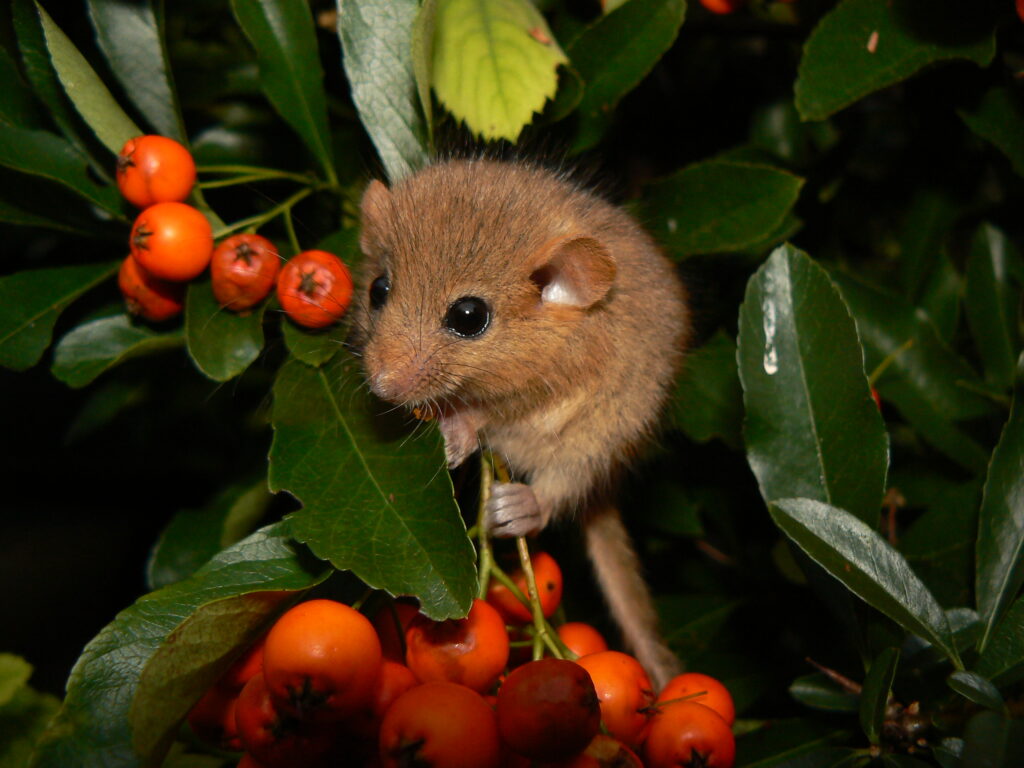
Hazel Dormouse
Photo © Danielle Schwarz
Photo © Danielle Schwarz — CC BY-SA 4.0 — Source: Wikimedia CommonsIdentification
The hazel dormouse is a tiny, endearing rodent with a body length of about 10 centimetres and a distinctive long tail adding a further 5.7 to 7.5 centimetres. It weighs a mere 17 to 20 grams in its active season, though this increases to 30–40 grams before hibernation. The animal is easily recognised by its reddish-brown fur, which can vary to golden-brown or yellow-orange-brown tones, becoming lighter on the underside. Its most striking features are its large, prominent black eyes and small, underdeveloped ears. The tail is notably long and completely covered in hair, giving the creature an elegant, squirrel-like appearance.
Range & Habitat
The hazel dormouse is native to northern Europe and Asia Minor, and is the only dormouse species native to the British Isles. It has recently been discovered spreading in Ireland, having appeared in County Kildare in 2010. The species thrives in deciduous woodlands but also inhabits hedgerows and scrub. Sites with abundant honeysuckle, yew, and birch trees support higher populations. Unfortunately, the species has suffered significantly, with populations estimated to have declined by 72% between 1993 and 2014, largely due to woodland habitat loss and climate change impacts.
Behaviour & Diet
The hazel dormouse is a nocturnal, almost entirely arboreal creature that spends most waking hours foraging among tree branches, rarely venturing to the ground. It hibernates from October through April or May, building ground-level nests at the base of old coppiced trees, under leaves, or log piles. Upon waking in spring, it constructs intricate woven nests from shredded honeysuckle bark, fresh leaves, and grasses. During cold, wet summers with scarce food, the dormouse enters torpor, curling into a ball to conserve energy. It seldom travels more than 70 metres from its nest.
The dormouse requires diverse tree foods to survive. Hazelnuts are its primary fattening food before hibernation, eaten with a characteristic neat, round hole left in the shell. It also consumes berries, fruits, nuts, buds, flowers providing nectar and pollen, and insects such as aphids and caterpillars found on food trees. Where hazel is scarce, it relies on hornbeam and blackthorn fruits, as well as alder buckthorn berries.
Best Time & Places to See It
The hazel dormouse is strictly nocturnal and spends much of its life sleeping, making encounters challenging. Late spring through early autumn, when the dormouse is active and building its summer nests, offers the best window for observation. Deciduous woodlands with healthy understory vegetation, particularly hazel coppice, hedgerows rich in honeysuckle, and scrubland in Britain and northern Europe are prime habitats. Look in areas where the recently expanding Irish population has been recorded, particularly in County Kildare.
Photography Tips
Photographing hazel dormice requires patience and nocturnal fieldcraft. Target woodlands and hedgerows during calm nights in late spring and summer when activity peaks. Position yourself quietly near productive food trees, particularly hazel, honeysuckle, and yew, using red-filtered torchlight to preserve night vision and minimise disturbance. A camera trap with infrared triggers set at nest sites or along regular travel routes may yield remarkable images of this elusive, delicate creature. Fast film and image stabilisation are essential for capturing this small, agile nocturnal forager among the branches.
Stenshuvuds National Park
Skåne län, Sweden
+224 birds+19 mammals
Where limestone cliffs rise sharply above the Øresund Strait, Stenshuvuds National Park commands the southeastern tip of Skåne, a landscape carved by glaciation into rolling beech…
VIEW NATIONAL PARKHarz National Park
Harz (LK Goslar), Germany
+141 birds+38 mammals
Where granite peaks rise above beech and spruce forests, the Harz unfolds as one of Germany's most biodiverse upland landscapes. Straddling the border between Lower Saxony…
VIEW NATIONAL PARKExmoor National Park
Somerset, United Kingdom
+159 birds+32 mammals
Where the Bristol Channel wind scours windswept moorland into rolling open heath, Exmoor rises from the Somerset coast as one of England's most rugged upland landscapes.…
VIEW NATIONAL PARKPembrokeshire Coast National Park
Pembrokeshire, United Kingdom
+250 birds+41 mammals
Where the Cambrian coastline meets the Celtic Sea, cliff-top moorland and hidden coves define a landscape carved by 300 million years of geological drama. Pembrokeshire Coast…
VIEW NATIONAL PARKEryri National Park
Gwynedd, United Kingdom
+199 birds+36 mammals
Where granite peaks rise abruptly from the Snowdonia landscape, Eryri National Park encompasses one of Britain's most dramatic mountain terrain. The park's rugged plateaus, deep glacial…
VIEW NATIONAL PARKLake District National Park
Westmorland and Furness, United Kingdom
+209 birds+36 mammals
Where slate fells rise steeply from mirror-still waters, the Lake District unfolds as one of Britain's most ecologically intricate mountain landscapes. The park's patchwork of deep…
VIEW NATIONAL PARKYorkshire Dales National Park
North Yorkshire, United Kingdom
+169 birds+25 mammals
Limestone pavements and deep limestone gorges carved by glaciation dominate the landscape of the Yorkshire Dales, creating a landscape of exceptional geological drama where moorland plateaus…
VIEW NATIONAL PARKBannau Brycheiniog National Park
Powys, United Kingdom
+178 birds+36 mammals
Where sandstone ridges rise above the rolling moorlands of mid-Wales, Bannau Brycheiniog National Park protects one of Britain's most compelling upland landscapes. The park's dramatic peaks,…
VIEW NATIONAL PARKSouth Downs National Park
Chichester, United Kingdom
+298 birds+45 mammals
Chalk downland ridges rise and fall across the South Downs, their open grasslands and beech hangers creating a mosaic of habitats that has shaped human settlement…
VIEW NATIONAL PARKDartmoor National Park
West Devon, United Kingdom
+162 birds+33 mammals
Across the high moorlands of Devon, where granite tors pierce through rolling heather and acid grassland, Dartmoor rises as one of Britain's most expansive upland wilderness…
VIEW NATIONAL PARKMercantour National Park
Isola, France
+146 birds+32 mammals
Where alpine meadows surrender to vertiginous limestone cliffs, the Mercantour's beating heart pulses with Mediterranean and Alpine rhythms. This 4,221-square-kilometre sanctuary straddles France's southeastern border, its…
VIEW NATIONAL PARKÉcrins National Park
La Chapelle-en-Valgaudémar, France
+143 birds+36 mammals
Where granite peaks and Alpine meadows converge across nearly 2,100 square kilometres, Écrins National Park forms one of the wildest mountainous strongholds of the French Alps.…
VIEW NATIONAL PARKForêts National Park
Lucey, France
+140 birds+50 mammals
Across the rolling plateaux of central Burgundy, where limestone uplands give way to deep valleys carved by time and water, lies a landscape of profound ecological…
VIEW NATIONAL PARKAggtelek National Park
Szin, Hungary
+119 birds+13 mammals
Where limestone karst terrain rises and plunges across North Hungary's borderlands, Aggtelek National Park unfolds across 543 square kilometres of one of Europe's most geologically dramatic…
VIEW NATIONAL PARKBükk National Park
Répáshuta, Hungary
+161 birds+15 mammals
Where forested limestone ridges rise across northern Hungary, Bükk National Park unfolds across nearly 900 square kilometres of temperate woodland, rocky gorges, and karst formations that…
VIEW NATIONAL PARKGran Paradiso National Park
Cogne, Italy
+120 birds+16 mammals
Where the western Alps rise steeply above the Aosta Valley, granite ridges and alpine meadows converge in a landscape shaped as much by glacial history as…
VIEW NATIONAL PARKAppennino Tosco-Emiliano National Park
Ventasso, Italy
+86 birds+8 mammals
Where the northern Apennines rise in folded ridges across the Emilia-Romagna borderland, the Dell'Appennino Tosco-Emiliano National Park protects one of Italy's most geologically complex mountain landscapes.…
VIEW NATIONAL PARKBieszczady National Park
Bieszczady County, Poland
+131 birds+16 mammals
Where the Carpathian foothills roll across southeastern Poland, a vast upland wilderness of beech and spruce forest unfolds across nearly 1,575 square kilometres, sheltering one of…
VIEW NATIONAL PARKTatra National Park
Zakopane, Poland
+126 birds+17 mammals
Where the High Tatras rise abruptly from the Carpathian foothills, Tatra National Park protects one of Europe's most dramatic mountain landscapes across its 507 square kilometres.…
VIEW NATIONAL PARKRoztocze National Park
Obrocz, Poland
+117 birds+4 mammals
Where the Lublin Upland plateaus meet their gentler eastern slopes, Roztocze National Park unfolds across 272 square kilometres of Central European woodland mosaic—a landscape where glacial…
VIEW NATIONAL PARKBiebrza National Park
Goniądz, Poland
+242 birds+33 mammals
Where the Narew River sprawls across northeastern Poland's flatlands, Biebrza National Park unfolds as one of Europe's largest and most ecologically vital wetland complexes. Encompassing roughly…
VIEW NATIONAL PARKBiałowieża National Park
Bialowieza, Poland
+177 birds+23 mammals
Straddling the border between Poland and Belarus, this primordial forest landscape encompasses one of Europe's last remaining expanses of old-growth woodland, where ancient trees rise through…
VIEW NATIONAL PARKVesuvius National Park
Ottaviano, Italy
+82 birds+4 mammals
The slopes of Vesuvius rise from the Campanian plain in a dramatic cone of volcanic rock and ash, their flanks wrapped in the characteristic vegetation of…
VIEW NATIONAL PARKDyfi National Nature Reserve
Aberdyfi, United Kingdom
+148 birds+25 mammals
Where the River Dyfi widens into a broad coastal basin, a 2,400-hectare mosaic of saltmarsh, reedbed, mudflat and freshwater wetland spreads across the Cardigan Bay estuary…
VIEW NATURE RESERVECors Fochno National Nature Reserve
Borth, United Kingdom
+179 birds+27 mammals
Where the Dovey Estuary opens to the Irish Sea, a sprawling wetland mosaic of reedbed, fen and mire transforms the coastal flats of mid-Wales into one…
VIEW NATURE RESERVEYnys-hir National Nature Reserve
Machynlleth, United Kingdom
+149 birds+5 mammals
Where the River Einig winds through the lowland valleys of mid-Wales, Ynys-hir National Nature Reserve unfolds as a mosaic of wet grassland, reedbed, and riparian woodland…
VIEW NATURE RESERVENo community photos yet. Log in to add the first one.
No community observations of this species yet.