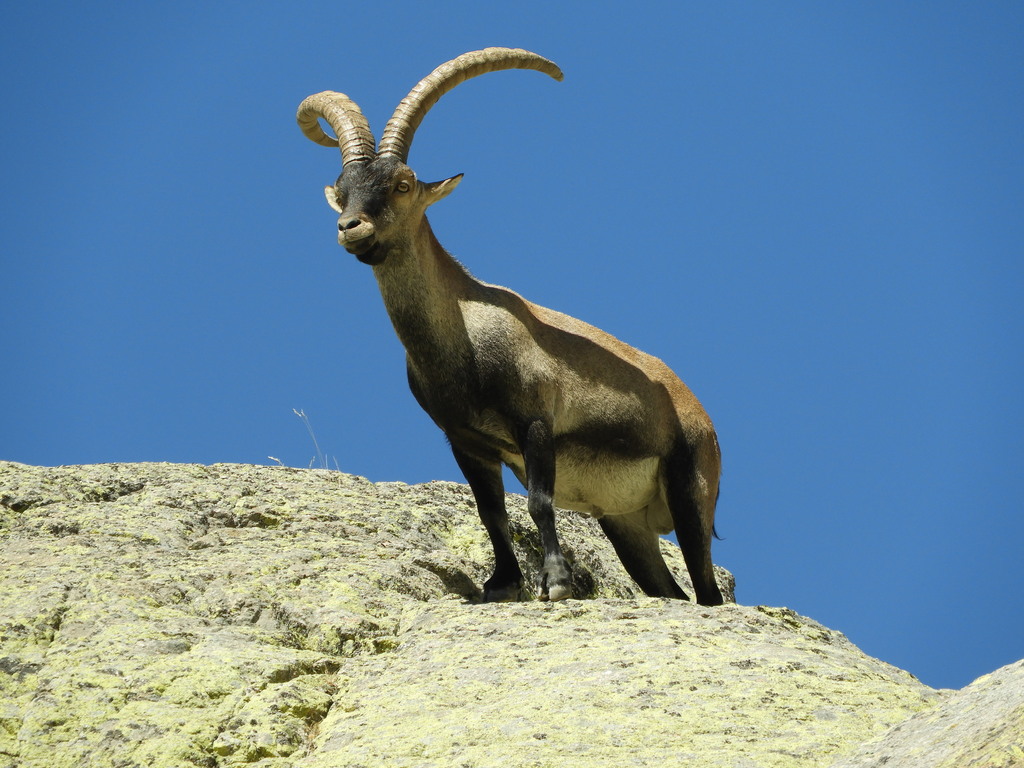
Iberian Ibex
Photo © Santiago Martín-Bravo
Photo © Santiago Martín-Bravo — CC BY 4.0 — Source: iNaturalist photo #322468213Identification
The Iberian ibex is a distinctive wild goat characterized by its large, flexible hooves and short legs—adaptations that make it a master of rocky terrain. Males are noticeably larger than females and sport impressive curved horns that sweep outward and upward before curving back inward, with their exact shape varying by subspecies. Female ibex have smaller horns and lighter builds. The sexual dimorphism is pronounced, with males significantly heavier and more robust. Horn growth varies with age and environmental conditions, creating unique patterns that can help identify individuals.
Range & Habitat
Endemic to the Iberian Peninsula, the Iberian ibex inhabits Spain and northern Portugal, with a small reintroduced population in the French Pyrenees. Only two of the original four subspecies survive today: the Southeastern (Beceite) ibex and the Western (Gredos) ibex. Historically, the species has been extirpated from Gibraltar and possibly Andorra. The remaining populations favor the steep, rocky slopes and mountainous terrain of the peninsula, where their specialized hooves provide crucial advantage over predators unable to follow into such challenging landscapes.
Behaviour & Diet
Iberian ibex are mixed feeders, consuming both browsed vegetation and grass depending on seasonal and geographical availability. They possess a remarkable physiological adaptation—a specialized kidney mechanism that stores fat during productive warm seasons to fuel survival through harsh winters when food is scarce. Foraging patterns shift seasonally: in winter, when resources are limited, they reduce movement; in spring, increased food availability and competition drive them to cover more ground and forage more actively.
These ibex establish distinct social structures, with males typically forming bachelor groups separate from females with young. Rutting season occurs in November and December, when males join mixed groups to breed. Yearlings are separated from females at birth time, with males returning to male-only groups while females eventually rejoin their mothers. When danger appears, ibex respond with coordinated alarm calls—distinctive explosive whistles—and flee together to rocky slopes, following experienced adults who lead the group to safety.
Best Time & Places to See It
The Western (Gredos) and Southeastern (Beceite) ibex populations offer the best opportunities for observation in Spain. Spring and early summer provide ideal conditions when ibex are most active and mobile while foraging, making them more likely to be spotted. Mixed groups are particularly common during winter months. Early morning and late afternoon typically offer the best wildlife viewing opportunities, when ibex are most active in feeding.
Photography Tips
Patience and positioning are essential for photographing Iberian ibex. Position yourself with a clear view of rocky slopes where ibex naturally congregate and shelter—these dramatic backdrops enhance compelling wildlife images. Telephoto lenses are necessary given the remote, steep terrain these animals favor. Watch for the distinctive posture of alert ibex: erect stance with ears and head raised toward potential threats. Capture images during spring when activity levels peak and lighting is optimal. Remember that alarm calls alert entire groups simultaneously, so anticipate coordinated movement across rocky terrain for dynamic action shots.
Picos de Europa National Park
Posada de Valdeón, Spain
+166 birds+26 mammals
Where limestone massifs rise abruptly from the Castilian plateau, the Picos de Europa create one of Spain's most dramatic mountain wilderness areas. The park's jagged peaks,…
VIEW NATIONAL PARKCañón del Río Lobos Natural Park
Santa María de las Hoyas, Spain
+136 birds+2 mammals
Where the Río Lobos carves its relentless path through the Iberian plateau, limestone cliffs rise in dramatic ramparts above a ribbon of water that has spent…
VIEW NATURAL PARKSierra Mágina Natural Park
Bélmez de la Moraleda, Spain
+114 birds+2 mammals
Where limestone ridges rise abruptly from the Jaén countryside, Sierra Mágina unfolds as one of Andalusia's most underrated natural treasures. This protected landscape, anchored by the…
VIEW NATURAL PARKSierra Nevada National Park
Válor, Spain
+137 birds+7 mammals
Where granite ridges rise above 3,000 metres across the Alpujarra foothills, Sierra Nevada National Park crowns southern Spain's most dramatic mountain landscape. The park encompasses a…
VIEW NATIONAL PARKSierra de Tejeda, Almijara y Alhama Natural Park
Frigiliana, Spain
+128 birds+8 mammals
Where limestone ridges rise sharply from the Axarquía lowlands, the Sierra de Tejeda, Almijara y Alhama Nature Park unfolds across a dramatic landscape of white-rock massifs,…
VIEW NATURAL PARKCabo de Gata-Níjar Natural Park
San José, Spain
+274 birds+11 mammals
Where volcanic ridges plunge toward the Mediterranean, Cabo de Gata-Níjar Nature Park unfolds across one of Europe's most arid coastlines, a landscape sculpted by tectonic violence…
VIEW NATURAL PARKSerra de Montsant Natural Park
La Morera de Montsant, Spain
+134 birds+15 mammals
Rugged limestone ridges and deeply incised gorges define the Serra de Montsant, a 10,000-hectare protected landscape that rises abruptly from the wine-growing plains of Tarragona in…
VIEW NATURAL PARKMontaña Palentina Natural Park
Vidrieros, Spain
+180 birds+29 mammals
Where the Cantabrian mountains rise above the Palencia plateau, Montaña Palentina Nature Park sprawls across nearly 1,500 square kilometres of some of northern Spain's most dramatic…
VIEW NATURAL PARKSierra de las Nieves National Park
Tolox, Spain
+159 birds+7 mammals
Where limestone summits pierce the Mediterranean sky above Andalusia's coastal ranges, Sierra de las Nieves National Park unfolds across nearly 500 square kilometres of dramatically folded…
VIEW NATIONAL PARKSierra de Guadarrama National Park
Rascafría, Spain
+179 birds+13 mammals
Where granite peaks rise abruptly from the central Spanish plateau, the Sierra de Guadarrama National Park unfolds across more than eleven hundred square kilometres of montane…
VIEW NATIONAL PARKSierra de Cazorla, Segura y las Villas Nature Park
Las Canalejas, Spain
+176 birds+21 mammals
Where granite gorges slice through mountainous terrain in eastern Andalusia, the Sierra de Cazorla, Segura y las Villas Nature Park sprawls across more than 5,200 square…
VIEW NATURAL PARKPeneda-Gerês National Park
A Baixa Limia, Portugal
+156 birds+15 mammals
Where granite gorges cut through ancient montane forests, the Peneda-Gerês National Park rises across the rugged borderlands between northern Portugal and Galicia, a landscape shaped by…
VIEW NATIONAL PARKSierra de Andújar Natural Park
Our Lady of Cabeza, Spain
+198 birds+19 mammals
Where granite gorges slice through Mediterranean scrubland and cork forests cascade down Andalusian hillsides, one of Spain's most pristine wilderness areas unfolds across 74,000 hectares of…
VIEW NATURAL PARKMontaña de Montserrat Natural Park
Marganell, Spain
+149 birds+10 mammals
Where granite monoliths erupt from the Mediterranean scrubland like cathedral spires, an otherworldly landscape unfolds across Catalonia's most dramatic mountain reserve. These iconic sandstone and conglomerate…
VIEW NATURAL PARKSierra de Gredos Regional Park
Candeleda, Spain
+180 birds+18 mammals
Where granite peaks claw at 2,592 metres and alpine meadows give way to cork oak scrubland, Spain's central highlands reveal a landscape of remarkable vertical drama.…
VIEW NATURE RESERVEPorts Natural Park
Alfara de Carles, Spain
+157 birds+13 mammals
Where the eastern Catalan ranges descend toward the Mediterranean, a sprawling mosaic of Mediterranean scrubland, pine woodland, and rocky limestone terrain defines Ports Natural Park, a…
VIEW NATURAL PARKSierra y Cañones de Guara Natural Park
Casbas de Huesca/Casbas de Uesca, Spain
+175 birds+10 mammals
Where limestone gorges slice through the pre-Pyrenean foothills of Aragon, the Sierra y Cañones de Guara sprawls across nearly 940 square kilometers of one of Spain's…
VIEW NATURE RESERVESerra de Mariola Natural Park
Bocairent, Spain
+164 birds+19 mammals
Where limestone ridges rise above the Valencian interior, Serra de Mariola unfolds across 225 square kilometers of Mediterranean mountain terrain that shifts between dense evergreen woodland,…
VIEW NATURE RESERVESierras Subbéticas Natural Park
Algar, Spain
+156 birds+10 mammals
Where limestone ridges rise abruptly from the Córdoba countryside, the Sierras Subbéticas Nature Park sprawls across nearly 583 square kilometres of one of Andalusia's most rugged…
VIEW NATURAL PARKSierra de Castril Natural Park
Castril, Spain
+110 birds+13 mammals
Where limestone walls rise abruptly from the Guadalentín valley, carving passages of breathtaking drama through Andalusia's interior, one encounters the raw geological theatre of this protected…
VIEW NATURE RESERVESierra de Huétor Natural Park
Huétor Santillán, Spain
+126 birds+3 mammals
Where limestone ridges pierce the Mediterranean sky above Granada, a 273-square-kilometre sanctuary of pine forest and alpine meadow rises to nearly 2,400 metres. This protected landscape,…
VIEW NATURAL PARKPyrénées National Park
Hautes Pyrenees, France
+150 birds+35 mammals
Where alpine meadows give way to limestone cliffs and rushing torrents carve through ancient stone, the Pyrénées National Park spans a landscape of austere beauty along…
VIEW NATIONAL PARKNo community photos yet. Log in to add the first one.
No community observations of this species yet.