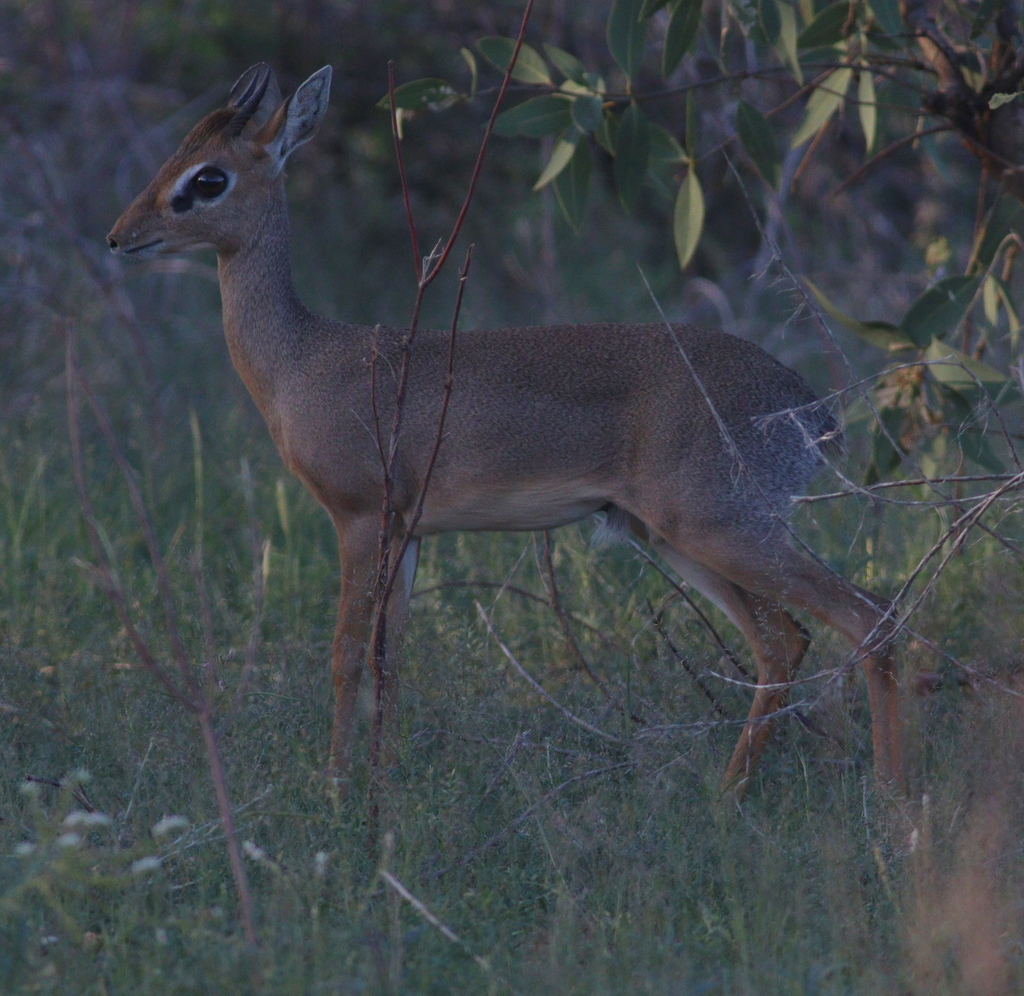
Kirk’s Dik-dik
Photo © Jan Ebr & Ivana Ebrová
Photo © Jan Ebr & Ivana Ebrová — CC BY 4.0 — Source: iNaturalist #104982479Identification
Kirk's dik-dik is among the world's smallest antelopes, standing just 35–45 cm (14–18 in) tall and weighing 3.8–7.2 kg (8.4–15.9 lb). These dainty creatures are instantly recognizable by their pointed, mobile snout, large eyes and ears, and distinctive pipestem legs with hare-like hind limbs noticeably larger than their forelimbs. Their fawn to gray-brown coats provide excellent camouflage in savannah habitats, complemented by tan flanks and limbs, whitish eye rings and underparts, and an erectile head crest.
Sexual dimorphism is pronounced: females are larger and lack horns, while males sport backward-slanted horns about 7.5 cm long with seven to nine ridges at the base, a more developed muzzle, and a longer crest. Kirk's dik-dik can be distinguished from the similar Günther's dik-dik by its longer facial profile and more wedge-shaped head, along with its longer nasal bones and shorter proboscis.
Range & Habitat
Kirk's dik-dik is native to Eastern and Southern Africa, with six recognized subspecies and possibly a seventh in southwest Africa. These animals are endemic to savannah areas, primarily in the Somali and Southwest arid biotic zones, with populations encroaching into the Southern savannah biotic zone. Their distribution is discontinuous, occurring in dispersed patches across suitable habitat. In Namibia, they inhabit isolated areas along the Fish River but avoid the Namib desert itself, though they traverse desert thickets near water sources.
These antelope prefer habitats with good cover but lacking tall vegetation—thicket mosaics with well-developed shrub layers and short grass cover that allows them to see at eye level. They require variety in browse, extensive shade, and an open understory, and will move to different ranges when grass grows too high and obstructs their view. Kirk's dik-diks live in pairs on territories ranging from 2–86 acres depending on available cover and resources, and may occupy the same territory for life if undisturbed.
Behaviour & Diet
Kirk's dik-dik derives its name from its distinctive alarm call—a trumpet-like "zik-zik" sound emitted when threatened. When discovered, they flee in a swift, zigzag pattern toward nearby thickets while vocalizing to alert mates and harass predators. When threatened but not yet detected, they crouch low to avoid discovery. These highly nocturnal animals rest in shade during the hottest daytime hours to conserve precious fluids in their arid environment, and are capable of reaching speeds up to 42 km/h when fleeing danger.
Herbivorous and highly selective feeders, Kirk's dik-diks browse on foliage, fruits, shoots, and berries, preferring dicotyledonous plants that ferment and digest rapidly. Remarkably, they are water-independent, obtaining all necessary moisture from their food. Males are the primary territory defenders, engaging in ritualistic charging encounters with rivals that end when one male surrenders, followed by mutual ground-scratching, urination, and defecation. In the wild, Kirk's dik-diks typically live about 5 years but may exceed 10 years.
Best Time & Places to See It
Finding Kirk's dik-dik requires patience and attention to their nocturnal habits—early morning and late afternoon offer the best opportunities to observe them before they retreat to shade. Search thicket mosaics and scrubby savannah with good ground-level visibility, avoiding areas where tall grass obscures the understory. In Namibia, the Fish River region holds populations, while their broader range across eastern African savannah offers multiple opportunities for encounters across the Somali and Southwest arid zones.
The species' preference for specific habitat types—dense shrub cover combined with open understory—means productive viewing often concentrates in particular patches rather than entire regions. Patient observation during cooler parts of the day when dik-diks are more active yields the best results.
Photography Tips
Kirk's dik-dik's diminutive size and cryptic behavior demand telephoto lenses and patience. Their fawn coloration blends seamlessly with savannah scrub, so scanning thickets methodically and watching for movement proves more effective than active pursuit. Early morning and late afternoon light enhances the warm tan and gray tones of their coat while minimizing harsh shadows.
Photograph from a low angle to capture their distinctive profile—the pointed snout, large ears, and proportionally massive hind legs are key identifying features worth emphasizing. Males' small corrugated horns and longer crests are details worth isolating. Their rapid zigzag flight pattern offers dramatic action shots for patient photographers, while territorial behaviors provide compelling behavioral imagery.
Serengeti National Park
Tanzania
+558 birds+57 mammals
Across Tanzania's northern plateau, where volcanic soils meet acacia woodland and open grassland, unfolds one of Earth's most dynamic ecosystems. The Serengeti National Park sprawls across…
VIEW NATIONAL PARKTsavo East National Park
Athi ward, Kenya
+468 birds+50 mammals
Across the semi-arid lowlands of southeastern Kenya, where acacia woodland fragments into scrubland and the landscape rolls toward the Indian Ocean horizon, lies one of Africa's…
VIEW NATIONAL PARKTsavo West National Park
Mwatate, Kenya
+513 birds+49 mammals
Where volcanic ridges and weathered lava flows meet the semi-arid lowlands of south-central Kenya, Tsavo West National Park unfolds across a landscape sculpted by fire and…
VIEW NATIONAL PARKAmboseli National Park
Etonet/Lenkism ward, Kenya
+501 birds+43 mammals
Where the Amboseli basin opens toward the Tanzanian frontier, a shallow alkaline lake mirrors vast skies across one of East Africa's most iconic savanna landscapes. The…
VIEW NATIONAL PARKNgorongoro Conservation Area
Tanzania
+626 birds+55 mammals
Volcanic calderas and open grassland dominate this high plateau in northern Tanzania, where the landscape rises above 2,000 metres and ancient geological forces have shaped both…
VIEW WILDLIFE MANAGEMENT AREAEtosha National Park
Namibia
+356 birds+58 mammals
Across northern Namibia's stark semi-arid plateau, a vast shallow depression transforms seasonally into one of Africa's most dramatic wildlife theaters. Etosha National Park, encompassing more than…
VIEW NATIONAL PARKMeru National Park
Igembe Central, Kenya
+408 birds+38 mammals
Granite outcrops and acacia woodland rise across the northern reaches of Meru, where semi-arid savanna transitions into drier scrubland under the fierce equatorial sun. The park's…
VIEW NATIONAL PARKSamburu National Reserve
Samburu, Kenya
+430 birds+42 mammals
Across the arid plains of northern Kenya, where scattered acacia woodland gives way to rocky outcrops and dry riverbeds, Samburu National Park unfolds as one of…
VIEW NATURE RESERVEHell’s Gate National Park
Olkaria ward, Kenya
+388 birds+18 mammals
Volcanic scarps and geothermal vents dominate the floor of Hell's Gate, where the East African Rift has carved a dramatic gorge through crystalline rock formations. The…
VIEW NATIONAL PARKChyulu Hills National Park
Kibwezi East, Kenya
+232 birds+30 mammals
Volcanic cones rise abruptly from the Kenyan savanna floor, their flanks clothed in dense acacia woodland and grassland that transforms the Chyulu Hills into an ecological…
VIEW NATIONAL PARKArabuko Sokoke Forest Reserve
Kilifi, Kenya
+383 birds+29 mammals
Coastal forest rises from the Indian Ocean plains of Kilifi County, where sandy soils and seasonal rainfall have sculpted a woodland ecosystem unlike anywhere else on…
VIEW NATURE RESERVENo community photos yet. Log in to add the first one.
No community observations of this species yet.