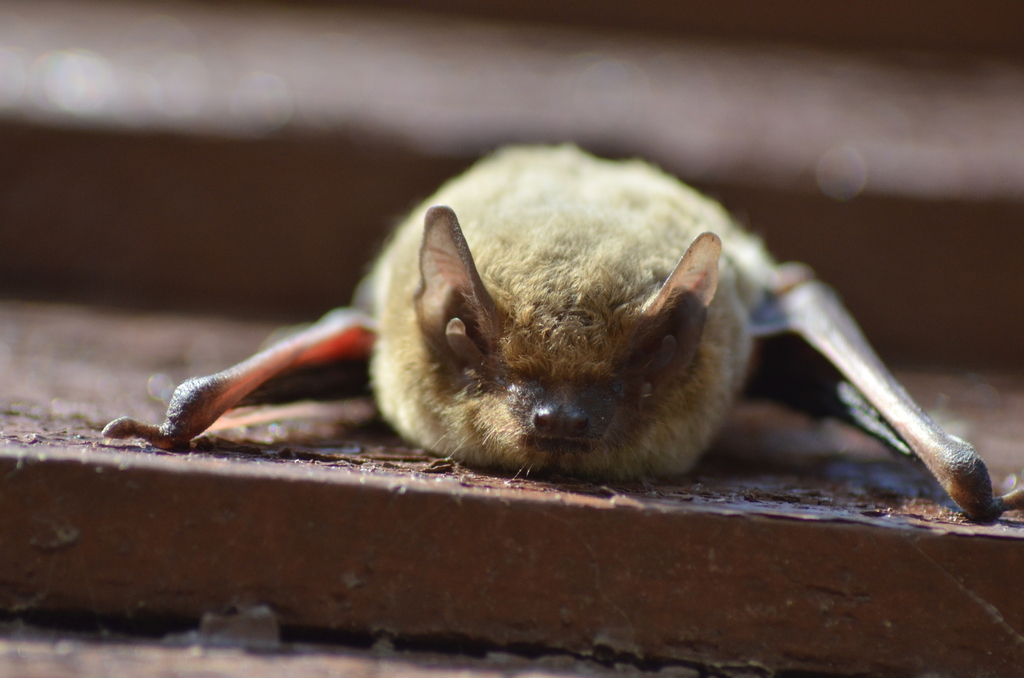
Kuhl’s Pipistrelle
Photo © Ömer Selim Kaya
Photo © Ömer Selim Kaya — CC BY-SA 4.0 — Source: iNaturalist photo #629631098Identification
Kuhl's pipistrelle is a small vesper bat with dark brown to yellowish fur and black or dark brown wings. Some individuals display a distinctive white stripe along the wing edges, which can aid identification in the field. This tiny bat has a body length of 40–55 mm with a tail measuring 30–45 mm and weighs only around 5–10 grams—making it roughly the weight of a coin. Its wingspan is relatively modest at 210–230 mm. The species shows slight sexual dimorphism, with males being larger than females.
Range & Habitat
Kuhl's pipistrelle has an extensive distribution across North Africa, Southern Europe, and West Asia, occupying an increasingly large range. This adaptable bat thrives in temperate forests, Mediterranean-type shrubby vegetation, subtropical or tropical dry shrubland, temperate grassland, rural gardens, and urban areas. It shows a remarkable ability to coexist with human settlements and can be found from sea level up to elevations of 2,000 metres. Its conservation status is listed as Least Concern, reflecting its abundance and successful expansion across its range.
Behaviour & Diet
Kuhl's pipistrelle is a generalist insectivore with a flexible diet that varies significantly depending on the individual and location, with occasional supplementation of small amounts of fruit. The bat employs an efficient hunting technique, catching prey in flight by scooping insects into its wings or tail membrane. Notably, it typically hunts in proximity to other Kuhl's pipistrelles, suggesting a degree of social tolerance or loose aggregation during foraging.
During the breeding season, males employ distinctive mating calls that differ from their standard echolocation calls, often performed in large groups to attract females. This behaviour highlights the species' social nature beyond simple cohabitation.
Best Time & Places to See It
Kuhl's pipistrelle's preference for urban and suburban habitats makes it one of the more accessible bat species for travellers and wildlife enthusiasts. Look for them in rural gardens, parks, and towns throughout its range in North Africa, Southern Europe, and West Asia. The species is active during warmer months when insect prey is abundant, making summer an ideal time for observation. Dawn and dusk are prime viewing periods, when the bats emerge from roosts to hunt.
Photography Tips
Photographing Kuhl's pipistrelle presents challenges typical of small, fast-moving nocturnal creatures. High-speed flash photography or infrared imaging equipment will be necessary to capture sharp images of these bats in flight. Focus on areas where they hunt—around street lights, gardens, and open spaces where insects congregate—and patience is essential. The distinctive white wing stripe, present in some individuals, makes an excellent focal point if you can isolate such specimens. Early evening, when light conditions are still reasonable, offers the best opportunity for handheld photography before full darkness falls.
Danube Delta Biosphere Reserve
Tulcea, Romania
+277 birds+27 mammals
Where the Danube surrenders to the Black Sea, a vast labyrinth of channels, reed beds, and freshwater lakes sprawls across nearly 13,400 square kilometers of eastern…
VIEW NATIONAL PARKCévennes National Park
Vebron, France
+187 birds+63 mammals
Where granite gorges slice through the limestone plateaux of southern France, the Cévennes Cœur National Park unfolds across nearly 3,500 square kilometres of one of Europe's…
VIEW NATIONAL PARKMercantour National Park
Isola, France
+146 birds+32 mammals
Where alpine meadows surrender to vertiginous limestone cliffs, the Mercantour's beating heart pulses with Mediterranean and Alpine rhythms. This 4,221-square-kilometre sanctuary straddles France's southeastern border, its…
VIEW NATIONAL PARKÉcrins National Park
La Chapelle-en-Valgaudémar, France
+143 birds+36 mammals
Where granite peaks and Alpine meadows converge across nearly 2,100 square kilometres, Écrins National Park forms one of the wildest mountainous strongholds of the French Alps.…
VIEW NATIONAL PARKVanoise National Park
Val-Cenis, France
+107 birds+29 mammals
Where the French Alps rise in serrated ranks above the Maurienne valley, Vanoise National Park sprawls across more than 1,700 square kilometres of high-altitude wilderness—a realm…
VIEW NATIONAL PARKTúria Natural Park
València, Spain
+150 birds+21 mammals
Where the Túria riverbed winds through the lowlands south of Valencia, a sprawling natural park of nearly 440 square kilometres unfolds across one of Spain's most…
VIEW NATURAL PARKParc del Garraf
Rat-Penat, Spain
+190 birds+15 mammals
Where limestone ridges rise abruptly from the Mediterranean coastal plain, Parc Natural del Garraf unfolds across 319 square kilometers of one of Catalonia's most dramatic protected…
VIEW NATURAL PARKCollserola Natural Park
Barcelona, Spain
+194 birds+20 mammals
Where Mediterranean scrubland rises steeply from Barcelona's urban edge, Collserola unfolds across 173 square kilometres of low mountains that form a crucial ecological buffer between city…
VIEW NATURAL PARKForêts National Park
Lucey, France
+140 birds+50 mammals
Across the rolling plateaux of central Burgundy, where limestone uplands give way to deep valleys carved by time and water, lies a landscape of profound ecological…
VIEW NATIONAL PARKCadí Moixeró Natural Park
Bor, Spain
+172 birds+21 mammals
Cadí-Moixeró Natural Park is one of the largest and most spectacular protected areas in Catalonia, located in the heart of the eastern Pyrenees. Covering more than…
VIEW NATURAL PARKMontseny Natural Park
Viladrau, Spain
+156 birds+30 mammals
The Montseny Natural Park is one of Catalonia’s most remarkable protected areas, offering an extraordinary blend of biodiversity, scenic landscapes, and cultural heritage within easy reach…
VIEW NATURAL PARKCamargue Regional Nature Park
Saintes-Maries-de-la-Mer, France
+378 birds+48 mammals
Where the Rhône Delta sprawls into the Mediterranean, a landscape of stark and haunting beauty emerges—vast salt marshes punctuated by shallow lagoons, reed beds, and scrubland…
VIEW NATURAL PARKSamegrelo Planned National Park
Medani, Georgia
+44 birds+4 mammals
Where the Caucasus descends toward the Black Sea, temperate rainforests cloak steep valleys in an emerald tapestry rarely seen in continental Europe. This corner of Georgia,…
VIEW NATIONAL PARKRegional Park of the Catalan Pyrenees
Olette, France
+244 birds+63 mammals
Where granite peaks thrust skyward above cloud-laden valleys, a wild tapestry of Mediterranean and alpine ecosystems interweaves across the Franco-Spanish frontier. These Pyrenean slopes harbour extraordinary…
VIEW NATURE RESERVEPort-Cros National Park
Hyères, France
+271 birds+29 mammals
Where Mediterranean granite islands rise from crystalline waters off the Provençal coast, Port-Cros National Park protects one of Europe's most intact marine and terrestrial ecosystems. The…
VIEW NATIONAL PARKPyrénées National Park
Hautes Pyrenees, France
+150 birds+35 mammals
Where alpine meadows give way to limestone cliffs and rushing torrents carve through ancient stone, the Pyrénées National Park spans a landscape of austere beauty along…
VIEW NATIONAL PARKCalanques National Park
Bouches-du-Rhône, France
+233 birds+42 mammals
Where limestone cliffs plunge dramatically into crystalline Mediterranean waters, Calanques National Park preserves one of Europe's most striking coastal landscapes. These steep-sided inlets, carved by erosion…
VIEW NATIONAL PARKNo community photos yet. Log in to add the first one.
No community observations of this species yet.