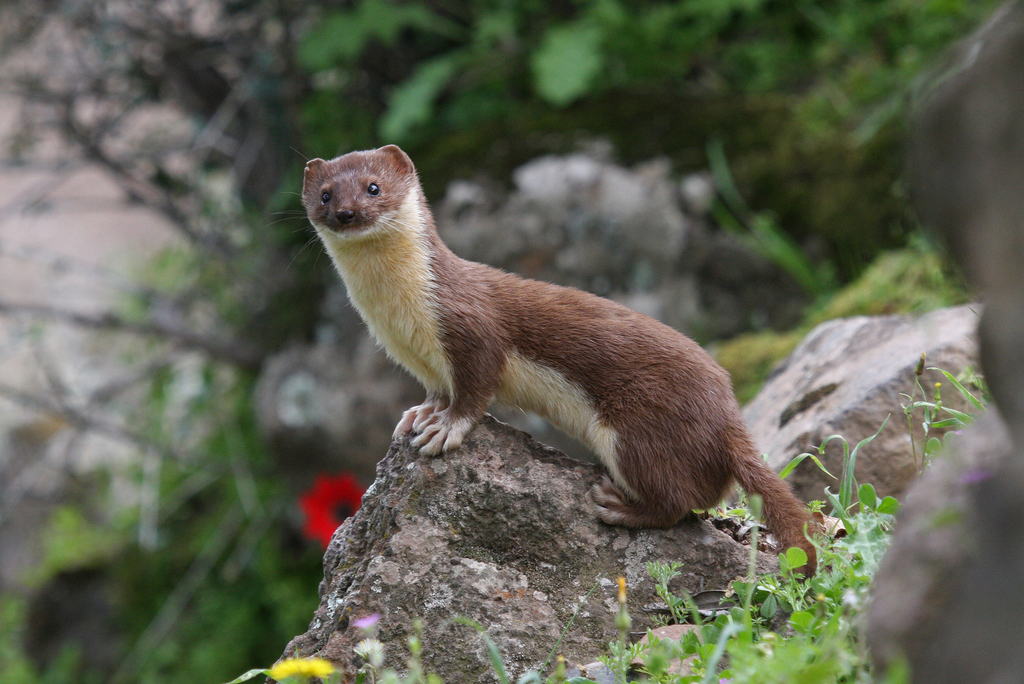
Least Weasel
Photo © Christoph Moning
Photo © Christoph Moning — CC BY 4.0 — Source: iNaturalist photo #60012116Identification
The least weasel is the smallest member of the genus Mustela and family Mustelidae. It has a distinctively thin, greatly elongated and extremely flexible body with a small, blunt-muzzled head no thicker than the neck. The legs and tail are relatively short, with the tail constituting less than half the body length. Small, dark, bulging eyes and sharp, dark claws on heavily haired feet are characteristic features.
Colouration varies geographically, but typically the dorsal surface, flanks, limbs and tail are some shade of brown, while the underparts are white, with a usually straight line delineating the boundary between the two colours. At high altitudes and in the northern part of its range, the coat becomes pure white in winter. The least weasel shows considerable size variation across its range, with three main subspecies groups ranging from tiny pygmaea–rixosa forms to larger boccamela varieties.
Range & Habitat
The least weasel is native to Eurasia, North America and North Africa, and has been introduced to New Zealand, Malta, Crete, the Azores, and São Tomé. It is classified as least concern by the IUCN due to its wide distribution and large population throughout the Northern Hemisphere, with eighteen subspecies recognised. The species probably crossed to North America through the Bering land bridge approximately 200,000 years ago.
Different subspecies groups occupy distinct habitats. The small pygmaea–rixosa group inhabits northern European Russia, Siberia, the Russian Far East, Finland, the northern Scandinavian Peninsula, Mongolia, northeastern China, Japan and North America. The large boccamela group is found in Transcaucasia, western Kazakhstan, Middle Asian deserts, and North African regions including Morocco, Algeria and Tunisia. The medium-sized nivalis group occupies middle and southern European Russia, Crimea, the Ciscaucasus, and montane parts of Middle Asia.
Behaviour & Diet
Small rodents form the largest part of the least weasel's diet, but it also kills and eats rabbits, other mammals, and occasionally birds, birds' eggs, fish and frogs. Despite its small size, it is a fierce predator well-adapted to hunting in burrows and beneath snow.
Males mark their territories with olfactory signals and maintain exclusive home ranges which may intersect with or include several female ranges. Least weasels use pre-existing holes to sleep, store food and raise their young. Breeding takes place in spring and summer, with a single litter of about six kits reared exclusively by the female.
Best Time & Places to See It
The least weasel's wide geographic distribution and large population make it present across much of the Northern Hemisphere, though it remains elusive due to its small size and primarily nocturnal or crepuscular habits. Northern regions, including Scandinavia, Russia, and northern North America, are particularly good locations, especially during winter months when white-coated individuals may be more visible against darker backgrounds in snow-covered landscapes.
Look for activity around rodent burrows, grasslands, and open areas where small mammal populations are abundant. Early morning and dusk are the best times for observation, when the weasel is most active.
Photography Tips
Photographing the least weasel presents significant challenges due to its small size, speed and elusive nature. A macro or telephoto lens is essential to capture detail without disturbing the animal. Patient, stationary observation near active burrows and rodent colonies offers the best opportunities, particularly in open grassland habitats where visibility is good.
Winter presents a unique photographic opportunity in northern regions, where the pure white winter coat provides striking contrast against darker surroundings. Early morning light and overcast conditions help minimize harsh shadows on the animal's elongated form. Remote camera traps may be more effective than active pursuit for obtaining reliable images of this diminutive but fierce carnivore.
Abruzzo, Lazio and Molise National Park
Alpilles Regional Nature Park
Avesnois Regional Nature Park
Bannau Brycheiniog National Park
Belluno Dolomites National Park
Białowieża National Park
Biebrza National Park
Cabo Peñas
Cadí Moixeró Natural Park
Nothing matches these filters.
No community photos yet. Log in to add the first one.
No community observations of this species yet.