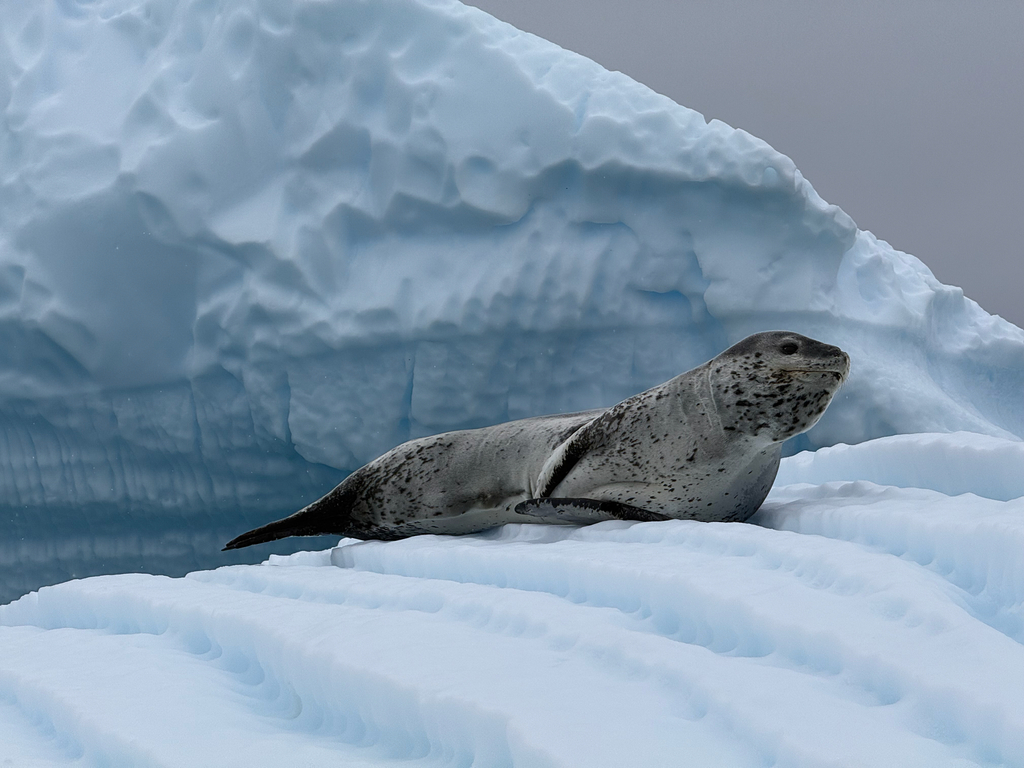
Leopard Seal
Photo © Ingvild Riska
Photo © Ingvild Riska — CC BY 4.0 — Source: iNaturalist photo #607715414Identification
The leopard seal is a distinctively long and muscular seal, the second largest in Antarctic waters after the southern elephant seal. Adults measure 2.4–3.5 meters in length and weigh 200–600 kilograms, making them equivalent in length to a walrus but typically less than half its weight. Females are notably larger, reaching up to 50% heavier than males. Their most striking feature is their massive jaws armed with canine teeth up to 2.5 centimeters long—adaptations that mark them as apex predators of their realm. The pelage is countershaded, with dark gray to silver coloring on the dorsum adorned with distinctive leopard-like dark spots, contrasting sharply with white to light gray undersides. Despite lacking external ears, they possess highly sensitive whiskers and excellent hearing adapted for underwater hunting.
Range & Habitat
Leopard seals are pagophilic seals—"ice-loving" pinnipeds that primarily inhabit the Antarctic pack ice between 50°S and 80°S latitudes. They achieve higher densities in West Antarctica than elsewhere. Beyond the Antarctic continent, established populations occur in Chilean Patagonia, where reproduction has been documented, and in New Zealand waters, where individuals are present year-round with confirmed breeding. A thick blubber layer insulates them against the extreme cold while simultaneously streamlining their bodies for hydrodynamic efficiency in pursuit of swift prey.
Behaviour & Diet
As apex predators, leopard seals employ sophisticated hunting strategies, using their exceptional hearing and sensitive whiskers to track prey underwater. Their diet is remarkably diverse, encompassing fellow pinnipeds, cephalopods, krill, fish, and seabirds—particularly penguins. Their formidable canines are complemented by specialized molars that lock together to function as a krill-sieve, a trait shared with other Antarctic seal species. Orcas represent their only natural predator. In the wild, leopard seals can live up to 26 years, allowing these powerful hunters to maintain their ecological role for decades.
Best Time & Places to See It
Observing leopard seals requires travel to their remote Antarctic and sub-Antarctic strongholds. The pack ice zones of West Antarctica offer the highest encounter densities, though sightings remain relatively uncommon due to their preference for dispersed ice habitats. Chilean Patagonian waters and New Zealand coastal regions provide more accessible alternatives for dedicated wildlife enthusiasts. Zodiac cruises around Antarctic ice floes and visits to penguin colonies—particularly during pupping and penguin breeding seasons—offer the best opportunities for encounters.
Photography Tips
The leopard seal's striking spotted pattern and powerful physique make compelling subjects, but capturing them demands patience and distance. Use a telephoto lens (400mm or longer) as seals are easily disturbed by close approach. The countershaded coloration presents exposure challenges—meter carefully to retain detail in both the dark dorsum and pale ventral surface, or bracket exposures. Underwater photography, if conducted from a zodiac or with a guide, reveals their remarkable agility; fast shutter speeds (1/1000s or faster) are essential to freeze their swift movements through the water column. Early morning or late afternoon light accentuates the distinctive spotted pattern on their backs.
Ben Boyd National Park
Bouddi National Park
Brown Bluff
Cooper Bay
Cuverville Island
Danco Island
Deception Island
Elsehul Bay
Fiordland National Park
Nothing matches these filters.
No community photos yet. Log in to add the first one.
No community observations of this species yet.