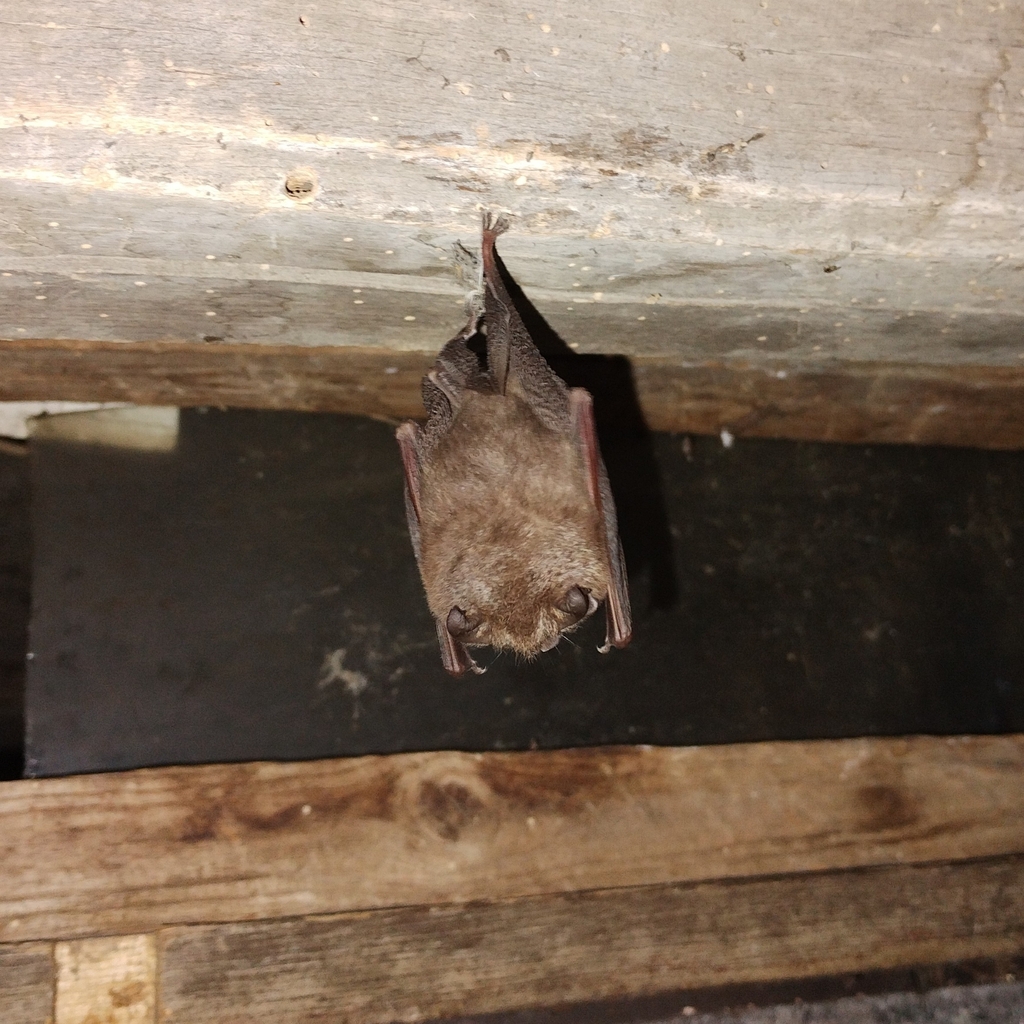
Lesser Horseshoe Bat
Photo © Harukano
Photo © Harukano — CC0 1.0 — Source: iNaturalist #182939975Identification
The lesser horseshoe bat is one of the world's smallest bats, weighing only 5 to 9 grams with a wingspan of 192–254 millimetres and a body length of 35–45 millimetres. Its most distinctive feature is the horseshoe-shaped noseleaf that gives the species its name. The bat has soft, fluffy fur with a light grey base, smoky brown on the dorsal side and grey on the ventral side; juvenile bats are entirely dark grey. Its ears and wing membranes are light greyish brown. Despite its small eyes, the lesser horseshoe bat can see reasonably well and possesses strong feet for grasping rocks and branches.
Range & Habitat
The lesser horseshoe bat is found across Europe and North Africa, with populations recorded from western Ireland and south-west Britain through parts of Germany and the Bavarian foothills of the Alps, across the Mediterranean region, and into Asia Minor, around the Black Sea, Kashmir, the Near East, Iran, Iraq, and the Arabian Peninsula. The species also occurs in parts of East Africa. In the UK, populations are concentrated in Wales and the Southwest of England, while Ireland holds an estimated population of 13,000 across counties including Galway, Mayo, Clare, Limerick, Cork and Kerry. The Balearic Islands support established populations on Mallorca, Menorca, Ibiza and smaller islands.
The species favours warmer regions in foothills and highland areas, particularly wooded areas or limestone regions where it roosts in caves. Summer range extends up to 1160 metres above sea level, rising to 2000 metres in winter, with the highest known nursery roost at 950 metres. The lesser horseshoe bat is sedentary, typically moving only 5 to 10 kilometres between summer and winter roosts, though one individual travelled 153 kilometres.
Behaviour & Diet
Lesser horseshoe bats are highly social, living in colonies and hunting by echolocation, emitting ultrasound from specialized round pads in their mouth. When hunting, they are quick and agile, flying within five metres of the ground while deftly avoiding contact with bushes and shrubs. They feed on small insects gleaned from stones and branches, with particular preference for flies, mosquitoes, butterflies, moths, and spiders. The average lifespan is 3 years, though some individuals live considerably longer.
Mating occurs in autumn, with females giving birth to a single pup between mid-June and early July. Newborns weigh around 1.8 grams, open their eyes after approximately 10 days, and become independent at six to seven weeks. Females reach sexual maturity within their first year. During winter, bats hibernate in dark caves, mines, old buildings, and cellars. Maternity colonies form from April onwards and may contain anywhere from a handful to hundreds of individuals, often shared with other bat species such as the greater mouse-eared bat.
Best Time & Places to See It
The lesser horseshoe bat can be observed year-round in suitable habitat, though maternity colonies are most active from April through July when females give birth and raise young. In the UK, Wales and the Southwest of England offer the best opportunities; notably, a breeding colony inhabits a 7-square-metre barn in Gloucestershire. In Ireland, counties such as Cork, Kerry, and Limerick provide good sighting prospects. The Balearic Islands, particularly Ibiza where this is the most common bat species, host accessible populations, with caves such as the Cova de Ca Na Rea known to harbour roosts of up to 50 individuals. Tunisia's humid northern regions, particularly around Ain Draham, have recently revealed maternity colonies in abandoned buildings, offering exciting new opportunities for observation.
Photography Tips
Photographing lesser horseshoe bats presents considerable challenges due to their small size, nocturnal activity, and high-speed, agile flight. Night vision and thermal imaging equipment are essential, along with fast shutter speeds and sensitive sensors to capture movement in low light. The distinctive horseshoe-shaped noseleaf should be a priority compositional element. Access to hibernation sites or maternity roosts with appropriate permissions offers the best opportunity for close-up shots of stationary individuals. Early evening emergence from roosts or dawn returns provide brief windows for flight photography. Always prioritize the welfare of these protected bats and obtain necessary permits before photographing in caves or other roost sites.
Picos de Europa National Park
Posada de Valdeón, Spain
+166 birds+26 mammals
Where limestone massifs rise abruptly from the Castilian plateau, the Picos de Europa create one of Spain's most dramatic mountain wilderness areas. The park's jagged peaks,…
VIEW NATIONAL PARKSerra D’Irta Natural Park
Alcossebre, Spain
+122 birds+13 mammals
Where Mediterranean limestone cliffs meet the Balearic Sea, Serra d'Irta unfolds as a tapestry of dramatic coastal terrain and diverse terrestrial habitats. This Category 5 protected…
VIEW NATURAL PARKOrdesa y Monte Perdido National Park
Sobrarbe, Spain
+162 birds+13 mammals
Where limestone cliffs soar a thousand metres above cascading rivers, the Pyrenean massif reveals itself in its most dramatic form. Ordesa y Monte Perdido National Park…
VIEW NATIONAL PARKExmoor National Park
Somerset, United Kingdom
+159 birds+32 mammals
Where the Bristol Channel wind scours windswept moorland into rolling open heath, Exmoor rises from the Somerset coast as one of England's most rugged upland landscapes.…
VIEW NATIONAL PARKPembrokeshire Coast National Park
Pembrokeshire, United Kingdom
+250 birds+41 mammals
Where the Cambrian coastline meets the Celtic Sea, cliff-top moorland and hidden coves define a landscape carved by 300 million years of geological drama. Pembrokeshire Coast…
VIEW NATIONAL PARKEryri National Park
Gwynedd, United Kingdom
+199 birds+36 mammals
Where granite peaks rise abruptly from the Snowdonia landscape, Eryri National Park encompasses one of Britain's most dramatic mountain terrain. The park's rugged plateaus, deep glacial…
VIEW NATIONAL PARKBannau Brycheiniog National Park
Powys, United Kingdom
+178 birds+36 mammals
Where sandstone ridges rise above the rolling moorlands of mid-Wales, Bannau Brycheiniog National Park protects one of Britain's most compelling upland landscapes. The park's dramatic peaks,…
VIEW NATIONAL PARKDartmoor National Park
West Devon, United Kingdom
+162 birds+33 mammals
Across the high moorlands of Devon, where granite tors pierce through rolling heather and acid grassland, Dartmoor rises as one of Britain's most expansive upland wilderness…
VIEW NATIONAL PARKCap de Creus Natural Park
Roses, Spain
+245 birds+23 mammals
Where the Pyrenees tumble into the Mediterranean, Cap de Creus Nature Park unfolds across 300 square kilometres of one of northeastern Spain's most dramatic coastal wilderness…
VIEW NATURAL PARKCévennes National Park
Vebron, France
+187 birds+63 mammals
Where granite gorges slice through the limestone plateaux of southern France, the Cévennes Cœur National Park unfolds across nearly 3,500 square kilometres of one of Europe's…
VIEW NATIONAL PARKMercantour National Park
Isola, France
+146 birds+32 mammals
Where alpine meadows surrender to vertiginous limestone cliffs, the Mercantour's beating heart pulses with Mediterranean and Alpine rhythms. This 4,221-square-kilometre sanctuary straddles France's southeastern border, its…
VIEW NATIONAL PARKÉcrins National Park
La Chapelle-en-Valgaudémar, France
+143 birds+36 mammals
Where granite peaks and Alpine meadows converge across nearly 2,100 square kilometres, Écrins National Park forms one of the wildest mountainous strongholds of the French Alps.…
VIEW NATIONAL PARKForêts National Park
Lucey, France
+140 birds+50 mammals
Across the rolling plateaux of central Burgundy, where limestone uplands give way to deep valleys carved by time and water, lies a landscape of profound ecological…
VIEW NATIONAL PARKDuna-Ipoly National Park
Dömös, Hungary
+208 birds+19 mammals
Where the Danube curves through central Hungary, the limestone hills and forested valleys of Duna-Ipoly National Park create a landscape that feels caught between seasons and…
VIEW NATIONAL PARKMontseny Natural Park
Viladrau, Spain
+156 birds+30 mammals
The Montseny Natural Park is one of Catalonia’s most remarkable protected areas, offering an extraordinary blend of biodiversity, scenic landscapes, and cultural heritage within easy reach…
VIEW NATURAL PARKRegional Park of the Catalan Pyrenees
Olette, France
+244 birds+63 mammals
Where granite peaks thrust skyward above cloud-laden valleys, a wild tapestry of Mediterranean and alpine ecosystems interweaves across the Franco-Spanish frontier. These Pyrenean slopes harbour extraordinary…
VIEW NATURE RESERVEPirin National Park
Bansko, Bulgaria
+124 birds+10 mammals
Where jagged limestone peaks pierce the Macedonian sky, ancient glacial valleys cradle some of Bulgaria's most pristine wilderness. This southwestern corner of the Balkans rises to…
VIEW NATIONAL PARKStrandzha Nature Park
Kondolovo, Bulgaria
+215 birds+19 mammals
Where the Rhodope Mountains descend toward the Black Sea coast, ancient forests rise above limestone plateaus in a tapestry of ecological richness rarely found elsewhere in…
VIEW NATURAL PARKCentral Balkan National Park
Zhidov dol, Bulgaria
+135 birds+16 mammals
Where granite peaks pierce the Bulgarian highlands, ancient beech and conifer forests blanket mountains that rise dramatically from the Balkan range's heart. This wilderness encompasses three…
VIEW NATIONAL PARKVitosha Nature Park
Chuypetlovo, Bulgaria
+137 birds+12 mammals
Where ancient granite peaks rise above the Bulgarian capital, a wild sanctuary unfolds across nearly 27,000 hectares of pristine montane wilderness. Vitosha's character shifts dramatically with…
VIEW NATURAL PARKVratsa Balkan
Zgorigrad, Bulgaria
+128 birds+10 mammals
Where limestone cliffs plunge into deep river canyons and beech forests give way to rocky karst plateaus, one of Bulgaria's most dramatic mountain landscapes unfolds across…
VIEW NATURE RESERVEMaiella National Park
Pacentro, Italy
+131 birds+11 mammals
Limestone scarps rise abruptly from the valleys around Pacentro, their pale faces scored by millennia of water and wind into a landscape of canyons, karst features,…
VIEW NATIONAL PARKKerkini Lake National Park
Serres, Greece
+291 birds+18 mammals
Where the Strymon River widens into a sprawling freshwater lake hemmed by the Rhodope Mountains, Kerkini National Park unfolds across northern Greece as one of southeastern…
VIEW NATIONAL PARKCalanques National Park
Bouches-du-Rhône, France
+233 birds+42 mammals
Where limestone cliffs plunge dramatically into crystalline Mediterranean waters, Calanques National Park preserves one of Europe's most striking coastal landscapes. These steep-sided inlets, carved by erosion…
VIEW NATIONAL PARKDyfi National Nature Reserve
Aberdyfi, United Kingdom
+148 birds+25 mammals
Where the River Dyfi widens into a broad coastal basin, a 2,400-hectare mosaic of saltmarsh, reedbed, mudflat and freshwater wetland spreads across the Cardigan Bay estuary…
VIEW NATURE RESERVEKenfig National Nature Reserve
Kenfig, United Kingdom
+142 birds+5 mammals
Where brackish lakes meet windswept dunes and the North Atlantic's influence shapes every living thing, Kenfig National Nature Reserve spreads across Wales's coastal Glamorgan landscape like…
VIEW NATURE RESERVEBerwyn National Nature Reserve
Llangywer, United Kingdom
+77 birds+11 mammals
Where the Berwyn Mountains rise across the borderlands of north Wales, upland moorland and mixed woodland create a landscape of profound ecological richness, shaped by oceanic…
VIEW NATURE RESERVECors Fochno National Nature Reserve
Borth, United Kingdom
+179 birds+27 mammals
Where the Dovey Estuary opens to the Irish Sea, a sprawling wetland mosaic of reedbed, fen and mire transforms the coastal flats of mid-Wales into one…
VIEW NATURE RESERVEYnys-hir National Nature Reserve
Machynlleth, United Kingdom
+149 birds+5 mammals
Where the River Einig winds through the lowland valleys of mid-Wales, Ynys-hir National Nature Reserve unfolds as a mosaic of wet grassland, reedbed, and riparian woodland…
VIEW NATURE RESERVENo community photos yet. Log in to add the first one.
No community observations of this species yet.