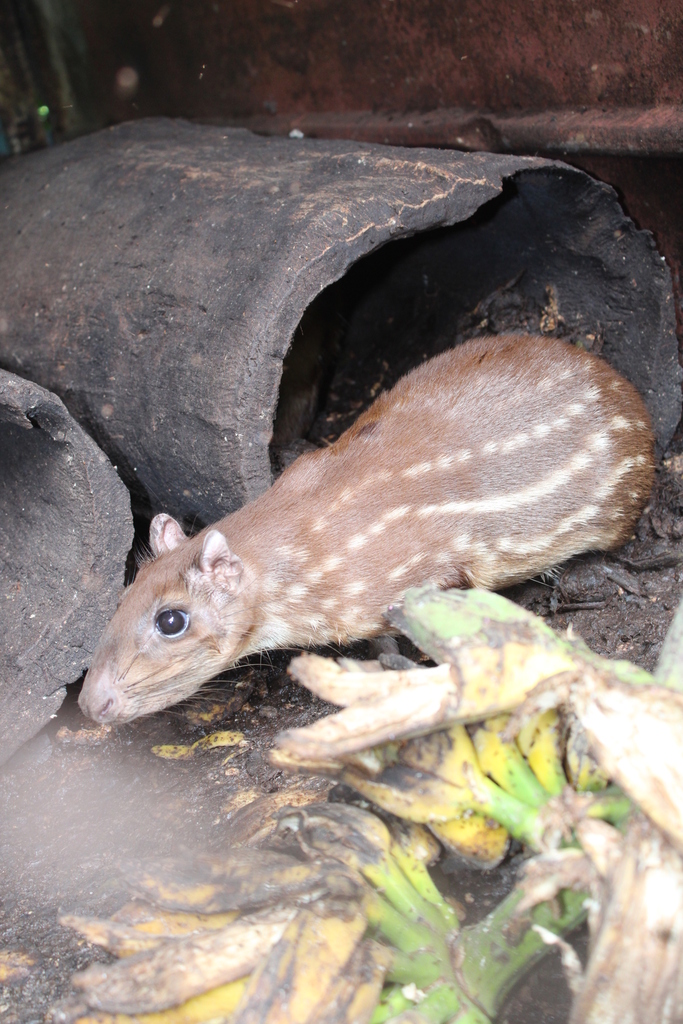
Lowland Paca
Photo © Erminio
Photo © Erminio — CC BY-SA 4.0 — Source: iNaturalist photo #295051207Identification
The lowland paca is a stocky, large rodent weighing 6–12 kilograms (13–26 lb), instantly recognizable by its distinctive spotted coat. Its upper body is dark brown to black, contrasting sharply with a white or yellowish underbelly. The animal's most striking feature is its pattern of three to five rows of white spots running along its flanks against a dark grey background. Its body is compact with thick, strong legs—the forefeet have four digits and the hind feet five (though the first and fifth are reduced)—with nail-like hooves for gripping. The short, hairless tail and rounded profile complete the unmistakable appearance. A unique anatomical feature, rarely seen in mammals, is the paca's laterally and dorsally expanded zygomatic arch (cheekbone), which functions as a resonating chamber.
Range & Habitat
The lowland paca is found throughout tropical and sub-tropical America, ranging from east-central Mexico south to northern Argentina. It has also been introduced to Cuba and Algeria. This rodent is deeply associated with water and favours forested habitats near smaller rivers and streams. It is a burrowing animal, digging simple tunnels approximately 2 metres below the surface with multiple exits, though it may also occupy burrows abandoned by other species. The paca's range spans diverse ecosystems across Central and South America, where it remains plentiful in protected habitats despite significant local population declines.
Behaviour & Diet
The lowland paca is primarily nocturnal and solitary, vocalizing very little. It is an excellent swimmer and characteristically retreats to water when threatened, capable of remaining submerged for several minutes. The paca is an omnivorous forager with a diet encompassing leaves, stems, roots, tubers, nuts, seeds, and herbs. It shows a particular preference for fruits including avocados, mangos, and zapotes, along with coco macaque, balata, wild chataigne, hog plum, pomerac, and guava, plus introduced species like jack-fruit and buri. The animal sometimes caches food for later consumption and exhibits necrophagous behaviour, scavenging decomposing animal carcasses—likely an adaptation to meet protein demands. Pacas typically produce one to three young per year with a gestation period of 115–120 days; litters usually contain a single pup, occasionally two. Sexual maturity is reached at about one year, and individuals may live up to 13 years in the wild.
Best Time & Places to See It
Because lowland pacas are strictly nocturnal, nighttime is essential for observation. Your best opportunities occur in protected forest reserves and national parks where populations remain plentiful and hunting pressure is minimal. Search forested areas adjacent to rivers and streams, particularly in Central and South America. The paca's preference for water-adjacent habitats and its tendency to create predictable burrow systems with multiple exits make riverine forests particularly promising. Early morning hours just before dawn may also yield sightings as animals return to their burrows.
Photography Tips
Photographing lowland pacas requires patience and night-vision capability. A camera trap or headlamp setup near burrow entrances and along river paths offers the best chances for consistent images. Focus on capturing the distinctive white spotting pattern on the dark flanks, as this is the species' most photogenic feature. The animal's reflective eyes will catch light effectively at night. Given the paca's wariness and quick retreat to water when alarmed, remote camera placement is often more successful than active stalking. Shooting in burst mode helps capture movement as the paca forages or transitions between its burrow and feeding areas.
Yasuní National Park
Aguarico, Ecuador
+601 birds+43 mammals
Where the western Amazon basin converges with Ecuador's Orellana Province, lowland rainforest reaches toward the horizon in an unbroken canopy of staggering botanical density. Yasuní National…
VIEW NATIONAL PARKNatural Utría National Park
Alto Baudó (Pie de Pató), Colombia
+372 birds+11 mammals
Where the Chocó's coastal mountains plunge toward the Pacific, Utría National Park preserves one of Colombia's most biodiverse and least-visited wilderness expanses. Sprawling across 1,287 square…
VIEW NATIONAL PARKYanachaga–chemillén National Park
Palcazu, Peru
+639 birds+6 mammals
Where the eastern slopes of Peru's central cordillera plunge into cloud forest, Yanachaga–Chemillén National Park protects nearly three thousand square kilometres of montane wilderness that few…
VIEW NATIONAL PARKManu National Park
Manu, Peru
+892 birds+26 mammals
Across the eastern slopes of the Peruvian Andes, tropical rainforest descends into the Amazon basin with a complexity that few terrestrial ecosystems match. Manu National Park…
VIEW NATIONAL PARKChagres National Park
Caimitillo, Panama
+486 birds+19 mammals
Where the Chagres River carves through the humid tropics of central Panama, a vast montane and lowland forest sprawls across more than 2,300 square kilometers, anchoring…
VIEW NATIONAL PARKMontes Azules
Candelaria, Mexico
+395 birds+47 mammals
Where jungle-clad limestone plateaus plunge into canyon systems carved by the Usumacinta River, Mexico's most pristine rainforest reserve unfolds across the Lacandón region of Chiapas. Montes…
VIEW BIOSPHERE RESERVEGandoca-Manzanillo National Wildlife Refuge
Manzanillo, Costa Rica
+394 birds+18 mammals
Where the Caribbean coastal plain surrenders to water-logged forest and mangrove tangles, Gandoca-Manzanillo Wildlife Sanctuary shelters one of Costa Rica's most biodiverse lowland wetland ecosystems. The…
VIEW WILDLIFE SANCTUARYNo community photos yet. Log in to add the first one.
No community observations of this species yet.