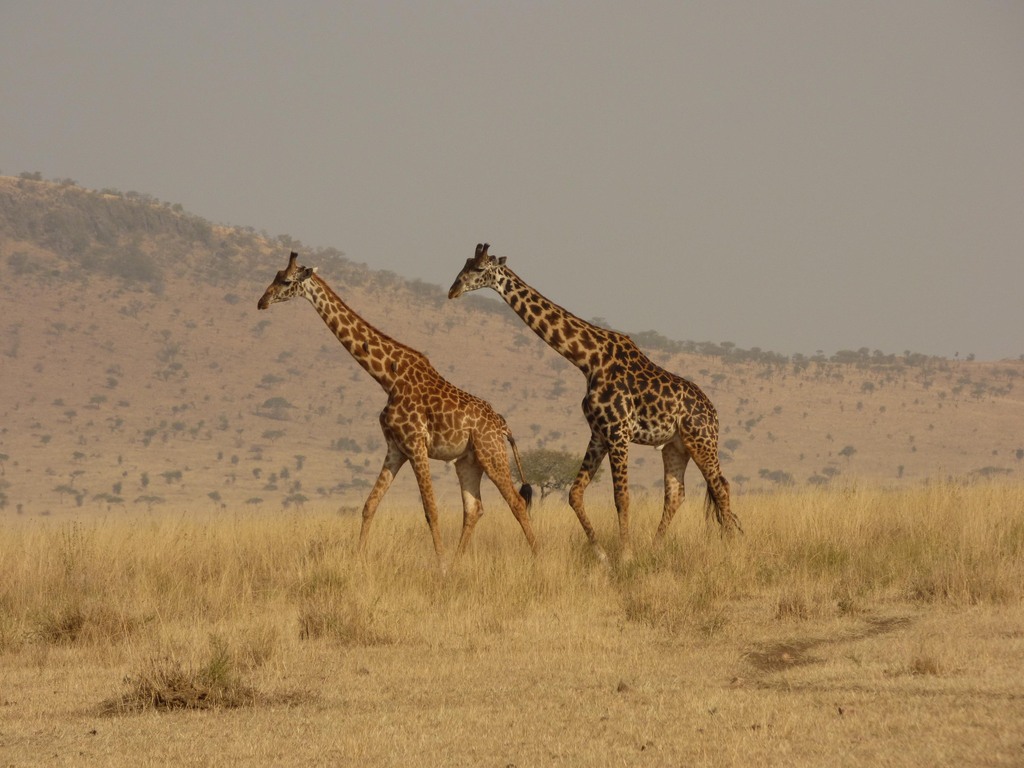
Maasai Giraffe
Photo © Luis G Restrepo
Photo © Luis G Restrepo — CC BY 4.0 — Source: iNaturalist photo #510220347Identification
The Maasai giraffe is the largest-bodied giraffe species and the tallest land animal on Earth. Bulls are generally larger than cows, weighing close to 1.3 tonnes and growing up to 5.8 metres (19 feet) in height. The most distinctive feature of the Maasai giraffe is its coat pattern: jagged and irregular leaf-like blotches that extend from the hooves to the head, setting it apart from other giraffe species with their more geometric spot patterns.
The species' famous neck contains seven vertebrae and makes up roughly one third of its body height. A long and muscular prehensile tongue, which can reach up to 50 centimetres in length, allows the animal to grasp leaves from tall trees inaccessible to other animals. The tongue's darker pigment acts as a natural sunscreen. On top of the head are two bony structures called ossicones, covered in thick skin with dark hair on the tips; bulls typically have an extra ossicone between the eyes.
Range & Habitat
The Maasai giraffe is native to East Africa and can be found in central and southern Kenya, Tanzania, Uganda, and the Luangwa Valley region of Zambia. This species is the national animal of Tanzania. The Thornicroft's giraffe, also known as the Luangwa giraffe, found in the Luangwa Valley region of Zambia, is a subspecies of the Maasai giraffe.
Behaviour & Diet
The Maasai giraffe uses its extraordinarily long tongue to feed on leaves from tall trees, a feeding behaviour that takes advantage of its unique anatomy. When galloping, the species has been recorded to reach speeds of almost 64 kilometres per hour (40 miles per hour). Ossicones are used during fights between individuals to club opponents. In the wild, Maasai giraffes can live to around 30 years of age, with individuals in captivity often living longer.
Best Time & Places to See It
The Maasai giraffe's survival is influenced by seasonal factors, including the season of birth and the seasonal presence of long-distance migratory herds of wildebeest and zebra. Protected areas across Kenya, Tanzania, Uganda, and Zambia offer the best opportunities for viewing this species, as demographic studies show that protected areas are important for sustaining giraffe populations in the larger landscape.
Photography Tips
Photograph the Maasai giraffe's distinctive jagged and irregular spot pattern, which provides excellent contrast and detail at all distances. The species' impressive height and long neck offer dramatic compositional opportunities, particularly when the animal is silhouetted against the African sky or feeding from acacia trees. Early morning and late afternoon light will best highlight the texture and pattern of its coat. Look for the characteristic ossicones on the head and the dark-tipped ears as identifying features in your shots.
Serengeti National Park
Tanzania
+558 birds+57 mammals
Across Tanzania's northern plateau, where volcanic soils meet acacia woodland and open grassland, unfolds one of Earth's most dynamic ecosystems. The Serengeti National Park sprawls across…
VIEW NATIONAL PARKArusha National Park
Tanzania
+555 birds+16 mammals
Where the slopes of Mount Mawenzi rise above the Arusha region, a compact yet ecologically rich national park unfolds across montane forest, moorland, and alpine zones.…
VIEW NATIONAL PARKTsavo East National Park
Athi ward, Kenya
+468 birds+50 mammals
Across the semi-arid lowlands of southeastern Kenya, where acacia woodland fragments into scrubland and the landscape rolls toward the Indian Ocean horizon, lies one of Africa's…
VIEW NATIONAL PARKTsavo West National Park
Mwatate, Kenya
+513 birds+49 mammals
Where volcanic ridges and weathered lava flows meet the semi-arid lowlands of south-central Kenya, Tsavo West National Park unfolds across a landscape sculpted by fire and…
VIEW NATIONAL PARKAmboseli National Park
Etonet/Lenkism ward, Kenya
+501 birds+43 mammals
Where the Amboseli basin opens toward the Tanzanian frontier, a shallow alkaline lake mirrors vast skies across one of East Africa's most iconic savanna landscapes. The…
VIEW NATIONAL PARKKilimanjaro National Park
Kenya
+207 birds+16 mammals
Africa's highest mountain rises not in isolation but as the centerpiece of a vast national park that sweeps across the borderlands of northern Tanzania, where savanna…
VIEW NATIONAL PARKTarangire National Park
Tanzania
+527 birds+50 mammals
Acacia woodland and grassland sweep across the Manyara Region where the Tarangire River carves through low hills and volcanic soils, creating one of East Africa's most…
VIEW NATIONAL PARKNgorongoro Conservation Area
Tanzania
+626 birds+55 mammals
Volcanic calderas and open grassland dominate this high plateau in northern Tanzania, where the landscape rises above 2,000 metres and ancient geological forces have shaped both…
VIEW WILDLIFE MANAGEMENT AREANairobi National Park
Nairobi, Kenya
+515 birds+35 mammals
Just minutes from Kenya's capital, where the Nairobi River winds through acacia woodland and open grassland, lies one of Africa's most paradoxical wildlife sanctuaries. The park's…
VIEW NATIONAL PARKLake Nakuru National Park
Nakuru West, Kenya
+494 birds+32 mammals
Alkaline waters ringed by acacia woodland and grassland create one of East Africa's most distinctive wetland ecosystems, where the interplay of geology and climate sustains a…
VIEW NATIONAL PARKHell’s Gate National Park
Olkaria ward, Kenya
+388 birds+18 mammals
Volcanic scarps and geothermal vents dominate the floor of Hell's Gate, where the East African Rift has carved a dramatic gorge through crystalline rock formations. The…
VIEW NATIONAL PARKRuma National Park
Suba, Kenya
+250 birds+8 mammals
Where the Winam Gulf narrows toward the Kenyan mainland, Ruma National Park rises as a sanctuary of evergreen woodland set within the humid tropics of Homa…
VIEW NATIONAL PARKNo community photos yet. Log in to add the first one.