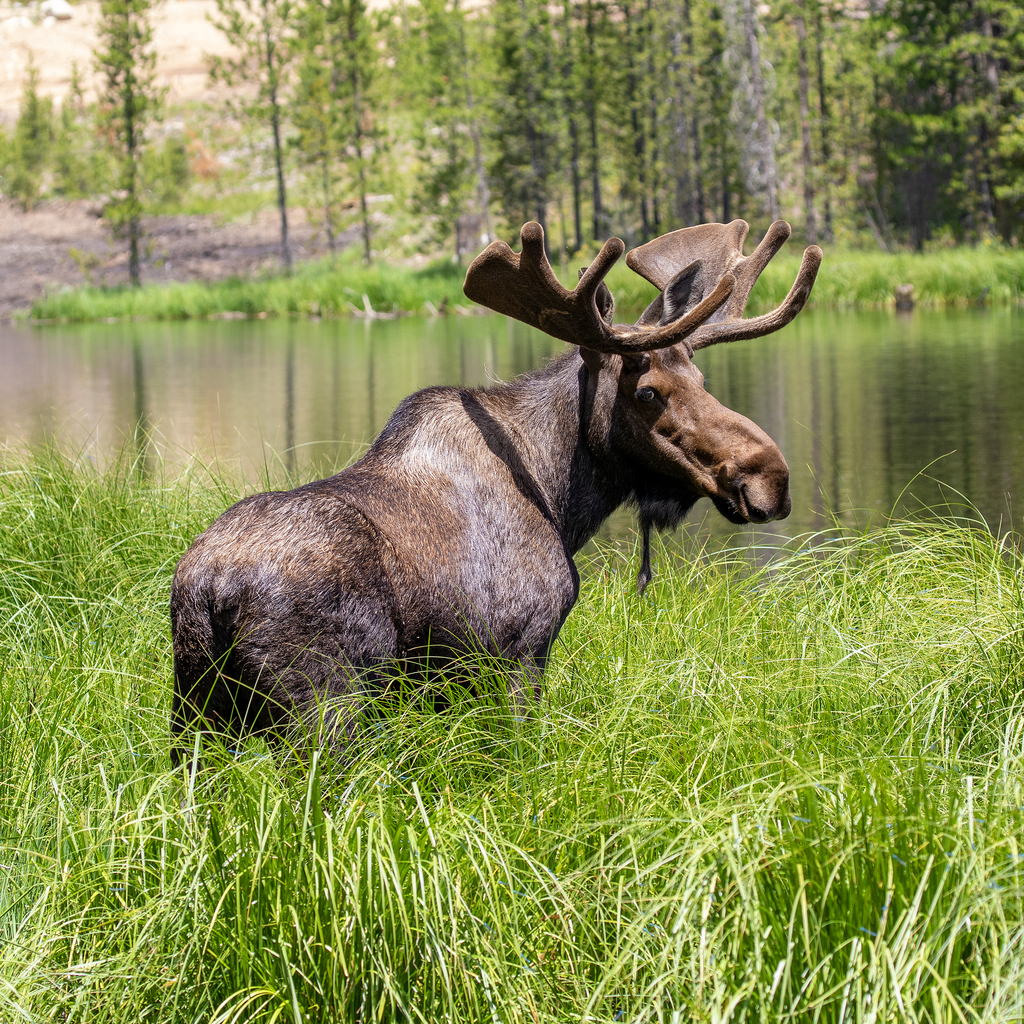
Moose
Photo © Dan Vickers
Photo © Dan Vickers — CC BY 4.0 — Source: iNaturalist photo #458933375Identification
The moose is the world's tallest, largest and heaviest extant species of deer, and the only extant species in the genus Alces. An adult moose stands 1.4–2.1 m (4.6–6.9 ft) high at the shoulder—more than 30 cm higher on average than any other deer species. Males typically weigh 380 to 700 kg (838 to 1,543 lb), while females weigh 200 to 490 kg (441 to 1,080 lb), though the Alaskan subspecies can exceed these averages. The moose's most distinctive feature is the broad, palmate ("open-hand shaped") antlers borne by most adult males—unlike other deer with pointed, twig-like antlers. The animal has a characteristically short tail of only 6–8 cm, which is too short to swish away insects as other ungulates do.
Antler size and growth are determined by diet and age. The symmetry and number of points on a bull's antlers signal his health, and cows select mates partly based on antler size and symmetry. Bulls use their antlers to display dominance, discourage competition, and spar with rivals during the autumn mating season.
Range & Habitat
Moose inhabit the circumpolar boreal forests and temperate broadleaf and mixed forests of the Northern Hemisphere, thriving in cooler, temperate areas as well as subarctic climates. Hunting and habitat loss have historically reduced their range and fragmented populations, even leading to occasional "urban moose" sightings in some areas. However, moose have been reintroduced to some former habitats and currently maintain the greatest populations in Canada.
Substantial numbers are also found in Alaska, the northern states of the contiguous United States, Fennoscandia, the Baltic states, the Caucasus region, Poland, Eastern Europe, Mongolia, Kazakhstan, and Russia.
Behaviour & Diet
Unlike most other deer species, moose are solitary animals and do not form herds. Calves remain with their mother until approximately 18 months of age, when the cow begins estrus again and chases her calf away. Although generally slow-moving and sedentary, moose can become defensively aggressive and move very quickly if angered or startled. Their autumn mating season features energetic fights between males competing for a female.
Predominantly a browser, the moose's diet consists of both terrestrial and aquatic vegetation depending on the season, with branches, twigs and dead wood making up a large portion of their winter diet. Predators include wolves, bears, humans, and wolverines (rarely, particularly targeting calves), with orcas occasionally preying on swimming moose in ocean waters.
Best Time & Places to See It
The greatest moose populations occur in Canada, with substantial numbers also in Alaska and the northern contiguous United States. In Eurasia, strong populations exist in Fennoscandia, the Baltic states, the Caucasus region, Poland, Eastern Europe, Mongolia, Kazakhstan, and Russia. The autumn mating season offers opportunities to observe the energetic behavioural displays and fights between bulls competing for cows, though moose can be unpredictable and defensive during this period.
Photography Tips
The moose's massive size, distinctive palmate antlers, and solitary nature make it a compelling photographic subject. Capture the characteristic broad antlers during autumn, when bulls display them prominently. Remember that although generally sedentary, moose can move very quickly and become defensive if startled or angered—maintain a safe distance and exercise caution when approaching or photographing these powerful animals in their natural habitat.
Tombstone Territorial Park
Acadia National Park
Alaska Maritime National Wildlife Refuge
Algonquin Provincial Park
Arctic National Wildlife Refuge
Åsnens National Park
Bavarian Forest National Park
Becharof National Wildlife Refuge
Białowieża National Park
Nothing matches these filters.
No community photos yet. Log in to add the first one.
No community observations of this species yet.