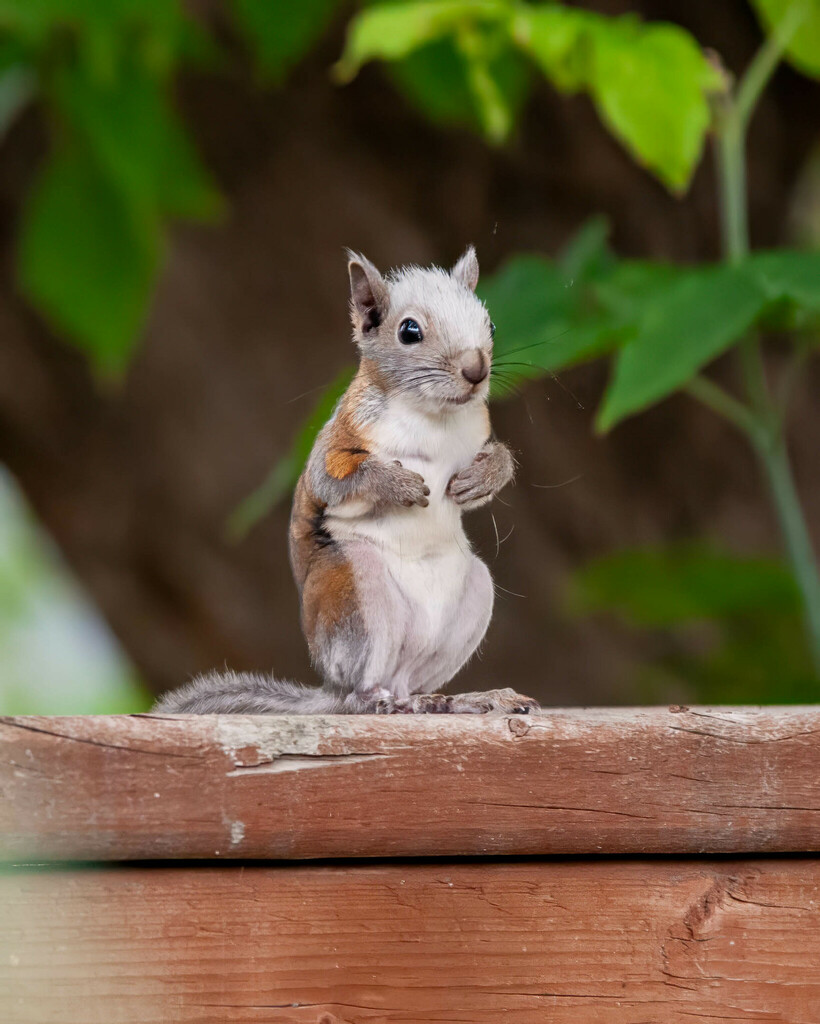
North American Red Squirrel
Photo © Chris O'Donoghue
Photo © Chris O'Donoghue — CC BY 4.0 — Source: iNaturalist #169282888Identification
The North American red squirrel is a small, compact tree squirrel weighing 200–250 grams with a total length of 28–35 centimeters including the tail. It is easily distinguished from other North American tree squirrels by its reddish fur, white underbelly, small size, and notably territorial behavior. Red squirrels are somewhat larger than chipmunks and should not be confused with the Eurasian red squirrel, which inhabits different ranges entirely.
Range & Habitat
This species is widely distributed across North America, occupying most of Canada (except the far north and southwestern British Columbia coast), the southern half of Alaska, the Rocky Mountains, and the northern half of the eastern United States. Red squirrels are abundant wherever conifers are common, particularly favoring mature white spruce and conifer-dominated forests. The species has been expanding its range into hardwood forests and is not of conservation concern throughout most of its range.
Behaviour & Diet
Red squirrels are diurnal and defend exclusive year-round territories. They are primarily granivores, feeding heavily on conifer seeds—particularly white spruce seeds, which can comprise over 50% of their diet in some regions. They also consume spruce buds and needles, mushrooms, willow leaves, poplar buds, and opportunistically eat bird eggs and other animal matter. Red squirrels harvest cones in late summer and early autumn, storing them in central caches called middens that can reach 12 meters across, providing sustenance through winter and fueling spring reproduction.
Best Time & Places to See It
Red squirrels are active year-round and can be observed throughout their range in coniferous forests. Late summer and autumn, when squirrels are actively harvesting and caching seeds, offer particularly good viewing opportunities. Look for signs of their feeding activity around conifer stands, particularly the characteristic middens of fallen cone scales that mark their territories.
Photography Tips
Photograph red squirrels in soft morning or late afternoon light to capture the warmth of their reddish fur and the contrast of their white underside. Use a fast shutter speed to freeze their quick, jerky movements as they forage and leap between branches. Patient observers stationed near active middens or feeding areas may capture engaging shots of their energetic territorial behavior and feeding habits.
Tombstone Territorial Park
Acadia National Park
Alaska Maritime National Wildlife Refuge
Algonquin Provincial Park
Banff National Park
Bic National Park
Cape Breton Highlands National Park
Cuyahoga Valley National Park
De Biesbosch National Park
Nothing matches these filters.
No community photos yet. Log in to add the first one.
No community observations of this species yet.