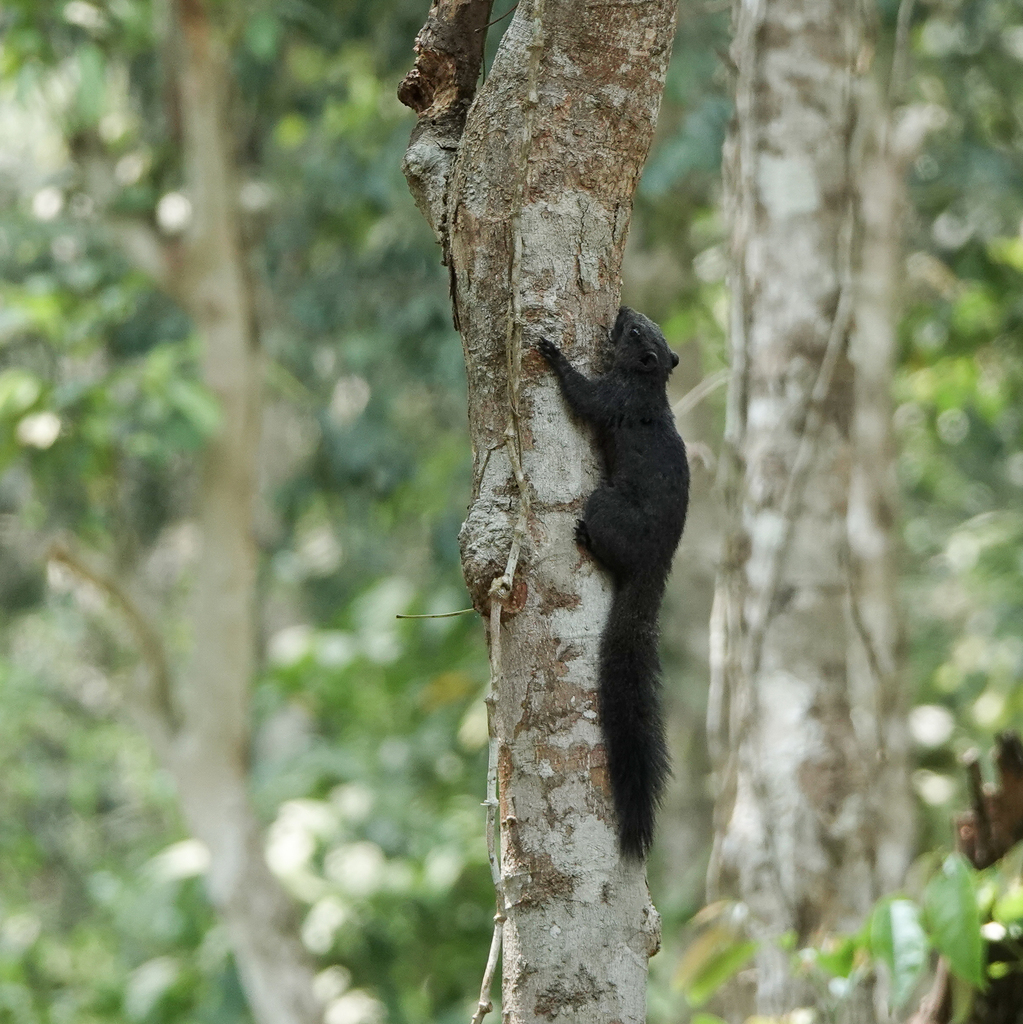
Pallas’s Squirrel
Photo © Rejoice Gassah
Photo © Rejoice Gassah — CC BY 4.0 — Source: iNaturalist #44559940Identification
Pallas's squirrel, also known as the red-bellied tree squirrel, is a medium-sized tree squirrel with a head-body length of 16 to 28 cm and a tail measuring 11 to 26 cm. Both males and females weigh between 310 and 460 g, with similar size and appearance. The species is characterized by brownish upper body fur with a distinctive reddish tint on the belly, often accompanied by black markings on the tail. With over 30 recognized subspecies, the precise pattern and shade of fur varies considerably across the species's range, which can make individual identification challenging without knowledge of the local subspecies.
Range & Habitat
Pallas's squirrel is native to a vast region of Asia, including far eastern India, Bhutan, northern and eastern Myanmar, Vietnam, Cambodia, Laos, Thailand, northern peninsular Malaysia, Taiwan, and southern and eastern China including Hainan. The species inhabits forest environments below 3,000 m elevation, thriving in tropical and subtropical evergreen forests, deciduous broadleaf woodlands, and subalpine conifer forests.
The species has been introduced to several regions outside its native range, including Buenos Aires Province in Argentina, Belgium, the Netherlands, France, and Japan, where it is considered invasive. In Europe, it can cause considerable damage to trees and outcompete native species such as the red squirrel. Due to these concerns, the species was listed in 2016 on the European Union's list of Invasive Alien Species of Union concern, prohibiting its import, breeding, transport, commercialization, or intentional release throughout the EU.
Behaviour & Diet
Pallas's squirrels are diurnal, herbivorous animals that spend much of their time in the forest canopy. They construct leaf nests 7 to 18 m above the ground and occasionally inhabit burrows. Their diet consists primarily of leaves, flowers, seeds, and fruit, supplemented by small quantities of insects and occasional bird eggs. Females occupy small, non-overlapping home ranges of 0.5 to 0.8 hectares, while males maintain much larger territories of 1.3 to 3.8 hectares that overlap with other males and females. These squirrels have been observed caching acorns in autumn and communicating with neighbors through predator-warning calls. Females protecting young are particularly active in mobbing tree-climbing snakes, while males produce loud calls during mating season.
Best Time & Places to See It
Pallas's squirrels are diurnal and active throughout the day, making them accessible for wildlife observation whenever you visit their forest habitats. The species can be encountered across its native range in Southeast Asia, southern China, Taiwan, and northeastern India within tropical and subtropical forests. Their year-round breeding activity means populations are consistently present in suitable habitat.
Photography Tips
To photograph Pallas's squirrels, focus on the forest canopy 7 to 18 m above the ground where they construct their leaf nests and spend most of their time. Early morning hours may be productive, as the squirrels are diurnal and active throughout daylight. The distinctive reddish belly and brownish upper fur provide good contrast for photography. Be patient and remain quiet to observe their natural behavior, including feeding on seeds and fruits. Listen for their warning calls and vocalizations, which may indicate active individuals nearby and provide opportunities for behavioral shots.
Khao Laem Ya-Mu Ko Samet National Park
Mueang Rayong District, Thailand
+159 birds+3 mammals
Where limestone hills meet the Gulf of Thailand, Khao Laem Ya–Mu Ko Samet National Park stitches together a mosaic of terrestrial and marine worlds that few…
VIEW NATIONAL PARKCamargue Regional Nature Park
Saintes-Maries-de-la-Mer, France
+378 birds+48 mammals
Where the Rhône Delta sprawls into the Mediterranean, a landscape of stark and haunting beauty emerges—vast salt marshes punctuated by shallow lagoons, reed beds, and scrubland…
VIEW NATURAL PARKGiant Panda National Park
Mianyang, China
+447 birds+47 mammals
Where the eastern slopes of China's Sichuan plateau descend into cloud-wrapped valleys, one of Asia's most biodiverse landscapes unfolds across more than 350,000 square kilometres. This…
VIEW NATIONAL PARKKaziranga National Park
Kohora, India
+422 birds+26 mammals
Dawn breaks over the floodplains of the Brahmaputra, where tall grasslands stretch endlessly beneath monsoon-heavy skies. This sprawling wilderness of northeastern Assam is a mosaic of…
VIEW NATIONAL PARKXishuangbanna National Nature Reserve
Xishuangbanna Dai Autonomous Prefecture, China
+173 birds+2 mammals
Where subtropical monsoon forests meet the margins of the Yunnan plateau, Xishuangbanna National Nature Reserve sprawls across a landscape of dramatic relief—deep river valleys carved by…
VIEW NATURE RESERVEGaoligong Mountain National Nature Reserve
Nujiang Lisu Autonomous Prefecture, China
+443 birds+13 mammals
VIEW NATURE RESERVENo community photos yet. Log in to add the first one.
No community observations of this species yet.