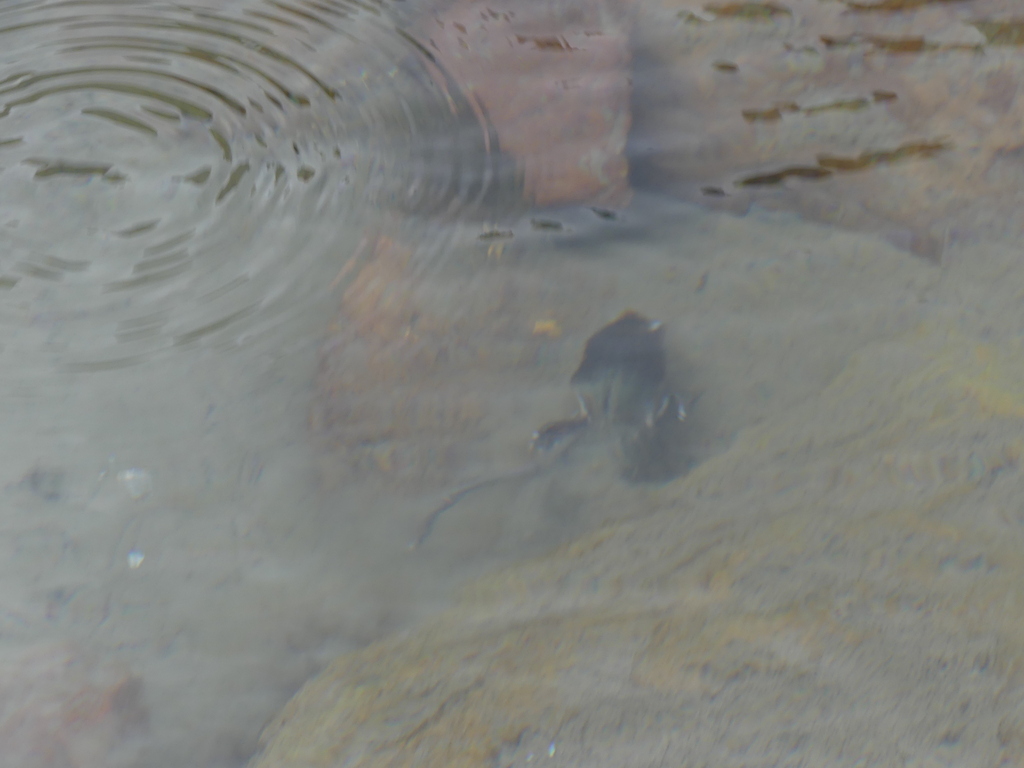
Pyrenean Desman
Photo © Adrien Jailloux
Photo © Adrien Jailloux — CC BY 4.0 — Source: iNaturalist #336120367Identification
The Pyrenean desman is a small semiaquatic mammal measuring approximately 25 cm in total length, with more than half of this comprising its robust tail. Weighing only 50–60 g, it combines anatomical features from several familiar animals: the stocky build and powerful tail of a brown rat, the strong clawed forelimbs and sensitive snout of a mole, and the elongated snout of a shrew. Its most distinctive feature is a trunk-like, prehensile snout bearing specialized tactile structures—vibrissae at the base and Eimer's organs at the tip—which gives rise to its alternative name "trumpet rat." The fur is grey-brown with silvery reflections on the underside and tawny coloration on the chest, arranged in small tufts that give a scaly appearance. The animal has webbed hind feet, a relatively uncommon adaptation among insectivorous mammals. The desman's eyes are visible but small; with very limited vision, it relies almost entirely on its highly developed sense of touch for orientation and foraging.
The two anterior upper incisors are particularly developed, and the complete dentition comprises 44 teeth. There is no pronounced sexual dimorphism, though females are on average slightly larger than males.
Range & Habitat
The Pyrenean desman is endemic to the mountain ranges of the Pyrenees and mountainous areas of northwestern Iberia, primarily the Cantabrian Mountains and the Sistema Central. Its distribution spans four European countries: Andorra, Spain, France, and Portugal. The species is strictly dependent on clear, fast-flowing mountain streams and lakes with unpolluted, unaltered watercourses. It is particularly sensitive to anthropogenic habitat modification, including dam construction, riverbank armouring with rock, and the building of barrages, all of which cause habitat loss and fragmentation.
Behaviour & Diet
The desman is an insectivorous specialist that forages primarily on aquatic larvae sensitive to water pollution, including larvae of stoneflies, caddisflies, and mayflies. The species is strictly nocturnal and actively avoids human presence, making direct observation extremely difficult. Several aspects of its biology, including details of its reproductive cycle, remain poorly documented. On land, it shelters in burrows that it digs using its powerful forelimbs. In water, it is an agile and powerful swimmer, capable of swimming upstream and diving for around twenty seconds, during which nasal valves close to prevent water entry. The animal's fur is exceptionally well adapted to an aquatic lifestyle, comprising a dense, silky underfur and an outer layer of long guard hairs that trap insulating air when submerged.
Best Time & Places to See It
Observing the Pyrenean desman in the field is extremely challenging due to its strictly nocturnal habits and avoidance of human disturbance. Your best opportunities lie in remote, pristine mountain streams and lakes in the Pyrenees, Cantabrian Mountains, and Sistema Central, particularly in Spain, France, Andorra, and Portugal. Searching at night along clear, fast-flowing watercourses with minimal human activity offers the highest probability of encounter, though patience and silence are essential.
Photography Tips
Photographing this species presents significant challenges. The desman's nocturnal behaviour and sensitivity to human presence mean that long-distance observation and specialist night photography equipment are necessary. Position yourself quietly near pristine mountain streams well before dusk, using low-light capable cameras and minimal disturbance. Infrared or thermal imaging may be more practical than visible-light flash photography. Given the species' extreme wariness, remote camera traps set along watercourse banks offer a more realistic opportunity for obtaining images. Focus on the animal's distinctive trunk-like snout and webbed feet when opportunities arise.
La Mata de València
Pyrénées Ariégeoises Regional Nature Park
Pyrénées Catalanes Regional Nature Park
Pyrénées National Park
Regional Park of the Catalan Pyrenees
Nothing matches these filters.
No community photos yet. Log in to add the first one.
No community observations of this species yet.