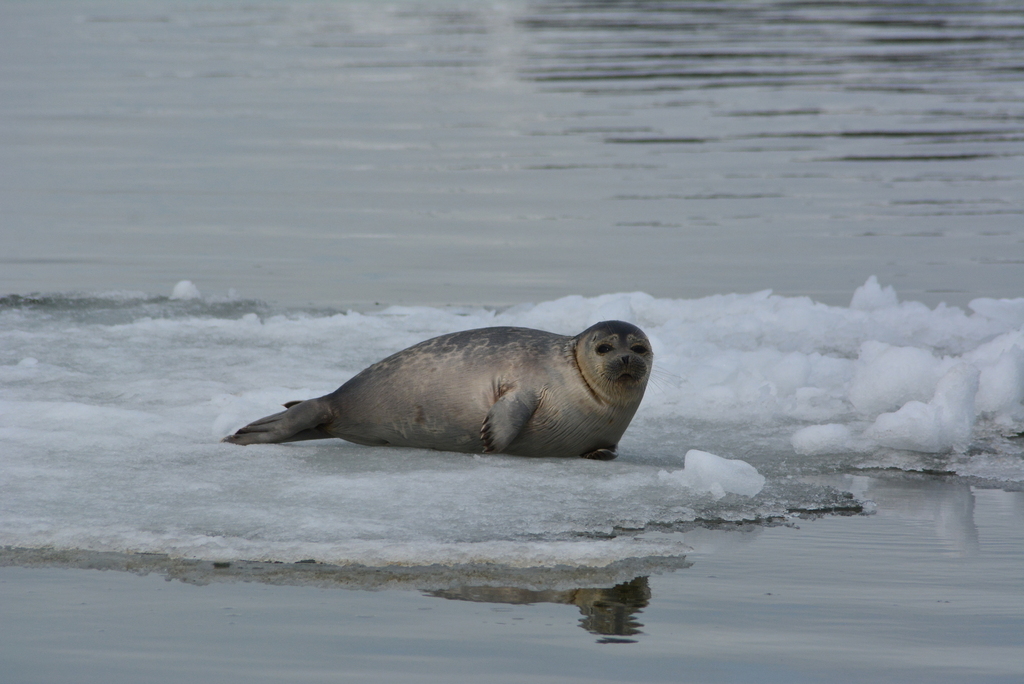
Ringed Seal
Photo © Игорь Загребин
Photo © Игорь Загребин — CC0 1.0 — Source: iNaturalist photo #258215337Identification
The ringed seal is the smallest seal species in Arctic and sub-Arctic regions, typically averaging 1.5 metres (5 ft) in length and weighing 50–70 kg (110–150 lb). Its most distinctive feature is a dark coat patterned with silver rings on the back and sides, contrasting with a silver belly—the source of its common name. The head is small with a short, cat-like snout, and the body is characteristically plump. Their remarkably thick front flipper claws, exceeding 2.5 cm (1 in), are specially adapted for maintaining breathing holes through ice sheets as thick as 1.8 metres (6 ft).
Range & Habitat
The ringed seal is the most abundant and wide-ranging ice seal in the Northern Hemisphere, with a circumpolar distribution spanning from approximately 35°N to the North Pole. These seals occur throughout the Arctic Ocean, Bering Sea, Okhotsk Sea, and extend as far south as the northern coast of Japan in the Pacific and Newfoundland in the North Atlantic. Two freshwater subspecies inhabit northern European lakes. Ringed seals have a strong affinity for ice-covered waters and prefer to rest on large ice floes, often positioning themselves in the interior ice pack where sea ice coverage exceeds 90%. They remain in contact with ice for most of the year, migrating northward with the ice edge in late spring and summer.
Behaviour & Diet
Ringed seals are solitary animals with a notably long lifespan averaging around 40 years. Their diet consists predominantly of Arctic cod and planktonic crustaceans. Females reach sexual maturity at 4 years old, while males mature later at 7 years. During spring, females construct specialized lairs within thick ice where they give birth to a single pup in March or April, following a 9-month gestation period. Pups are weaned after two months and rapidly build up thick blubber reserves. Ringed seals face predation from polar bears, their primary predator, as well as killer whales, and have traditionally been hunted by Arctic indigenous peoples.
Best Time & Places to See It
Ringed seals are best observed during late April through June, when they are distributed throughout their range from the southern ice edge northward. The nearshore fast and pack ice of the Chukchi Sea, along with the Beaufort and Bering Seas, offer reliable viewing opportunities. In the Alaskan Beaufort Sea during early summer, seal density is higher to the east of Flaxman Island. Observers should search ice-covered waters where these seals remain closely associated with their ice habitat year-round.
Photography Tips
Photograph ringed seals on stable ice floes during the optimal late spring season when they are most widely distributed across their range. Position yourself to capture their distinctive silver-ring patterning against their dark coat, which is most visible when seals are hauled out on ice. The contrast between their dark backs and silver bellies provides excellent compositional opportunities. Early morning or late evening light will enhance the visibility of their silvery markings. Patience and a respectful distance are essential, as their solitary nature means they spend considerable time resting on ice between feeding sessions.
Arctic Ecology and Ecosystem Conservation Tour
South Spitsbergen National Park
Norway
+41 birds+15 mammals
Glaciers and tundra meet in Norway's high Arctic, where South Spitsbergen National Park sprawls across the southernmost reaches of the Svalbard archipelago. Here, massive valley glaciers…
VIEW NATIONAL PARKNorthwest Spitsbergen National Park
Norway
+58 birds+17 mammals
Where the High Arctic converges with the Norwegian mainland, Northwest Spitsbergen National Park sprawls across one of Earth's most extreme and pristine wildernesses. Crowned by jagged…
VIEW NATIONAL PARKNorthern Isfjorden National Park
Norway
+40 birds+12 mammals
Where the Arctic fjord system cuts deep into Svalbard's northwestern coast, Northern Isfjorden National Park protects a landscape of stark geological drama—towering cliff faces, tidewater glaciers,…
VIEW NATIONAL PARKSassen-Bünsow Land National Park
Soere, Norway
+30 birds+10 mammals
Where Arctic tundra sprawls across glaciated plateaus in the remote Svalbard archipelago, a realm of raw geological drama unfolds. Sassen-Bünsow Land National Park encompasses a landscape…
VIEW NATIONAL PARKWrangel Island Nature Reserve
Wrangel Island, Russia
+25 birds+11 mammals
Where the Chukchi Sea fractures Arctic ice beneath an unforgiving sky, a lonely island holds one of Earth's most pristine ecosystems. Wrangel Island spans tundra so…
VIEW NATURE RESERVEDisko Bay
Kitsissuarsuit, Greenland
+46 birds+9 mammals
Where Arctic fjords carve deep into Greenland's western coast, Disko Bay creates a protected landscape of extraordinary ecological complexity. The waters here merge temperate Atlantic currents…
VIEW PROTECTED LANDSCAPEScoresby Sund
Vandreblok, Greenland
+43 birds+9 mammals
Where granite peaks pierce an Arctic sky and the world's largest fjord system carves deep into northeastern Greenland, a primordial landscape unfolds in shades of ice-blue…
VIEW PROTECTED LANDSCAPENortheast Greenland National Park
Northeast Greenland National Park, Greenland
+34 birds+10 mammals
Where granite peaks plunge into the Arctic Ocean and pack ice dominates a landscape of incomparable vastness, one of Earth's most remote wildernesses reveals itself. Spanning…
VIEW NATIONAL PARKAlaska Maritime National Wildlife Refuge
Alaska, United States
+391 birds+58 mammals
Where the North Pacific collides with Alaska's rugged coastline, a sprawling archipelago of islands, rocky outcrops, and coastal headlands forms one of North America's most remote…
VIEW WILDLIFE SANCTUARYNo community photos yet. Log in to add the first one.
No community observations of this species yet.