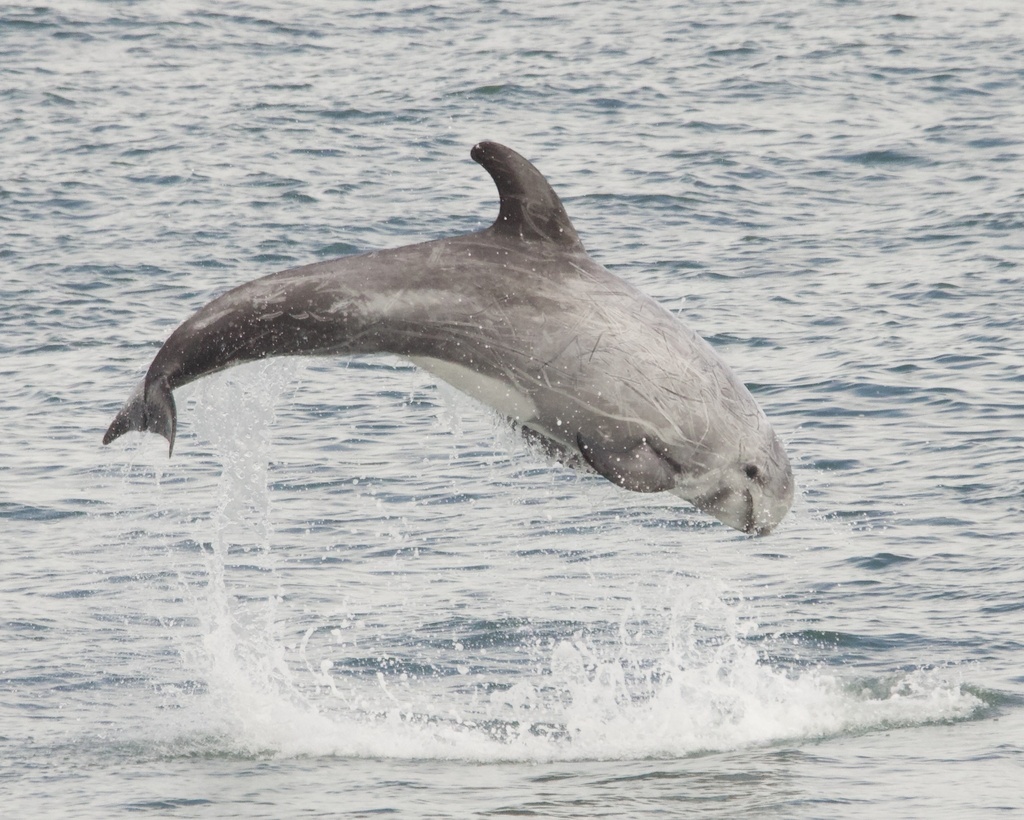
Risso’s Dolphin
Photo © Morgan Caygill
Photo © Morgan Caygill — CC BY 4.0 — Source: iNaturalist photo #318826478Identification
Risso's dolphin is the largest species commonly called a "dolphin," reaching typical lengths of 10 feet (3.0 m), with some specimens reaching up to 13 feet (4.0 m). The most distinctive feature is the heavy white scarring that covers the body, particularly in older individuals. Younger dolphins are grey to brown dorsally with cream-colored undersides and a characteristic white, anchor-shaped marking between the pectoral fins and around the mouth. As they age, the non-scarred areas darken and then gradually lighten again, though the dorsal fin remains dark. The head is notably bulbous with a vertical crease in front, and the body tapers toward a relatively narrow tail. Most individuals have only two to seven pairs of teeth, all located in the lower jaw.
Range & Habitat
Risso's dolphins are found nearly worldwide in cold to temperate waters across the Indian, Pacific, and Atlantic Oceans, as well as in the Mediterranean, North, Red, and Baltic Seas. In the Pacific, they range from French Polynesia and the Hawaiian Islands to the Gulf of Alaska and south to Tierra Del Fuego, with particular abundance along western coasts of North America. In the Atlantic, they occur from southern Greenland to Western Africa, and throughout much of the Caribbean and Gulf of Mexico. Recent sightings off the Norwegian coast suggest their range may be expanding northward.
These dolphins show a strong preference for deep waters just off continental shelves, typically at depths of 400–1,000 meters (1,300–3,300 feet), where water temperatures range from 10°C to preferably 15–20°C (50–68°F). They can dive to nearly 600 meters (2,000 feet) in pursuit of prey.
Behaviour & Diet
Risso's dolphins typically travel in tight-knit social groups of 10 to 50 individuals. They form strong social bonds with pod members, and males engage in frequent social interactions that result in the species' characteristically heavy scarring—a trait more pronounced in this species than in other toothed whales. The scarring may serve as a visual display that reduces further challenges from rival males.
Their diet consists primarily of cephalopods, particularly squid and octopus. Their ability to dive to extreme depths makes them effective hunters across various water layers, allowing them to access prey that other dolphin species cannot reach.
Best Time & Places to See It
Risso's dolphins are most reliably encountered along continental shelves and steep banks in cold to temperate waters. The western coasts of British Columbia, the United States, and Mexico offer good opportunities for sightings. The Mediterranean and parts of the North Atlantic, including around the Azores and Canary Islands, are also productive regions. Recent range expansion off the Norwegian coast, particularly around Bleik's Canyon off Andøya, represents an emerging location for viewing this species.
Photography Tips
The distinctive white scarring that develops with age makes older Risso's dolphins excellent photographic subjects, offering high contrast and unique identifying patterns. The bulbous head shape and relatively large dorsal fin are recognizable features to capture. Look for the characteristic anchor-shaped white marking on younger individuals. Since these dolphins dive to substantial depths, patience and observation of their surfacing patterns will improve your chances of capturing compelling images. Their preference for deeper offshore waters means that boat-based wildlife viewing is typically necessary for photography opportunities.
Pembrokeshire Coast National Park
Pembrokeshire, United Kingdom
+250 birds+41 mammals
Where the Cambrian coastline meets the Celtic Sea, cliff-top moorland and hidden coves define a landscape carved by 300 million years of geological drama. Pembrokeshire Coast…
VIEW NATIONAL PARKParque Nacional de Galápagos
Santo Tomás, Ecuador
+139 birds+23 mammals
Volcanic peaks and weathered lava fields dominate this remote archipelago in the Pacific, where the interplay of cold ocean currents and tropical latitude creates an ecological…
VIEW ISLAND & ARCHIPELAGOCamargue Regional Nature Park
Saintes-Maries-de-la-Mer, France
+378 birds+48 mammals
Where the Rhône Delta sprawls into the Mediterranean, a landscape of stark and haunting beauty emerges—vast salt marshes punctuated by shallow lagoons, reed beds, and scrubland…
VIEW NATURAL PARKBen Boyd National Park
Eden, Australia
+255 birds+47 mammals
Where the temperate forests of the far south coast meet towering sea cliffs, Ben Boyd National Park unveils one of New South Wales' most dramatic coastal…
VIEW NATIONAL PARKCalanques National Park
Bouches-du-Rhône, France
+233 birds+42 mammals
Where limestone cliffs plunge dramatically into crystalline Mediterranean waters, Calanques National Park preserves one of Europe's most striking coastal landscapes. These steep-sided inlets, carved by erosion…
VIEW NATIONAL PARKChannel Islands National Park
Santa Barbara County, United States
+330 birds+15 mammals
A chain of eight volcanic islands rises from the cold Pacific waters off the California coast, their rugged sea cliffs and windswept terrain shaped by millions…
VIEW NATIONAL PARKAlaska Maritime National Wildlife Refuge
Alaska, United States
+391 birds+58 mammals
Where the North Pacific collides with Alaska's rugged coastline, a sprawling archipelago of islands, rocky outcrops, and coastal headlands forms one of North America's most remote…
VIEW WILDLIFE SANCTUARYFarallon National Wildlife Refuge
San Francisco, United States
+384 birds+16 mammals
Windswept granite peaks rising abruptly from the Pacific, the Farallon Islands form a wildlife sanctuary of extraordinary seabird abundance and ecological significance just twenty-seven miles west…
VIEW WILDLIFE SANCTUARYNo community photos yet. Log in to add the first one.
No community observations of this species yet.