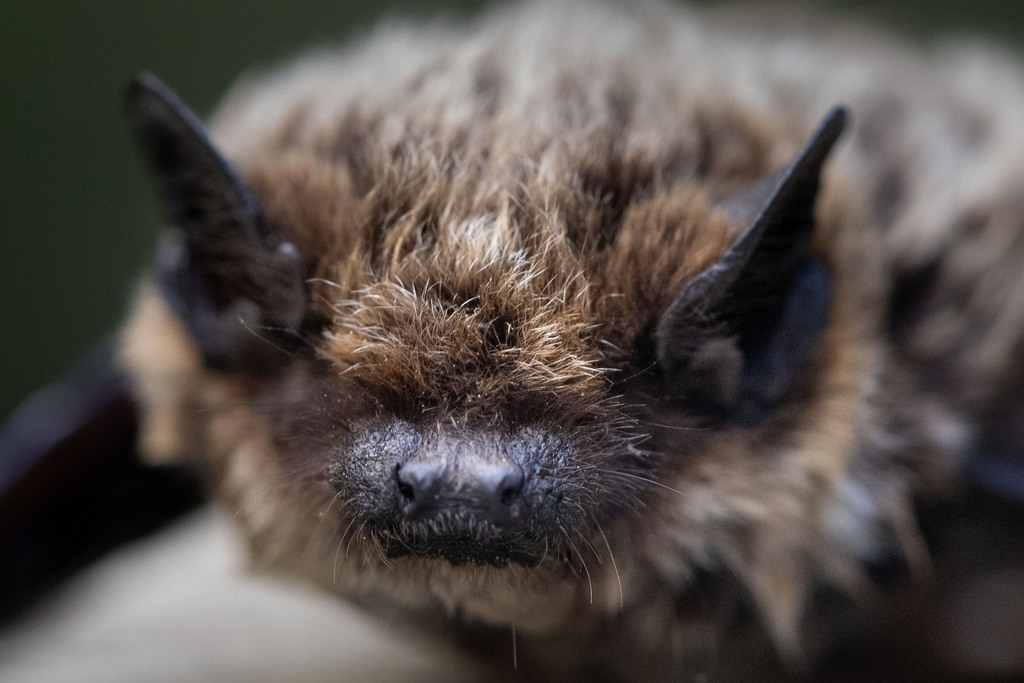
Savi’s Pipistrelle
Photo © Kristof Zyskowski
Photo © Kristof Zyskowski — CC BY 4.0 — Source: iNaturalist photo #572128555Identification
Savi's pipistrelle is a small bat, with a head and body length between 1.75 and 2 inches (44–51 mm) and forearm length of 1.25 to 1.5 inches (32–38 mm), weighing just 0.26 to 0.35 ounces (7.4–9.9 g). Its most distinctive features are its broad, rounded ears, each bearing a short tragus that is widest in the middle and tapers to a rounded tip. The face, ears and wing membranes are black, while the short fur on the upper body is dark brown and the underside is pale, creating a striking contrast between the back and the chin, throat and chest. A notably longer tail than in closely related species is another identifying characteristic.
Range & Habitat
This species is found across North West Africa, the Mediterranean region, the Middle East, central Asia, Mongolia and northern Japan, with populations also occurring in the Canary Islands, Switzerland, Austria and Slovakia. Savi's pipistrelle favours mountainous terrain, occurring at altitudes up to 2,500 metres (8,200 ft), particularly in bushy slopes with clumps of trees, scrubland, cliffs, gorges and ruins.
The bat's choice of roost varies seasonally. In summer, it shelters under tree bark, in rock clefts, hollow trees, holes in walls, and under building rafters and roof tiles. As winter approaches, it seeks more thermally stable environments such as cave entrances, underground vaults and deep rock crevices, typically roosting alone during the colder months. Maternity colonies of up to 70 females gather in summer breeding season.
Behaviour & Diet
An agile nocturnal hunter, Savi's pipistrelle feeds exclusively on flying insects, which it catches on the wing using echolocation. The species has evolved a remarkable hunting strategy: it synchronises its ultrasonic echolocation calls with its wing beats to maximise detection distances. It forages over pastureland, in villages and around streetlights, making it adaptable to human-modified landscapes.
Unlike many bats, Savi's pipistrelle has a distinctive drinking technique. It makes repeated low flights over water, raising its wings and scooping up water with its tongue as it passes over the surface.
Best Time & Places to See It
Summer is the optimal season for observing this species, when females congregate in maternity roosts and activity levels are high. Look for them in mountainous Mediterranean regions, particularly in areas with mixed scrubland and scattered trees near cliffs, gorges or old buildings. The species may be spotted foraging around villages at dusk and after dark, especially near streetlights where insects congregate. Early evening in late spring and summer offers the best viewing opportunities.
Photography Tips
Photographing Savi's pipistrelle presents significant challenges due to its small size, nocturnal habits and rapid flight. High-speed flash photography combined with bat detectors to locate foraging individuals is essential. Focus on capturing its distinctive broad ears and contrasting facial markings. Summer roosts under building eaves or tree bark offer better opportunities for static shots than attempting to photograph the bat in flight. Patience near water sources where the bat drinks may yield rewarding images of this elusive species in its natural behaviour.
Alpilles Regional Nature Park
Baronnies Provençales Regional Nature Park
Cadí Moixeró Natural Park
Calanques National Park
Camargue Regional Nature Park
Causses du Quercy Regional Nature Park
Cévennes National Park
Chartreuse Regional Nature Park
Collserola Natural Park
Nothing matches these filters.
No community photos yet. Log in to add the first one.
No community observations of this species yet.