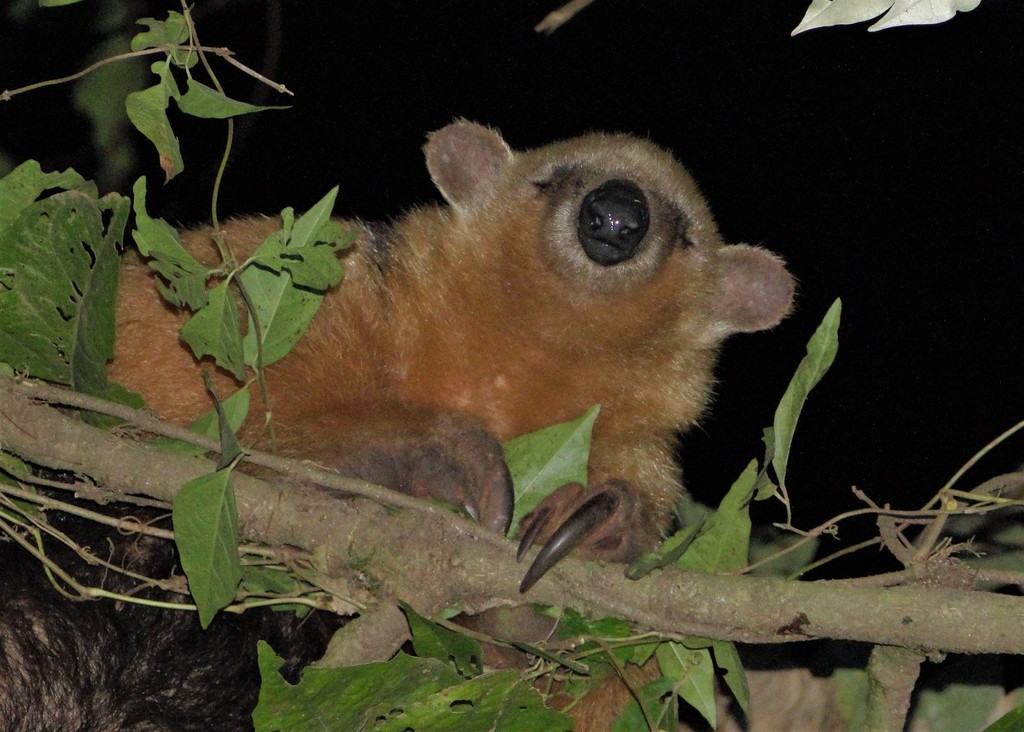
Southern Tamandua
Photo © Carlos Otávio Gussoni
Photo © Carlos Otávio Gussoni — CC BY 4.0 — Source: iNaturalist photo #59798029Identification
The southern tamandua is a medium-sized anteater with considerable size variation across its range. Head and body length ranges from 34 to 88 cm, with a distinctive prehensile tail measuring 37 to 67 cm long. Adults typically weigh between 1.5 and 8.4 kg, with no significant difference between males and females. The animal's most striking features include a long, curved snout with a mouth opening only as wide as a stick's diameter, four sharp claws on the forefeet and five on the hind feet, and slightly longer ears (averaging 5 cm) than its northern relative. The tail's underside and tip are hairless, aiding in climbing and gripping branches.
Coloration varies dramatically by geographic location. Animals from the southeastern part of the range display distinctive black markings from shoulder to rump that widen near the shoulders and encircle the forelimbs, with the remaining body blonde, tan, or brown. Northern populations from Brazil and Venezuela west of the Andes are typically solid blonde, brown, or black with only light markings. Trinidadian individuals are almost always solid blonde. Young anteaters at birth show highly variable coats ranging from white to black.
Range & Habitat
The southern tamandua inhabits Trinidad and ranges throughout South America from Venezuela to northern Argentina, southern Brazil, and Uruguay, occurring at elevations up to 1,600 meters. Four recognized subspecies occupy different regions: animals from southern and eastern Brazil and Uruguay, northern Brazil through Trinidad and the Guianas, Peru and Ecuador, and southern Brazil through Argentina respectively. This species adapts to remarkably diverse habitats, thriving in both wet and dry forests, tropical rainforests, savannas, and thorn scrub environments. The animals show a preference for habitats near streams and rivers, particularly those thick with vines and epiphytes, likely because their insect prey concentrate in these areas.
Behaviour & Diet
Southern tamanduas are primarily nocturnal but occasionally active during daylight hours. They are solitary animals occupying home ranges averaging 100 to 375 hectares depending on local environmental conditions. These anteaters spend a substantial portion of their time foraging arboreally—studies in Venezuelan habitats showed they spend between 13 and 64 percent of their time in trees. When threatened in trees, they grasp branches with their hind feet and tail, leaving their powerful forearms and curved claws free for defense. On the ground, they back against rocks or trees to protect themselves. Despite their climbing prowess, southern tamanduas are clumsy terrestrial walkers, incapable of the galloping speed achieved by giant anteaters. They communicate when aggravated through hissing and by releasing unpleasant scents from anal glands.
Southern tamanduas feed primarily on ants and termites in roughly equal proportions, though they may consume small quantities of fruit. They locate food by scent and prey on various species including army ants, carpenter ants, and Nasutitermes termites, while avoiding species with strong chemical defenses such as leafcutter ants. Their extremely long tongue, reaching up to 40 centimeters, combined with powerful forelimbs, enables them to breach insect nests and extract prey. Water requirements are met entirely through their food. Small eyes and poor vision contrast with large, upright ears, indicating that hearing is their primary sense.
Best Time & Places to See It
As primarily nocturnal animals, southern tamanduas are best observed during night hours. Their preference for habitats near streams and rivers thick with vines and epiphytes makes these riparian areas prime locations for encounters. Visitors should focus on protected forest areas throughout their extensive South American range and Trinidad, where habitat disturbance is minimized. Early morning and evening hours may also yield occasional daytime sightings, though patience and stealth are essential given their solitary nature and the vast home ranges they occupy.
Photography Tips
Photographing southern tamanduas requires nighttime equipment and techniques, as these are primarily nocturnal creatures. A headlamp or red-light torch will minimize disturbance while allowing observation and photography. The animal's distinctive coloration patterns—particularly the shoulder-to-rump black markings in southeastern populations—make for striking subjects. Focus on capturing details of the powerful forearms, curved claws, and distinctive long snout. Forest and riparian habitats near streams provide natural, habitat-appropriate backgrounds. Patience is essential; these solitary animals cover large territories, making encounters unpredictable. Early mornings may offer occasional opportunities for daytime photography in heavily canopied areas where the animals sometimes forage despite their nocturnal preference.
Yasuní National Park
Aguarico, Ecuador
+601 birds+43 mammals
Where the western Amazon basin converges with Ecuador's Orellana Province, lowland rainforest reaches toward the horizon in an unbroken canopy of staggering botanical density. Yasuní National…
VIEW NATIONAL PARKViruá National Park
Brazil
+389 birds+6 mammals
Across the northern frontier of Roraima, where the forest canopy rises from ancient Amazonian lowlands, Viruá National Park protects nearly 3,700 square kilometres of terra firme…
VIEW NATIONAL PARKPantanal Matogrossense National Park
Brazil
+322 birds+17 mammals
Where the flooded forests of central Brazil meet vast seasonally inundated grasslands, Pantanal Matogrossense National Park sprawls across nearly 2,900 square kilometers of one of the…
VIEW NATIONAL PARKNo community photos yet. Log in to add the first one.
No community observations of this species yet.