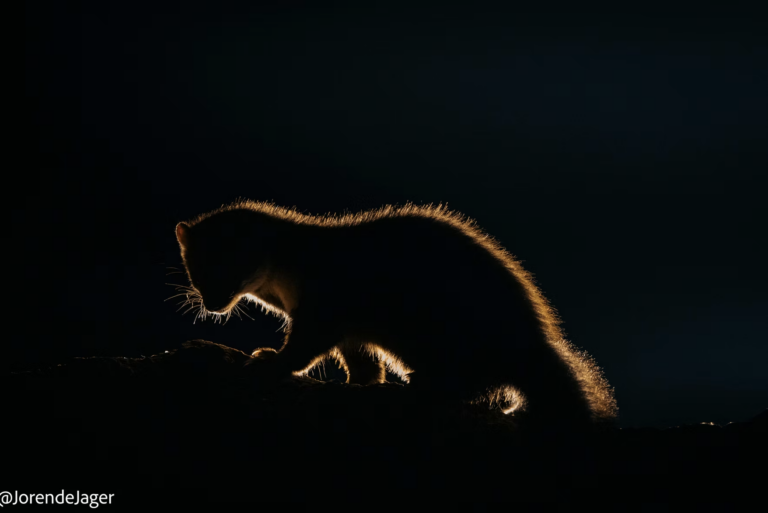
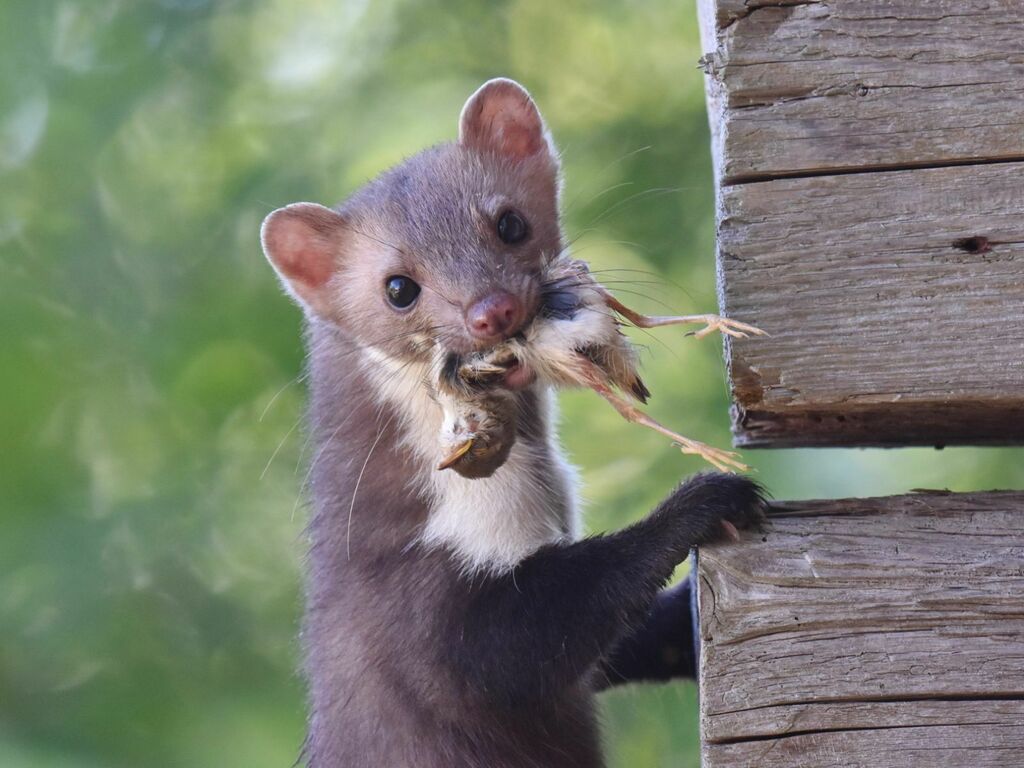
Stone Marten
Martes foina
Photo © Лариса Артемьева
Photo © Лариса Артемьева — CC0 1.0 — Source: iNaturalist photo #398534794ABOUT
Subspecies of Stone Marten
European Stone MartenCrimean Stone MartenSyrian Stone MartenCaucasian Stone MartenCentral Asian Stone MartenLhasa Stone MartenTibetan Stone Marten
Identification
The stone marten is a small, slender mustelid superficially similar to the European pine marten but distinctly smaller and more adaptable. Males measure 430–590 mm in body length and weigh 1.7–2.1 kg depending on season, while females are noticeably smaller at 380–470 mm and 1.1–1.5 kg. The most distinctive field mark is the white throat patch, which is always present and typically large, often with two projections extending backward to the base of the forelegs. This contrasts sharply with the darker belly.
Several features help distinguish it from the pine marten. The stone marten has a more elongated and angular head, shorter and more rounded ears, and a characteristic light peach or grey nose rather than the pine marten's dark coloring. Its fur is coarser with a lighter overall tone, and its paw pads remain visible even in winter due to less dense foot fur. The tail is notably long (250–320 mm in males) and dark brown, and the animal moves with a distinctive creeping, polecat-like gait rather than the bounding motion of its pine marten cousin.
Range & Habitat
The stone marten is native to much of Europe and Central Asia, with a feral population established in North America. Unlike the forest-specialist pine marten, the stone marten is a generalist species that occupies diverse open and forested habitats, making it considerably more adaptable to human-modified landscapes. Its evolutionary origins trace to the Near East or southwestern Asia, from which it likely arrived in Europe by the Late Pleistocene or early Holocene.
As of 2005, eleven subspecies are recognized across its range. The species is listed as Least Concern on the IUCN Red List, reflecting its wide distribution, large population, and presence in numerous protected areas. Notably, it avoids snowy regions due to the high loading pressure on its feet (double that of the pine marten), making it obliged to retreat from areas with heavy, persistent snow cover.
Behaviour & Diet
The stone marten is predominantly crepuscular and nocturnal, showing particular activity during moonlit nights. Being more terrestrial than the pine marten, it typically hunts on the ground rather than in trees, though it remains a skilled climber in heavily forested areas and is also an accomplished swimmer. During heavy snowfalls, it navigates using paths created by hares or skis. It may become active during daytime in summer months when nights are short.
In relatively unmodified habitats such as northeastern Spain, individual stone martens maintain home ranges of substantial size, with activity peaks occurring between 6 PM and midnight, and relative inactivity between 9 AM and 6 PM. The animal does not dig its own burrows but instead nests in naturally occurring rock fissures, spaces between stones, or human structures—particularly buildings in urban areas during winter. It may also occupy tree holes at heights up to 9 metres.
Best Time & Places to See It
Stone martens are best observed during their peak activity hours between dusk and midnight, particularly on moonlit nights. They are more likely to be encountered in open and semi-open habitats rather than dense forests, and they adapt readily to human-modified landscapes including villages and towns. In urban and periurban areas, they are more frequently observed than their forest-dwelling pine marten relatives, making towns and villages in their European range promising locations for encounters.
Summer months offer increased opportunities for daytime observations when nights are short and the animals may be active during daylight hours. Observers should focus their attention on ground-level activity rather than looking upward, as stone martens are primarily terrestrial hunters despite their climbing abilities.
Photography Tips
Successful photography requires patience and attention to timing, as stone martens are most active between dusk and midnight. Moonlit nights provide excellent natural lighting for nocturnal observation and photography. Position yourself near likely denning sites—stone structures, building eaves, or rock crevices—as the animal's distinctive white throat patch and angular head profile make for compelling subjects when well-lit.
The species' ground-based hunting behavior and creeping, polecat-like gait offer distinctive photographic opportunities that differ from more arboreal mustelids. Urban and periurban settings, where stone martens are more habituated to human presence, may offer closer approach distances than wild populations. Capture the characteristic light peach or grey nose and the contrast between the white throat patch and darker body coloration for identifiable and visually striking images.
HIDES
EXPERIENCES
Sort by
Photography WorkshopEasy
Pedro Marín – Instante Natural
Bearded Vulture photography workshop at Buseu
13–16 Nov 2026 and 1 more date
3 full days
6
ES
Golden Eagle · Bearded Vulture +10
735 €/ person
Book nowNothing matches these filters.
STAYS
Sort by
Nothing matches these filters.
HOTSPOTS
Country
Type
Sort by
National Park
Abruzzo, Lazio and Molise National Park
Pescasseroli·Italy
+139 birds+18 mammals
Natural Park
Aigüamolls L’Empordà Natural Park
Empuriabrava·Spain
+326 birds+23 mammals
Natural Park
Alpilles Regional Nature Park
Saint-Rémy-de-Provence·France
+219 birds+37 mammals
Natural Park
Avesnois Regional Nature Park
Saint-Hilaire-sur-Helpe·France
+206 birds+40 mammals
Natural Park
Baronnies Provençales Regional Nature Park
Sahune·France
+135 birds+30 mammals
National Park
Bavarian Forest National Park
Germany
+127 birds+18 mammals
National Park
Biebrza National Park
Goniądz·Poland
+242 birds+33 mammals
Natural Park
Boucles de la Seine Normande Regional Nature Park
Notre-Dame-de-Bliquetuit·France
+151 birds+31 mammals
Natural Park
Cadí Moixeró Natural Park
Bor·Spain
+172 birds+21 mammals
Nothing matches these filters.
COMMUNITY
Share your photo of this species
Sort by
No community photos yet. Log in to add the first one.
0
Observed by
0
Hotspots reported
0
Countries
No community observations of this species yet.