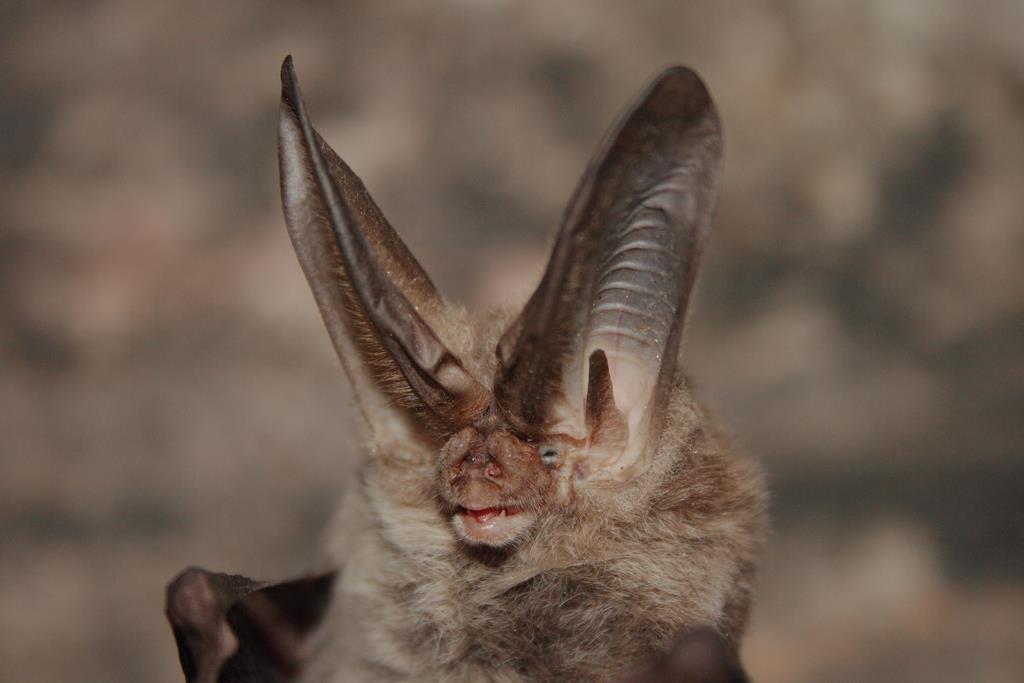
Townsend’s Big-eared Bat
Photo © Juan Cruzado Cortés
Photo © Juan Cruzado Cortés — CC BY-SA 4.0 — Source: iNaturalist photo #433408Identification
Townsend's big-eared bat is a medium-sized bat weighing 7–12 grams, with a total length around 10 centimeters and wingspan of approximately 28 centimeters. Its most distinctive feature is a pair of extremely long, flexible ears that dominate its appearance. The bat also displays small yet noticeable lumps on each side of its snout, another identifying characteristic that sets it apart from similar species.
Range & Habitat
This species is found throughout much of North America, ranging from southern British Columbia down the Pacific Coast and into the Great Plains, as well as Central Mexico. The species also maintains two isolated populations in central and eastern parts of the United States. A notable population inhabits Santa Cruz Island in the Channel Islands, California, where it was originally described and remains the only known colony in the Channel Islands; this colony currently resides in the Scorpion adobe building.
Townsend's big-eared bats require large cavities for roosting, including abandoned buildings and mines, caves, and basal cavities of trees. During summer, they inhabit rocky crevices, caves, and derelict structures. In winter, they hibernate in rocky crevices, caves, tunnels, mineshafts, spaces under loose tree bark, hollow trees, and buildings.
Behaviour & Diet
This species is a specialized moth hunter, feeding almost exclusively on Lepidoptera, though its diet may also include small flies, lacewings, dung beetles, sawflies, and other small insects. As a "whisper bat," it echolocates at much lower intensities than other bat species, making it difficult to detect with standard bat detectors. This quiet echolocation may be an adaptation to hunting moths, many of which can hear bat calls and employ defensive countermeasures. The bats exhibit 2–3 feeding periods between dark and dawn, interspersed with rest periods in locations separate from their daytime roosts.
Mating occurs in late fall, with females storing sperm through winter and fertilization happening in spring. A gestation period of 50–60 days produces a single pup per female. During summer, males and females roost separately; males typically remain solitary while females form maternity colonies ranging from 12 to 200 individuals (though colonies exceeding 1,000 have been recorded in the eastern United States). In winter, these bats hibernate singly or in small clusters, frequently waking to move within or between caves. One study recorded an average lifespan of 16 years.
Best Time & Places to See It
Summer is the best season to observe Townsend's big-eared bats, particularly in areas with suitable roosting habitats such as caves, abandoned mines, and old buildings. The species is most active during warm months when females gather in maternity colonies. The Santa Cruz Island population offers a notable opportunity for viewing, though access to the island may be restricted. Look for these bats emerging at dusk from their roosting sites near rocky terrain or abandoned structures.
Photography Tips
The bat's distinctive long ears and facial lumps make it visually striking when photographed, but capturing clear images requires patience and specialized equipment. Since these bats use quiet echolocation and are difficult to detect with standard bat detectors, locating them may require knowledge of local roosting sites. Photograph them during emergence times at dusk using high-speed flash or infrared equipment. Their slow, maneuverable flight—reaching speeds of only 2.9 to 5.5 meters per second—makes them easier to photograph in flight compared to faster-flying bat species, particularly when they hover near insects.
Gulf Islands National Park Reserve
Southern Gulf Islands Electoral Area, Canada
+268 birds+26 mammals
Scattered across the Salish Sea in British Columbia's southwestern corner, this national park reserve stitches together a fragmented archipelago of forested islands and rocky outcrops where…
VIEW NATIONAL PARKBig Bend National Park
Brewster County, United States
+345 birds+34 mammals
Where the Chisos Mountains rise abruptly from the Sonoran Desert floor, Big Bend National Park spans over 7,300 square kilometers of one of North America's most…
VIEW NATIONAL PARKSaguaro National Park
Rincon Valley, United States
+354 birds+40 mammals
Where the Sonoran Desert meets sky-island mountains, two geographically separated districts of Saguaro National Park sprawl across nearly two thousand square kilometers of Arizona's most iconic…
VIEW NATIONAL PARKJoshua Tree National Park
Riverside County, United States
+221 birds+23 mammals
Across 5,610 square kilometers of Riverside County's high desert, a landscape of geological drama unfolds where granite monoliths pierce through bajadas of creosote scrub and Joshua…
VIEW NATIONAL PARKGreat Basin National Park
White Pine County, United States
+170 birds+19 mammals
Where the Great Basin's high desert plateaus rise above 10,000 feet, ancient bristlecone pines endure on moonscape ridges of limestone and quartzite, creating one of North…
VIEW NATIONAL PARKMount Rainier National Park
Pierce County, United States
+187 birds+25 mammals
A volcanic colossus dominates the Cascade Range in western Washington, its 4,392-meter summit crowned year-round with glacial ice that cascades down toward temperate rainforest and subalpine…
VIEW NATIONAL PARKRedwood National Park
Humboldt County, United States
+343 birds+43 mammals
Where the Pacific fog rolls deep into northern California's coastal valleys, some of the tallest trees on Earth rise from a landscape shaped by tectonic forces…
VIEW NATIONAL PARKDeath Valley National Park
Inyo County, United States
+339 birds+25 mammals
Across nearly 3.5 million acres of southeastern California's Inyo County, vast salt flats meet sculpted badlands and alluvial fans in a landscape so extreme it defines…
VIEW NATIONAL PARKGrand Canyon National Park
United States
+277 birds+35 mammals
A mile-deep chasm of rust-red rock and purple shadow cuts through the high desert plateau of northern Arizona, revealing nearly two billion years of geological history…
VIEW NATIONAL PARKPetrified Forest National Park
Apache County, United States
+206 birds+23 mammals
Across the high desert plateau of northeastern Arizona, where the climate swings between scorching summer days and frost-laden winters, badlands of raw earth and timber-turned-to-stone dominate…
VIEW NATIONAL PARKWichita Mountains National Wildlife Refuge
Medicine Park, United States
+256 birds+17 mammals
Granite peaks rise abruptly from rolling prairie in southwestern Oklahoma, where the Wichita Mountains National Wildlife Refuge protects a rare collision of ecosystems. This sanctuary encompasses…
VIEW WILDLIFE SANCTUARYNo community photos yet. Log in to add the first one.
No community observations of this species yet.