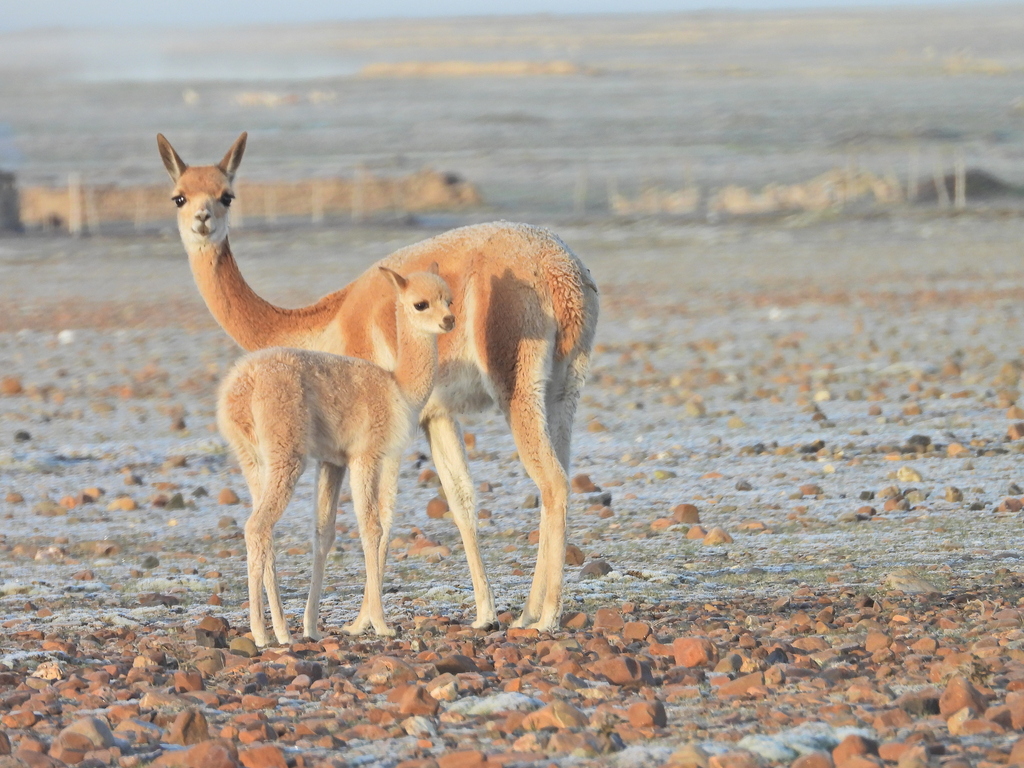
Vicuña
Photo © Humber Alberto
Photo © Humber Alberto — CC BY 4.0 — Source: iNaturalist photo #260856321Identification
The vicuña is one of South America's two wild camelids and the smaller, more delicate relative of the guanaco. Its body length ranges from 1.45 to 1.60 metres (about 5 feet), with a shoulder height of 75 to 85 centimetres (around 3 feet) and weight of 35 to 65 kilograms (under 150 pounds). The animal's most distinctive feature is its luxurious woolly coat: tawny brown on the back, with striking white hair on the throat and chest that is notably long and fluffy. The vicuña's head is slightly shorter than a guanaco's, while its ears are proportionally longer, giving it a characteristically alert appearance.
Range & Habitat
Vicuñas are restricted to the central Andes of South America, found in Peru, northwestern Argentina, Bolivia, northern Chile, and a smaller introduced population in central Ecuador. They inhabit extreme alpine elevations between 3,200 and 4,800 metres (10,500–15,700 feet), where they feed on nutrient-poor, tough bunch grasses and Festuca during daylight hours on the grassy plains, then retreat to the slopes at night. The environment is harsh: thin atmosphere allows intense daytime sun and relatively warm temperatures, but temperatures plummet to freezing each night. The vicuña's thick, soft coat is a remarkable evolutionary adaptation, trapping warm air close to the body to enable survival in these extreme conditions. Pumas, culpeos, and domestic dogs are the animal's chief predators.
Behaviour & Diet
Vicuñas are timid, easily startled animals with extraordinary hearing. They live in family-based groups typically consisting of one male, 5 to 15 females, and their young, each group defending a territory of about 18 square kilometres—a size that fluctuates with food availability. These are remarkably clean animals, always depositing excrement in designated locations. Their diet consists mainly of low grasses growing in ground-level clumps. Vicuñas frequently lick calcareous stones and salt water to obtain essential minerals.
Mating occurs in March and April, followed by an 11-month gestation period. Females give birth to a single fawn, which nurses for approximately ten months and becomes independent at 12 to 18 months old. Young males form bachelor groups while young females seek out sororities to join, a behaviour that prevents inbreeding and reduces competition among family members.
Best Time & Places to See It
The vicuña's recovery from near extinction offers genuine opportunities for wildlife travellers. Protected populations can be observed in Peru, Bolivia, Argentina, and Chile across the high Andes. The Pampa Galeras–Barbara D'Achille conservatory in Lucanas Province, Ayacucho, Peru, represents a landmark conservation site where vicuñas have been protected since the 1960s and may be encountered. Daytime hours on the grassy plains offer the best viewing opportunities, as vicuñas feed during daylight before retreating to slopes at nightfall.
Photography Tips
Photograph vicuñas during daylight hours when they are actively feeding on the open grassy plains—the high-altitude landscape provides dramatic natural backdrops. Remember that vicuñas are timid animals with acute hearing and are easily alarmed by intruders, so patience and distance are essential. Use a telephoto lens to capture detail without disturbing these animals. The contrast between the tawny-brown back and white chest and throat creates striking compositional opportunities, especially in the clear, intense light of the high Andes where thin atmosphere provides exceptional visibility and colour saturation.
Antisana National Park
Quijos, Ecuador
+432 birds+21 mammals
Where the eastern Andean slopes descend into the Amazon basin, Antisana National Park sprawls across roughly 2,500 square kilometers of some of South America's most dramatic…
VIEW NATIONAL PARKCotopaxi National Park
Mulaló, Ecuador
+211 birds+6 mammals
High in Ecuador's volcanic corridor, where the páramo transitions into cloud forest along the slopes of Cotopaxi volcano, the national park unfolds across nearly 500 square…
VIEW NATIONAL PARKHuascarán National Park
Independencia, Peru
+201 birds+5 mammals
Where granite peaks pierce the Andean sky above 6,000 metres, Huascarán National Park sprawls across more than 11,500 square kilometres of Peru's Cordillera Blanca, a landscape…
VIEW NATIONAL PARKSalar del Huasco National Park
Pica, Chile
+75 birds+2 mammals
High above the Atacama's shimmering flats, where the Andes grip the sky, lies a landscape of stark geological drama and surprising biological richness. Salar del Huasco…
VIEW NATIONAL PARKLauca National Park
Putre, Chile
+139 birds+17 mammals
Where the Andes rise toward the altiplano in Chile's far north, Lauca National Park sprawls across more than 3,000 square kilometres of some of South America's…
VIEW NATIONAL PARKReserva Nacional las Vicuñas
Putre, Chile
+87 birds+6 mammals
High desert plateaus interlace with volcanic ridges across this 4,204-square-kilometre expanse at the border between Chile and Bolivia, where altitudes exceed 3,500 metres and the climate…
VIEW NATIONAL PARKLos Cardones National Park
Argentina
+193 birds+6 mammals
Where the Andes descend into northwestern Argentina, Los Cardones National Park sprawls across nearly 1,200 square kilometres of one of South America's most distinctive high-altitude desert…
VIEW NATIONAL PARKNo community photos yet. Log in to add the first one.
No community observations of this species yet.