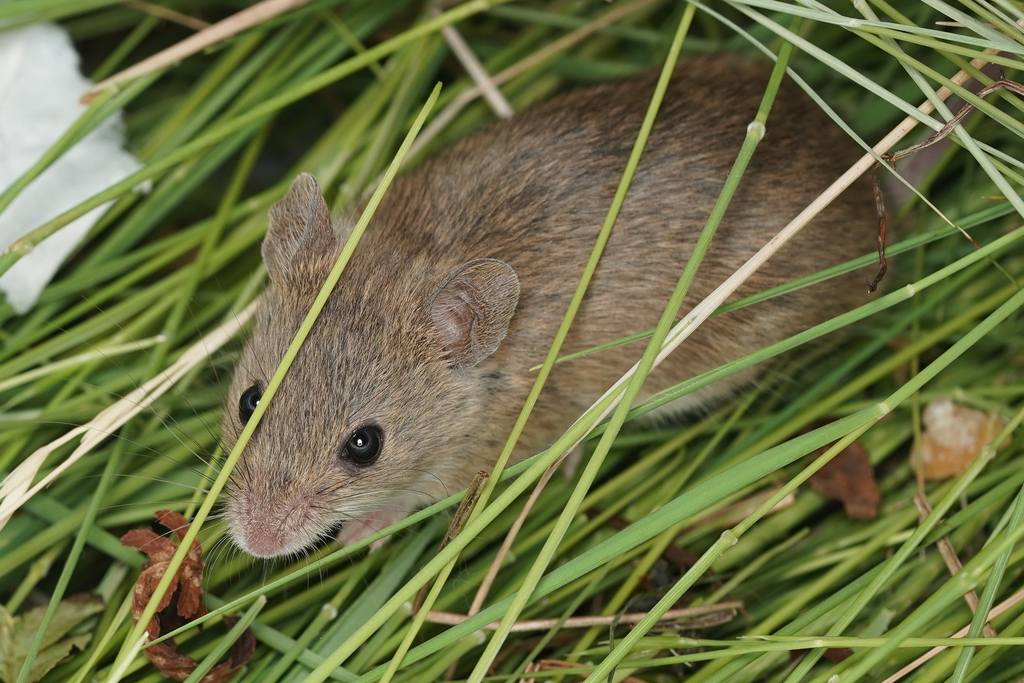
Western Mediterranean Mouse
Photo © Dr. Sven Gippner
Photo © Dr. Sven Gippner — CC BY 4.0 — Source: iNaturalist photo #386568689Identification
The Western Mediterranean Mouse closely resembles the house mouse but is most easily distinguished by its noticeably shorter tail. Adults display brownish fur across the back and sides, with distinctive white or buff-colored underparts. Head-body length ranges from 7.9 to 9.3 cm, with a tail measuring 5.9 to 7.3 cm and a body weight of 15 to 19 grams, making it a compact small rodent.
Range & Habitat
This species inhabits the southwestern Mediterranean region, occurring throughout mainland Portugal, most of Spain, southeastern France (around Toulouse and up the Rhone valley to Valence), and the Balearic Islands. In North Africa, it is found across the Maghreb in Morocco, Algeria, Tunisia, western Libya, and a small coastal population in eastern Libya, always north of the Sahara Desert. The Western Mediterranean Mouse prefers open terrain, typically found in temperate grasslands, arable land, rural gardens, and open scrub where tall grasses and shrubs provide cover while maintaining open ground for foraging. It avoids dense forests and, despite being fully wild and wary of humans, may occasionally shelter in abandoned buildings.
Behaviour & Diet
Primarily nocturnal, this species is an opportunistic omnivore feeding on grass seeds, fruit, and insects. Remarkably efficient with water, it requires only two-thirds the volume needed by house mice. Unlike the more aggressive house mouse, the Western Mediterranean Mouse establishes dominance through ritual behavior rather than overt violence, though males do defend territories of approximately 340 square meters that overlap with female ranges but not other males. Daily movements average 27.8 to 112 meters depending on habitat, sex, age, and season. The species exhibits distinctive hygienic behavior, actively clearing feces from areas where they regularly feed and rest—a behavior notably absent in house mice.
Best Time & Places to See It
The Western Mediterranean Mouse is active year-round but most readily encountered during breeding peaks in April–May and August–September when populations are elevated. It is strictly nocturnal, requiring spotlight surveys or night-vision equipment for observation. Open grasslands, scrubland, and agricultural areas throughout its Mediterranean range offer the best opportunities, particularly in Portugal, Spain, and southern France. In Africa, the Maghreb regions provide suitable habitat. Sympatric with house mice, this species typically dominates drier habitats where competition is reduced.
Photography Tips
Photographing this cryptic nocturnal species demands patience and specialized equipment. Night-vision or thermal imaging technology is essential for capturing natural behavior without disturbing the animal. Set up in open grassland or scrub habitats during peak activity hours after dark. Use low-light-capable cameras and sensitive lenses; red-light headlamps minimize disturbance to subjects. Photograph the diagnostic short tail and contrasting underparts to distinguish it from house mice. Spring and late-summer breeding seasons offer opportunities to capture social behaviors, including pair bonding and territorial interactions.
Serra de Montsant Natural Park
La Morera de Montsant, Spain
+134 birds+15 mammals
Rugged limestone ridges and deeply incised gorges define the Serra de Montsant, a 10,000-hectare protected landscape that rises abruptly from the wine-growing plains of Tarragona in…
VIEW NATURAL PARKCap de Creus Natural Park
Roses, Spain
+245 birds+23 mammals
Where the Pyrenees tumble into the Mediterranean, Cap de Creus Nature Park unfolds across 300 square kilometres of one of northeastern Spain's most dramatic coastal wilderness…
VIEW NATURAL PARKCollserola Natural Park
Barcelona, Spain
+194 birds+20 mammals
Where Mediterranean scrubland rises steeply from Barcelona's urban edge, Collserola unfolds across 173 square kilometres of low mountains that form a crucial ecological buffer between city…
VIEW NATURAL PARKParc del Montnegre i el Corredor
Font-Montnegre, Spain
+148 birds+16 mammals
Where Mediterranean scrubland gives way to deciduous and coniferous woodland, the Parc Natural del Montnegre i el Corredor unfolds across nearly 478 square kilometres of northeastern…
VIEW NATURAL PARKCamargue Regional Nature Park
Saintes-Maries-de-la-Mer, France
+378 birds+48 mammals
Where the Rhône Delta sprawls into the Mediterranean, a landscape of stark and haunting beauty emerges—vast salt marshes punctuated by shallow lagoons, reed beds, and scrubland…
VIEW NATURAL PARKRegional Park of the Catalan Pyrenees
Olette, France
+244 birds+63 mammals
Where granite peaks thrust skyward above cloud-laden valleys, a wild tapestry of Mediterranean and alpine ecosystems interweaves across the Franco-Spanish frontier. These Pyrenean slopes harbour extraordinary…
VIEW NATURE RESERVEPort-Cros National Park
Hyères, France
+271 birds+29 mammals
Where Mediterranean granite islands rise from crystalline waters off the Provençal coast, Port-Cros National Park protects one of Europe's most intact marine and terrestrial ecosystems. The…
VIEW NATIONAL PARKNo community photos yet. Log in to add the first one.
No community observations of this species yet.