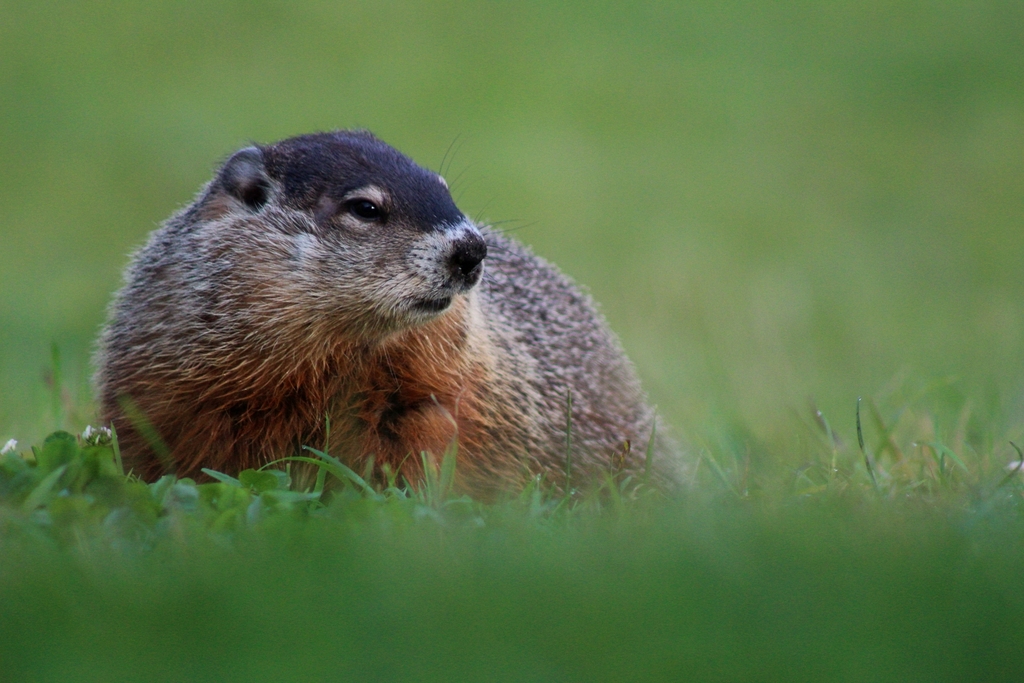
Woodchuck
Photo © Abby Ciona
Photo © Abby Ciona — CC BY 4.0 — Source: iNaturalist photo #305821474Identification
The woodchuck, also known as the groundhog, is the largest ground squirrel in its geographical range. Adults measure 41.8 to 68.5 cm in total length, including a relatively short tail of 9.5 to 18.7 cm—only about one-fourth of their body length. Adults typically weigh between 2 and 6.3 kg, with males averaging slightly larger than females. Woodchucks are powerfully built with short, sturdy legs and broad, long claws that are well-adapted for their prodigious digging abilities. A distinctive feature is their white to ivory-white incisors, which grow continuously at about 1.5 millimetres per week and are worn down at the same rate through constant use.
Range & Habitat
Woodchucks are found throughout much of the Eastern United States, across Canada and into Alaska, making them exceptional among marmots as a lowland creature. Unlike their cousins the yellow-bellied and hoary marmots, which inhabit rocky mountainous areas, woodchucks prefer open country and the edges of woodland. They are typically found in small woodlots, low-elevation forests, fields, pastures, and hedgerows, and are rarely seen far from a burrow entrance. Groundhogs construct their dens in well-drained soil and generally maintain both summer and winter burrows.
Behaviour & Diet
Woodchucks are among the most solitary of marmot species, though their social organization varies across populations. Some populations maintain long-term pair bonds year-round, while in others male-female interactions are limited to mating season. Groundhogs are highly intelligent animals capable of forming complex social networks and communicating threats through high-pitched whistles—earning them the nickname "whistle-pig." They are territorial and may skirmish with each other to establish dominance. Despite their heavy appearance, woodchucks are accomplished swimmers and capable climbers when escaping danger or surveying their surroundings.
When threatened, groundhogs prefer to retreat to their burrows, but will tenaciously defend themselves with their large incisors and front claws if cornered. Outside their burrows, they remain alert while feeding, often standing erect on their hind feet to watch for danger. They communicate through various vocalizations including high-pitched alarm whistles, squeals when fighting or caught, low barks, and teeth grinding. As an important habitat engineer, the woodchuck contributes significantly to maintaining healthy soil in woodlands and plains.
Best Time & Places to See It
Woodchucks are most active during daylight hours in open country and at the edges of woodlands. Look for them in fields, pastures, and meadows throughout their range in eastern North America. They are frequently observed standing upright on their hind legs, surveying their surroundings for potential threats. Spring through autumn offers the best viewing opportunities, as groundhogs undergo significant seasonal weight changes, becoming considerably heavier in autumn during their hyperphagia (intensive feeding period) in preparation for hibernation.
Photography Tips
Photograph woodchucks from a distance, as they may hide when they see, smell, or hear an observer. The classic upright posture—standing on hind legs to scan for danger—provides excellent photographic opportunities. Early morning or late afternoon light will showcase their stocky build and powerful claws to best effect. Patience is essential; remaining still and allowing the animal to resume normal behavior will yield more natural images than approaching directly. Look for burrow entrances in open grassland and fields, as groundhogs are rarely found far from these refuges.
Frontenac National Park
Sainte-Praxède, Canada
+178 birds+11 mammals
Where the Canadian Shield's ancient granite ridges meet coniferous forest and freshwater lakes, Frontenac National Park embraces a landscape carved by millennia of glacial movement. The…
VIEW NATIONAL PARKJasper National Park
Improvement District No. 12, Canada
+235 birds+34 mammals
Where the Canadian Rockies rise in dramatic succession across western Alberta, Jasper National Park spans over 11,000 square kilometres of subalpine and alpine terrain, glaciated valleys,…
VIEW NATIONAL PARKMont-Saint-Bruno National Park
Saint-Bruno-de-Montarville, Canada
+200 birds+13 mammals
Hardwood forests rise steeply from the suburbs of Montreal to crown a distinctive peak in the Monterégian Hills, their ancient geology pushing through mixed deciduous woodland…
VIEW NATIONAL PARKMauricie National Park
Shawinigan, Canada
+184 birds+12 mammals
Where the Canadian Shield meets boreal forest, Mauricie National Park unfolds across a landscape of granite ridges, crystalline lakes, and dense coniferous woodland that defines the…
VIEW NATIONAL PARKNew River Gorge National Park
Fayette County, United States
+183 birds+13 mammals
Where the New River carves its ancient path through the Appalachian plateau, a landscape of towering sandstone cliffs and dense deciduous forest creates one of the…
VIEW NATIONAL PARKMammoth Cave National Park
Edmonson County, United States
+179 birds+13 mammals
Beneath the rolling hills of central Kentucky lies one of North America's most extensive cave systems, where limestone passages descend through a landscape shaped by water…
VIEW NATIONAL PARKIndiana Dunes National Park
Porter, United States
+304 birds+15 mammals
Along the southern shore of Lake Michigan, where glacial geology meets temperate woodland and open water, sprawls a landscape of extraordinary ecological complexity. The dunes themselves—massive…
VIEW NATIONAL PARKGreat Smoky Mountains National Park
Sevier County, United States
+244 birds+40 mammals
Where the southern Appalachian ridgeline reaches its most densely forested expression, over 4,200 square kilometres of temperate woodland rise and fall across Tennessee and North Carolina,…
VIEW NATIONAL PARKGrands-Jardins National Park
Lac-Pikauba, Canada
+166 birds+10 mammals
Where the boreal forest transitions into the subalpine plateaus of Quebec's Laurentian highlands, Grands-Jardins National Park sprawls across nearly 690 square kilometers of wild terrain that…
VIEW NATIONAL PARKWood Buffalo National Park
Improvement District No. 24, Canada
+187 birds+10 mammals
Across nearly 75,000 square kilometres of boreal forest, wetland and grassland in northern Alberta, the landscape unfolds in a mosaic of spruce and pine woodland interspersed…
VIEW NATIONAL PARKFundy National Park of Canada
Alma Parish, Canada
+217 birds+24 mammals
Where the Bay of Fundy's tidal rhythms sculpt a landscape of dramatic cliffs, forested valleys, and boulder-strewn shorelines, Fundy National Park rises across approximately 345 square…
VIEW NATIONAL PARKMont-Tremblant National Park
Lac-des-Dix-Milles, Canada
+200 birds+12 mammals
Where the Laurentian plateau rises in central Quebec, a landscape of boreal forest and glacially carved lakes unfolds across nearly 3,100 square kilometres of protected wilderness.…
VIEW NATIONAL PARKÎles-De-Boucherville National Park
Boucherville, Canada
+243 birds+8 mammals
Where the Saint Lawrence River braids into a labyrinth of islands and channels, Îles-de-Boucherville National Park sprawls across approximately 18 square kilometres of riverine wilderness just…
VIEW NATIONAL PARKMont-Mégantic National Park
La Patrie, Canada
+136 birds+8 mammals
Granite peaks and boreal forest define the rugged terrain of this 115-square-kilometre national park in Quebec's Eastern Townships, where the landscape rises sharply above the surrounding…
VIEW NATIONAL PARKKouchibouguac National Park of Canada
Carleton Parish, Canada
+207 birds+14 mammals
Where the Maritime provinces meet the Atlantic, 591 square kilometres of coastal forest and wetland unfold across New Brunswick's eastern shoulder, a mosaic of boreal woodland,…
VIEW NATIONAL PARKAcadia National Park
Bar Harbor, United States
+291 birds+27 mammals
Where the Maine coast rises in granite cliffs and spruce-clad headlands, Acadia National Park unfolds across Mount Desert Island and its surrounding waters, a landscape carved…
VIEW NATIONAL PARKCuyahoga Valley National Park
Brecksville, United States
+255 birds+27 mammals
Where the Cuyahoga River carves through a glaciated landscape of Ohio, the valley reveals a temperate deciduous forest ecosystem shaped by four distinct seasons and reliable…
VIEW NATIONAL PARKHot Springs National Park
Hot Springs, United States
+168 birds+8 mammals
Thermal waters rising from deep within the Ouachita Mountains have carved a landscape unlike anywhere else in the continental United States, where 47 natural hot springs…
VIEW NATIONAL PARKShenandoah National Park
Page County, United States
+243 birds+31 mammals
Ridges of ancient quartzite rise above the Shenandoah Valley floor, their slopes dressed in a mosaic of oak and hickory forest that yields to cove hardwoods…
VIEW NATIONAL PARKBombay Hook National Wildlife Refuge
Kent County, United States
+323 birds+15 mammals
Tidal marshes and brackish shallows define this sanctuary on Delaware's Atlantic coast, where the meeting of freshwater and salt creates some of the Mid-Atlantic's most dynamic…
VIEW WILDLIFE SANCTUARYBlackwater National Wildlife Refuge
Fishing Creek, United States
+293 birds+15 mammals
Tidal marshes and brackish waterways define this wildlife sanctuary where the Chesapeake Bay's influence reshapes the landscape with every rise and fall of the water. Shallow…
VIEW WILDLIFE SANCTUARYNo community photos yet. Log in to add the first one.
No community observations of this species yet.