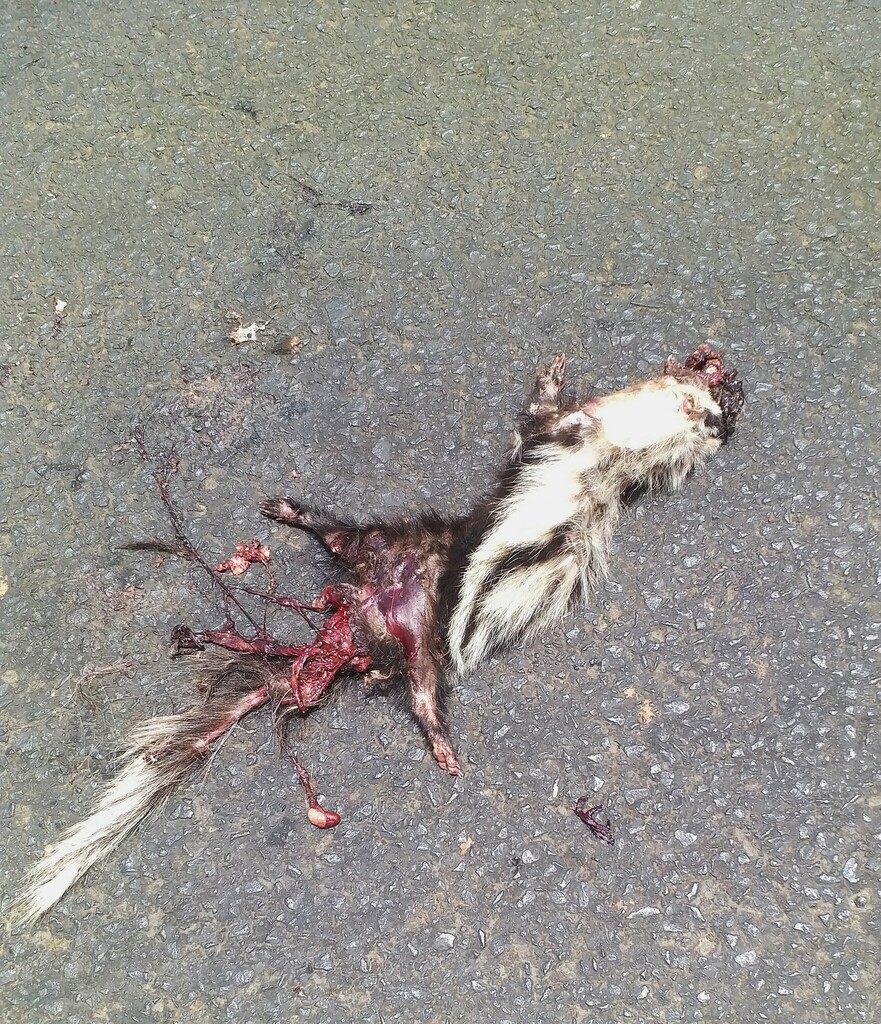
Zorilla
Photo © Lucy Keith-Diagne
Photo © Lucy Keith-Diagne — CC BY 4.0 — Source: iNaturalist #208276712Identification
The zorilla is a distinctive mustelid measuring 30–38 cm in body length, with males noticeably larger than females. Its most striking feature is its bold black fur contrasted with white stripes running down the back and white patches on the face and tail, though the exact patterning varies considerably between individuals. Despite superficial resemblance to skunks, the zorilla belongs to the family Mustelidae, with genetic analysis revealing its closest living relative to be the African striped weasel. Its forelimbs bear long, curved claws adapted for excavation and prey capture.
Range & Habitat
The zorilla is native to sub-Saharan Africa and is remarkably adaptable, inhabiting a wide range of habitats and elevations. It shows a preference for open environments with lower levels of shrub coverage. The species is common across most of its range, and while some localized population declines have been documented, it is not believed to face any major threats to its overall survival.
Behaviour & Diet
The zorilla is a nocturnal, mostly solitary predator that actively forages throughout the night and retreats to burrows or crevices during daylight hours. Its diet is primarily carnivorous, consisting mainly of insects, rodents and small reptiles, supplemented with birds, eggs, amphibians and other invertebrates. It uses its powerful claws to excavate burrows and dig for invertebrate prey in soil and dung.
Adult males are hostile towards one another, though family groups and breeding pairs do occur. Females tolerate males during breeding season and, following a 36-day gestation period, give birth to litters of two or three young. Communication occurs through various calls, behavioural cues and likely olfactory signals involving its odorous fluids. The zorilla possesses glands near its anus capable of spraying a nauseating, irritating defensive fluid. Its striking coloration serves as aposematism, warning predators of this spray; when threatened, the animal adopts a characteristic defensive stance with arched back and raised tail. Due to this formidable defence, the zorilla is rarely targeted by predators, making vehicular collision a more common cause of death.
Best Time & Places to See It
As a nocturnal species, the zorilla is most active during darkness, making night drives and spotlight surveys the best way to encounter it. Its preference for open habitats with lower shrub coverage makes it more likely to be spotted in such environments than in densely vegetated areas. Its common distribution across most of sub-Saharan Africa means it can potentially be found throughout this vast region, though sightings remain relatively infrequent due to its nocturnal habits.
Photography Tips
Photographing the zorilla requires nocturnal wildlife techniques, including night vision equipment, spotlight work or infrared camera traps. The animal's striking high-contrast markings—bold black fur with white stripes and facial patches—are visually dramatic and photograph well, particularly when the defensive posture with raised tail is displayed. Patient observers using spotlight surveys on open terrain during night drives offer the best opportunity to capture this elusive mustelid in its natural behaviour.
Addo Elephant National Park
Sundays River Valley Local Municipality, South Africa
+388 birds+55 mammals
Where the Eastern Cape's semi-arid scrublands meet transitional woodland, Addo sprawls across 13,478 square kilometres of one of southern Africa's most biodiverse landscapes. The terrain rises…
VIEW NATIONAL PARKNamibRand Nature Reserve
Hammerstein, Namibia
+107 birds+12 mammals
Where rust-coloured dunes surrender to sculpted granite outcrops and vast plains stretch toward an endless horizon, one of southern Africa's most pristine wilderness areas unfolds. The…
VIEW NATURE RESERVENo community photos yet. Log in to add the first one.
No community observations of this species yet.