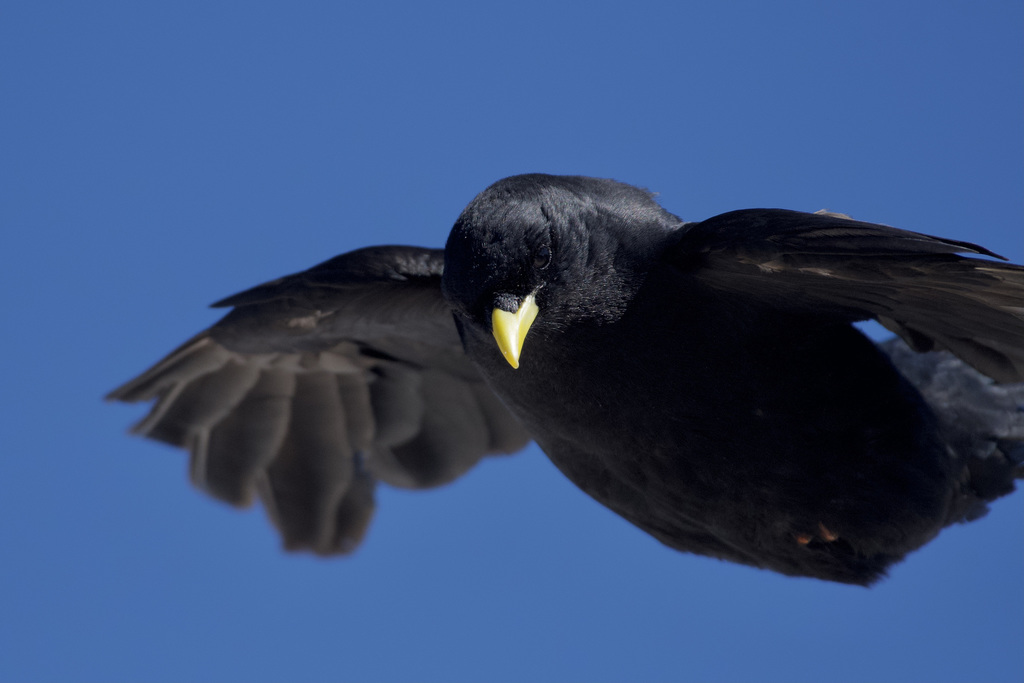
Alpine Chough
Photo © Dario Taraborelli
Photo © Dario Taraborelli — CC0 1.0 — Source: iNaturalist photo #147054046Identification
The Alpine chough is unmistakable in its mountain habitat. It displays glossy black plumage contrasted by a distinctive short yellow bill and striking red legs—features that immediately set it apart from related species. The bird measures 37–39 centimetres in length with a wingspan of 75–85 centimetres, making it slightly smaller than the red-billed chough but with a proportionally longer tail and shorter wings. Juveniles are duller, with a dull yellow bill and brownish legs that gradually mature to adult colouration.
The Alpine chough's distinctive calls—rippling "preep" sounds and whistled "sweeeooo" notes—differ markedly from the crow-like vocalisations of related species, making audio identification possible even at a distance. In flight, the bird demonstrates remarkable agility with its less rectangular wings and longer tail, easily distinguishing it from the red-billed chough. The two subspecies differ slightly, with the Asian P. g. digitatus being larger with stronger feet than the European nominate form.
Range & Habitat
The Alpine chough breeds across high mountain ranges from Spain through southern Europe and North Africa into Central Asia and the Himalayas, with populations recorded from the Alps, Corsica, Crete, and Morocco eastwards to western China and Nepal. This species is notably non-migratory, remaining resident throughout its range year-round. Remarkably, it may nest at a higher altitude than any other bird species, with its eggs displaying special adaptations to thin mountain atmosphere that improve oxygen uptake and reduce water loss.
Behaviour & Diet
Alpine choughs are highly social birds, typically feeding in flocks on short grazed grassland where they hunt mainly invertebrate prey during summer months and switch to fruit in winter. They pair for life and show strong fidelity to their breeding sites, typically nesting in caves or cliff crevices where they construct lined stick nests and lay three to five brown-blotched whitish eggs. The birds are notably bold around human activity, readily approaching tourist sites to supplement their natural diet with supplementary food sources.
Their flight is characterised by remarkable agility and buoyancy, achieved through swift, acrobatic movements with loose, deep wing beats. They exploit mountain air currents expertly, soaring in updraughts at cliff faces and utilising their fanned tails and folded wings to achieve exceptional manoeuvrability. Although subject to predation and parasitism, this abundant and widespread species maintains healthy populations across its range.
Best Time & Places to See It
Alpine choughs are year-round residents throughout their range, making them accessible to travellers visiting high mountain regions during any season. The species favours areas with short grazed grassland in high altitude zones, making them particularly visible in established trekking regions and mountainous national parks across the Alps, Pyrenees, and Himalayas. Their boldness around tourist sites means they are frequently encountered at high-altitude lodges, rest stops, and popular mountain hiking destinations where food scraps may be available.
Photography Tips
The Alpine chough's glossy black plumage, contrasting yellow bill, and red legs create striking photographic subjects, particularly in bright mountain light. Capture them in flight to showcase their distinctive silhouette and acrobatic abilities—their characteristic wing and tail positions are easier to photograph against clear mountain skies. The birds' tolerance of human proximity at mountain tourist sites provides excellent opportunities for close-range photography without requiring telephoto lenses, though a moderate telephoto will help isolate individuals in flock situations.
Early morning and late afternoon light typically provides the best conditions for revealing the glossy quality of their black plumage. When photographing at rest on grassland or at feeding sites, position yourself to backlight the yellow bill for maximum contrast. Capture their distinctive calls in action—their animated calling behaviour provides dynamic compositional opportunities as birds interact within their flocks.
Abruzzo, Lazio and Molise National Park
Alpilles Regional Nature Park
Altai Tavan Bogd National Park
Baima Snow Mountain National Nature Reserve
Baronnies Provençales Regional Nature Park
Belluno Dolomites National Park
Bosc de Virós
Cadí Moixeró Natural Park
Calanques National Park
Nothing matches these filters.
No community observations of this species yet.