Identification
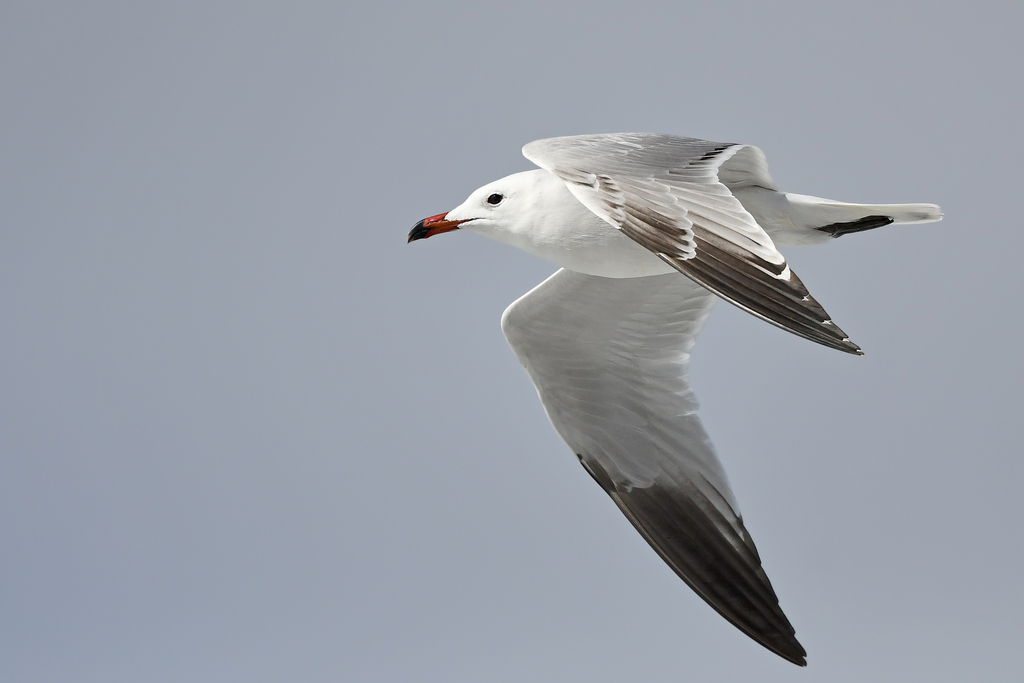
Audouin's gull is a large gull that superficially resembles a small European herring gull, but several distinctive features set it apart. The most striking characteristic is its short, stubby red bill, quite different from the heavier bills of related species. The wings display elegant "string of pearls" white primary tips rather than the large white "mirrors" seen on some other gulls. The legs are grey-green, adding to its refined appearance. Reaching adult plumage takes four years, so younger birds will show intermediate patterns during their development.
Range & Habitat
This gull is restricted to the Mediterranean Sea and the western coast of Saharan Africa and the Iberian Peninsula, making it a distinctly Old World species. It breeds colonially or solitarily on small islands, where pairs lay 2–3 eggs in ground nests. Audouin's gull shows little tendency to wander from its breeding areas, though rare vagrants have been recorded—single individuals reached the Netherlands and England in May 2003, and one remarkably spent several months from December 2016 to April 2017 in Trinidad, far from its typical range.
Behaviour & Diet
Unlike many large gulls, Audouin's gull is a specialist fish eater that rarely scavenges, making it strictly coastal and pelagic in its habits. This dietary specialization has shaped its behaviour: the bird feeds both during the day and at night, often hunting well out to sea. When feeding closer to shore, it slowly patrols beaches and employs a distinctive hunting technique, occasionally dangling its legs to increase drag and slow its pace—a behaviour that likely helps it spot and capture fish in shallow waters.
Best Time & Places to See It
Audouin's gull is best observed in its Mediterranean breeding grounds and along the Atlantic coasts of the Iberian Peninsula and western Saharan Africa. The bird's rarity and site fidelity mean that visiting known breeding colonies offers the most reliable viewing opportunities. Its specialist feeding behaviour means it is most likely to be found in coastal and offshore waters rather than inland sites, so boat-based birdwatching trips in Mediterranean regions provide excellent chances for encounters.
Photography Tips
The gull's distinctive red bill and elegant wing patterns are key photographic subjects—try to capture the characteristic "string of pearls" wing tips in flight shots, as this feature immediately separates it from similar gulls. The grey-green legs are also worth highlighting in close-up portraits. Given the species' pelagic habits and tendency to feed at distance from shore, a boat platform will greatly improve photography opportunities. Early morning or evening light can enhance the subtle grey and white tones of its plumage while bringing out the vivid red of its bill.