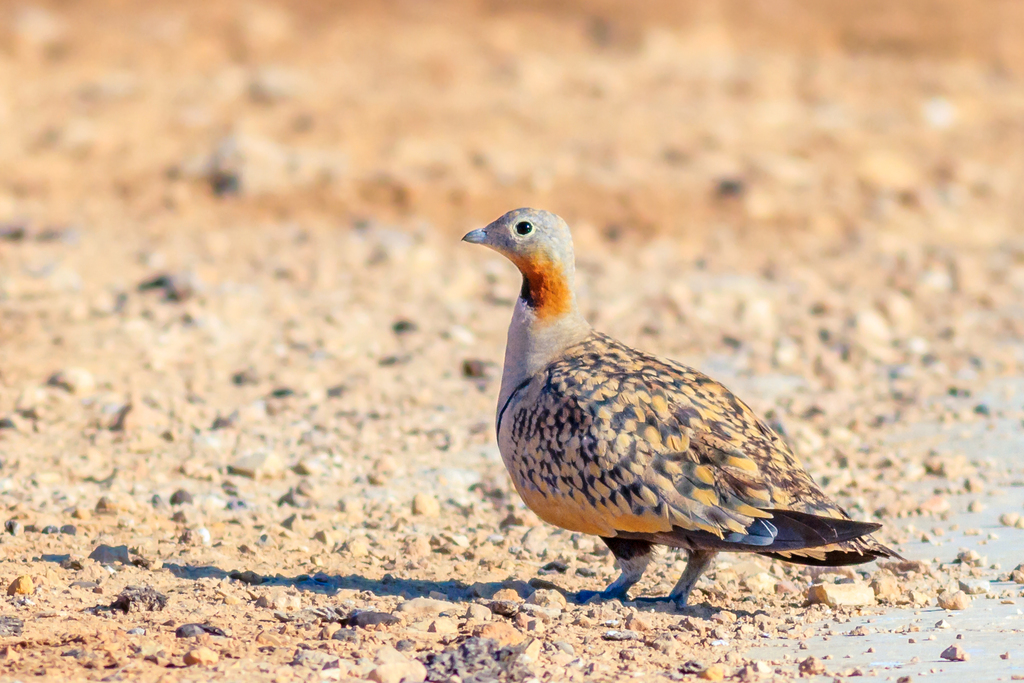
Black-bellied Sandgrouse
CC BY 4.0
CC BY 4.0 — Source: iNaturalist photo #371859041Identification
The black-bellied sandgrouse is a medium-large bird, measuring 33–39 cm in length and weighing 300–615 g, making it likely the largest species in the sandgrouse family. Males are distinctively marked with a grey head, neck, and breast, contrasting sharply with black underparts and golden-brown upperparts bearing darker markings. A chestnut throat patch and thin black border around the lower breast further distinguish males. Females are browner with more finely marked upper parts, but share the identical underparts and breast band pattern with males. The eastern race (arenarius) is noticeably paler and heavier than the western nominate race, with males displaying yellower upperparts and greyer underparts. Both sexes possess a small, pigeon-like head and neck set upon a stocky, compact body, with long pointed wings built for fast, direct flight.
In flight, this species is remarkably easy to identify by its distinctive white underwings contrasting with the black belly—a combination that makes it unmistakable even at distance. The call is a soft chowrrr rrrr-rrrr. Females are occasionally difficult to distinguish between subspecies, though eastern birds tend to be whiter below.
Range & Habitat
The black-bellied sandgrouse occupies two geographically distinct populations. The nominate western race (P. o. orientalis) breeds across the Iberian Peninsula, northwest Africa, the Canary Islands, Turkey, Iran, Cyprus, and Palestine. The eastern race (P. o. arenarius) ranges from Kazakhstan through western China to northern Pakistan. The eastern population is partially migratory, with birds from central Asia moving south to Pakistan and northern India during winter months.
This gregarious species favours dry open plains and similar arid habitats, though it differs from the pin-tailed sandgrouse in requiring at least some vegetation cover rather than completely barren terrain. Birds breed on these sparse, open landscapes where they nest in simple ground scrapes. Clutches typically comprise three greenish eggs with cryptic markings, with both sexes sharing incubation duties—though only males undertake the critical task of bringing water to the nest.
Behaviour & Diet
Black-bellied sandgrouse are highly gregarious birds that fly to watering holes at dawn in flocks, a behaviour critical for survival in their arid habitats. This water-dependency is particularly pronounced in the breeding male, who bears sole responsibility for transporting water to the nest and incubating chicks. The species' long pointed wings and compact body enable fast, direct flight suited to rapid journeys across open terrain.
Best Time & Places to See It
Observers seeking this species should focus on the arid plains of the Iberian Peninsula, north Africa, and the Mediterranean region for the western race. For the eastern population, Kazakhstan, western China, and northern Pakistan offer opportunities, with winter months bringing increased numbers to Pakistan and northern India as migratory birds arrive. Dawn visits to known watering holes offer the best chance of encountering flocks in their most active period.
Photography Tips
Dawn photography at watering holes is essential for capturing this species, as flocks arrive at first light. The striking white underwings and black belly are best photographed in flight, so positioning yourself with good sightlines and backlighting can showcase these diagnostic field marks brilliantly. The contrast between males' grey upperparts and black underparts, and females' browner plumage, offers rewarding compositional opportunities. Use fast shutter speeds to freeze the bird's rapid, direct flight, and remember that the cryptic golden-brown and grey tones of resting birds blend remarkably well with their sparse, open habitat.
Monfragüe National Park
Torrejón el Rubio, Spain
+219 birds+10 mammals
Where the Tagus River cuts through limestone plateaus in central Extremadura, Monfragüe National Park rises as a fortress of Mediterranean and Atlantic woodland, its dramatic rocky…
VIEW NATIONAL PARKTablas de Daimiel National Park
Daimiel, Spain
+246 birds+6 mammals
Where the Guadiana River spreads into a labyrinth of shallow lagoons and reed beds across the sun-baked plains of central Spain, Tablas de Daimiel National Park…
VIEW NATIONAL PARKCabo de Gata-Níjar Natural Park
San José, Spain
+274 birds+11 mammals
Where volcanic ridges plunge toward the Mediterranean, Cabo de Gata-Níjar Nature Park unfolds across one of Europe's most arid coastlines, a landscape sculpted by tectonic violence…
VIEW NATURAL PARKDirigida Laguna de Gallocanta Nature Reserve
Las Cuerlas, Spain
+250 birds+7 mammals
Where continental steppe meets the vast mirror of inland water, Spain's largest natural lagoon reveals a landscape of haunting beauty. The shallow alkaline lake, cradled in…
VIEW NATURE RESERVENo community photos yet. Log in to add the first one.
No community observations of this species yet.