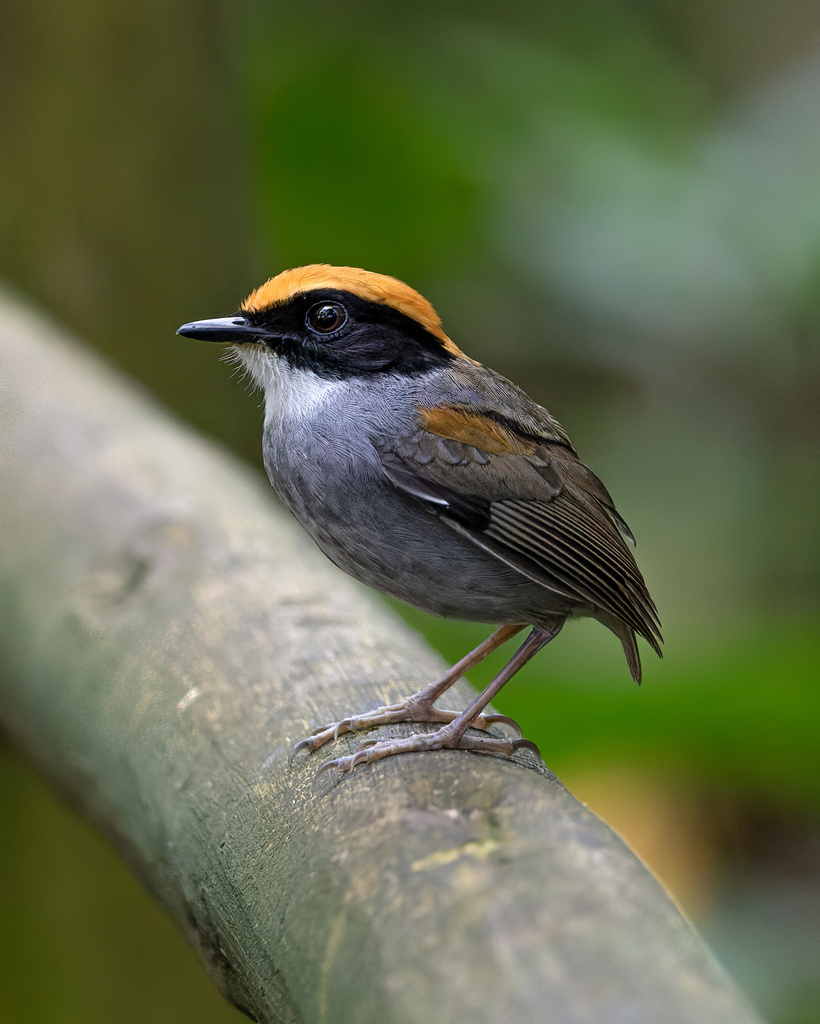
Black-cheeked Gnateater
Photo © Paulo Mascaretti
Photo © Paulo Mascaretti — CC0 1.0 — Source: iNaturalist photo #223774510Identification
The black-cheeked gnateater is a small, round bird measuring just 11.5 cm with a characteristically short tail. Sexual dimorphism is striking in this species. Males are unmistakable, displaying a bold orange crown that contrasts sharply with a jet-black face and cheeks, and a distinctive white throat. The upperparts are brownish, while the underparts are pale grey with a white belly and buff-coloured flanks. Females are considerably more subdued, appearing predominantly brown above with a white eyebrow stripe and a buff patch on the wings. Despite their colourful plumage in males, these birds can be surprisingly difficult to spot in the field due to their furtive behaviour.
Range & Habitat
Endemic to Brazil, the black-cheeked gnateater is found along the eastern coast from Paraíba south to Santa Catarina. The species inhabits subtropical and tropical moist lowland forests, where it stays close to the understory and forest floor. Unfortunately, the bird's range has become increasingly fragmented due to widespread habitat destruction across Brazil's Atlantic coastal regions, making populations patchier than they once were.
Behaviour & Diet
This is a monogamous and highly territorial species, with individual territories averaging 2.94 hectares. The black-cheeked gnateater breeds over a three-month period, constructing a distinctive platform-like nest positioned low on branches or palm leaves near the ground. Pairs typically lay a clutch of two eggs. True to the gnateater family name, the species forages for small arthropods and invertebrates gleaned from the forest floor and lower vegetation.
Best Time & Places to See It
Finding this species requires patience and knowledge of its preferred forest habitats. Look for the black-cheeked gnateater in protected lowland forests and reserves within its range in eastern Brazil, particularly in areas where understory vegetation remains intact. The bird's furtive nature means it is not often encountered despite its striking male plumage, so listening for its calls while walking slowly through suitable habitat offers the best chance of detection.
Photography Tips
Photographing this species presents challenges due to its skulking behaviour and preference for dense undergrowth. Use a telephoto lens to avoid disturbing birds on the forest floor. Early morning sessions when birds are more active offer the best opportunities. Males in breeding plumage provide spectacular photographic subjects with their contrasting orange, black, and white markings, while females require careful positioning to capture the subtle white eyebrow and buff wing patch that aid identification.
Carlos Botelho State Park
Intervales State Park
Itatiaia National Park
Saint-Hilaire/Lange National Park
Serra da Bocaina National Park
Serra do Itajaí National Park
Serra do Mar State Park
Serra dos Órgãos National Park
Superagui National Park
Nothing matches these filters.
No community photos yet. Log in to add the first one.
No community observations of this species yet.