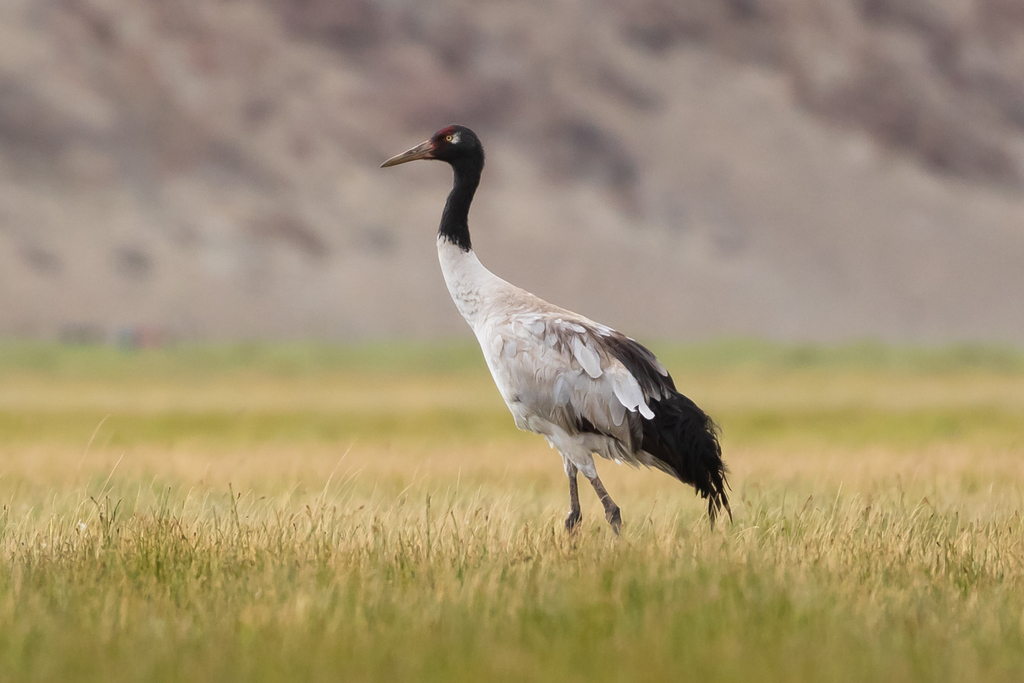
Black-necked Crane
Photo © Johannes S.
Photo © Johannes S. — CC BY 4.0 — Source: iNaturalist photo #713851574Identification
The black-necked crane is a medium-sized Asian crane measuring 139 cm in length with a 235 cm wingspan and weighing approximately 5.5 kg. Its plumage is predominantly whitish-gray, with distinctive markings that make it unmistakable in the field: a black head and upper neck, a dull red crown patch and lores, and a small white patch of feathers below and behind the eye. The tail and flight feathers are black, a useful field mark that distinguishes it from the similar-looking common crane, which has a gray tail. Both males and females are similar in appearance.
Range & Habitat
This species breeds on the high-altitude Tibetan Plateau, with smaller populations extending into the remote regions of Bhutan, India, and Vietnam. Breeding habitat consists of alpine meadows, lakeside and riverine marshes, river valleys, and cultivated barley and wheat fields at high elevation. The largest populations are found in China. In winter, birds move to sheltered valleys and lower altitudes. Some populations undertake seasonal movements, while vagrants have occasionally been recorded as far as Nepal.
Behaviour & Diet
Black-necked cranes are highly wary birds, though in some areas they have become accustomed to local people who do not disturb them—and remarkably, they appear to distinguish between people in traditional dress and others, being especially cautious of the latter. They produce loud trumpeting calls characteristic of cranes. These birds forage on the ground in small groups, with one individual acting as sentinel. They spend nearly 75% of the day foraging, with peak activity in early morning and late afternoon, walking considerable distances—several kilometers daily—between feeding spots. Their diet includes sedge tubers, plant roots, earthworms, insects, small vertebrates, frogs, and fallen grains of barley, oats, and buckwheat. They also dig up and consume potatoes, carrots, and turnips.
Best Time & Places to See It
Bhutan is among the most reliable destinations for observing black-necked cranes, where populations are well protected both legally and culturally, and an annual festival celebrates the species. Ladakh in India, where the crane is designated the state bird, also offers opportunities. The Phobjika valley in Bhutan and the high plateaus of Tibet represent important winter and breeding grounds respectively, though access to Tibetan areas may be limited. Winter months typically bring concentrations of birds to lower-altitude wintering grounds.
Photography Tips
The striking contrast between the whitish-gray body and black head and neck makes this crane highly photogenic. The black tail is a useful identifying feature to capture. Exercise patience and approach slowly and quietly, as these are wary birds. Early morning and late afternoon light during peak feeding times offers optimal conditions. Photographing birds with the sentinel individual in the frame can convey natural behaviour. In Bhutan, local guides familiar with crane behaviour and movements can greatly improve your chances of successful encounters and images.
Giant Panda National Park
Mianyang, China
+447 birds+47 mammals
Where the eastern slopes of China's Sichuan plateau descend into cloud-wrapped valleys, one of Asia's most biodiverse landscapes unfolds across more than 350,000 square kilometres. This…
VIEW NATIONAL PARKHuanglong Scenic and Historic Interest Area
Ngawa Tibetan and Qiang Autonomous Prefecture, China
+194 birds+7 mammals
Across the high plateau of northwestern Sichuan, a geological wonder unfolds where limestone terraces and mineral-rich springs have sculpted one of China's most distinctive natural monuments.…
VIEW NATURAL MONUMENTHemis National Park
Raigahar Dhar, India
+131 birds+13 mammals
Where granite gorges cleave through the Himalayas at dizzying altitudes, a vast wilderness of alpine desert unfolds across the rain shadow of Ladakh. Hemis sprawls across…
VIEW NATIONAL PARKGobi Gurvan Saikhan National Park
Tsagaan Subarga Hural, Mongolia
+183 birds+23 mammals
Where rust-coloured badlands rise from the southern Gobi steppe, the terrain transforms into a landscape of geological drama that few visitors expect to find in Mongolia's…
VIEW NATIONAL PARKSanjiangyuan National Park
Nagqu, China
+187 birds+25 mammals
Where the headwaters of three great Asian rivers emerge from a high alpine plateau, the landscape unfolds in tundra and dwarf shrubland—a world of austere beauty…
VIEW NATIONAL PARKCaohai National Nature Reserve
Bijie, China
+93 birds
At roughly 1,900 metres elevation on Guizhou's high plateau, Caohai sprawls across a temperate landscape shaped by pronounced seasonal extremes. Winters here are dry and cool,…
VIEW NATURE RESERVEQiangtang National Nature Reserve
Ngari Prefecture, China
+34 birds+5 mammals
Across the high Tibetan plateau north of Nagqu sprawls one of Earth's most extreme alpine tundra ecosystems, where vast expanses of sparse grassland and barren terrain…
VIEW NATURE RESERVEAltun Mountain National Nature Reserve
Jiuquan, China
+32 birds
Where the Altun Mountains rise across the high desert basin of northwestern China, one encounters a landscape shaped by extremes—cold, aridity, and relentless altitude. Spanning over…
VIEW NATURE RESERVEQinghai Lake National Nature Reserve
Hainan Tibetan Autonomous Prefecture, China
+243 birds+11 mammals
At 3,200 metres above sea level on the Tibetan plateau, where winter temperatures plunge far below freezing and snow blankets the landscape for half the year,…
VIEW NATURE RESERVEBaima Snow Mountain National Nature Reserve
Diqing Tibetan Autonomous Prefecture, China
+204 birds+3 mammals
High-altitude ridges and steep-sided valleys define this reserve in northwestern Yunnan, where elevations surge from around 3,000 metres to peaks above 4,100 metres. The terrain supports…
VIEW NATURE RESERVENo community photos yet. Log in to add the first one.
No community observations of this species yet.