Identification
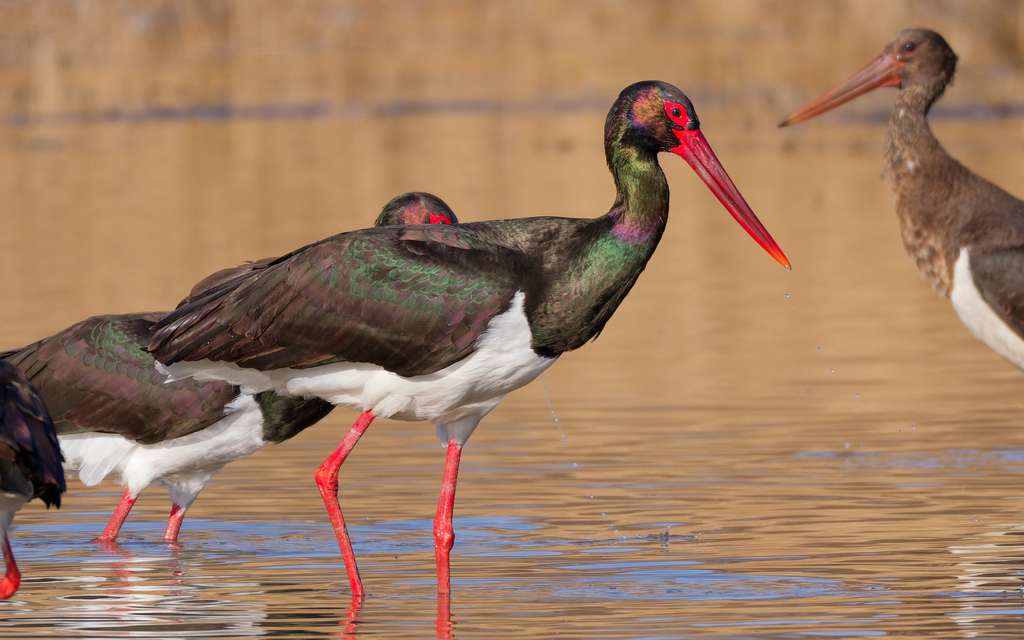
The black stork is a large and striking wading bird, measuring 95 to 100 cm in length with a wingspan of 145 to 155 cm. Its most distinctive features are its predominantly black plumage with a purplish-green sheen, contrasting sharply with white underparts including the lower breast, belly, and undertail coverts. Long red legs and a long, pointed red bill complete the unmistakable profile. Adults have bare red skin around brown eyes, and males are noticeably larger than females.
Juveniles are similar to adults but appear browner rather than glossy black, with pale-tipped feathers on the wings and tail coverts. Their legs, bill, and facial skin are greyish-green rather than red. In flight, like all storks, the black stork extends its neck fully, a characteristic posture that aids identification from distance.
Range & Habitat
The black stork breeds across a wide but scattered range spanning from eastern Asia through central and eastern Europe, with notable populations in the Iberian Peninsula, particularly in Portugal and Spain. Its breeding range extends from Siberia and northern China westward to Estonia, Germany, the Czech Republic, Hungary, Italy, and Greece. The species is a long-distance migrant; European populations winter in tropical Sub-Saharan Africa, while Asian populations migrate to the Indian subcontinent. During migration, these birds avoid crossing the Mediterranean Sea, instead detouring through the Levant, Sicily, or Gibraltar.
An isolated non-migratory population inhabits Southern Africa, where it is most numerous in the east, including eastern South Africa, Mozambique, Zimbabwe, Eswatini, and Botswana. The species favours marshy areas, rivers, and inland waters for feeding and roosting.
Behaviour & Diet
Unlike its more gregarious cousin the white stork, the black stork is notably shy and wary, typically seen singly or in pairs rather than in large flocks. It feeds primarily on amphibians, small fish, and insects, employing a patient hunting technique of wading slowly through shallow water while stalking prey. Breeding pairs construct large nests in forest trees—both deciduous and coniferous—which are often visible from considerable distances, or alternatively on large boulders and under cliff overhangs in mountainous terrain.
Females lay two to five greyish-white eggs, which become soiled during the extended incubation period of 32 to 38 days. Both parents share incubation duties and fledging takes 60 to 71 days. The breast feathers form a distinctive shaggy ruff used during courtship displays.
Best Time & Places to See It
Black storks are widespread but uncommon throughout their range, making them a challenging but rewarding species to locate. The Iberian Peninsula, particularly Spain and Portugal, offers some of the most reliable opportunities to encounter breeding birds. Central and eastern European populations in countries such as Poland, Hungary, and the Czech Republic are also accessible during the breeding season. For African sightings, the Southern African population in countries like South Africa, Mozambique, and Zimbabwe offers year-round viewing opportunities.
Look for them in spring and summer at marshes, riverine habitats, and wetlands. Due to their shy nature, patience and careful approach are essential. Early morning visits to suitable wetland habitats increase your chances of observation.
Photography Tips
The black stork's striking contrast between glossy black plumage and white underparts makes it visually dramatic, but its wariness demands careful stalking and the use of long lenses. Position yourself downwind and move slowly through wetland habitats, keeping low to avoid alarming birds. The red legs and bill provide vivid colour elements that photograph well in good light.
Capture birds wading in shallow water, where their hunting behaviour is most visible, or photograph from a distance as they fly with outstretched necks. Breeding birds at nest sites offer opportunities for family group photography, but approach with extreme caution to avoid disturbance. Dawn light often enhances the iridescent purple-green sheen on their black feathers, creating particularly striking images.