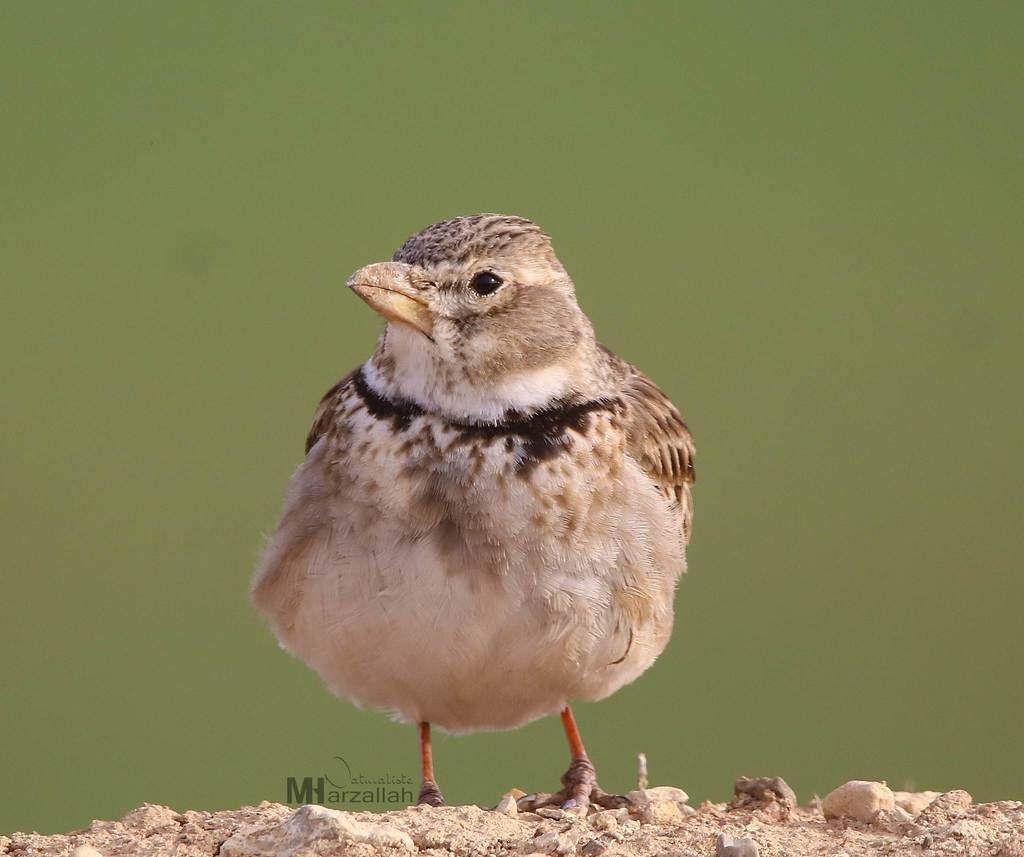
Calandra Lark
Photo © Mourad Harzallah
Photo © Mourad Harzallah — CC BY 4.0 — Source: iNaturalist #110888918Identification
The calandra lark is a large, robust lark measuring 17.5–20 cm in length. On the ground, it presents an undistinguished appearance, with mainly streaked greyish-brown plumage above and white underparts. Its most distinctive feature is a pair of large black patches on the breast sides, along with a white supercilium (eyebrow stripe). In flight, the bird reveals short, broad wings that are dark below and a short white-edged tail—wing and tail patterns that distinguish it from its more easterly relatives. The song resembles a slower version of the skylark's.
Range & Habitat
The calandra lark breeds in warm temperate regions around the Mediterranean and eastwards through Turkey into northern Iran and southern Russia. Four subspecies are recognized across its range: the western calandra lark in southern Europe and north-western Africa; the eastern calandra lark from northern Iraq to Kazakhstan; and two additional subspecies in the eastern Mediterranean region. Western populations are mainly resident year-round, while Russian populations are more migratory, moving south in winter as far as the Arabian Peninsula and Egypt. The species is a very rare vagrant to western Europe.
This is a bird of open cultivation and steppe, favouring open plains from steppes and pastures to extensive dry cereal cultivations. In the Mediterranean Basin it prefers dry pastures and dry cultivations, particularly fallows and field edges, selecting unirrigated legumes and barley fields.
Behaviour & Diet
The calandra lark is monogamous and breeds from early April to July. It builds its nest from grass stems and small leaves, lined with softer material, constructed in a shallow depression on the ground, often beneath a tussock. Clutches typically contain three to six eggs. Outside the breeding season, the bird is gregarious, forming large flocks in autumn and winter.
Its diet is highly seasonal: during summer months it feeds predominantly on insects, while in winter it shifts to seeds and grass shoots. Eastern populations exhibit migratory or partially migratory behaviour, while Mediterranean populations remain resident throughout the year.
Best Time & Places to See It
The calandra lark is best observed in its Mediterranean and eastern range during the breeding season from April through July, when pairs are territorial and vocal. Winter months offer excellent opportunities to witness the species' gregarious behaviour in large flocks across open plains and cultivated areas. Mediterranean populations provide year-round viewing opportunities, while visitors to Russia and the eastern Mediterranean should focus on spring and summer months. Open steppe habitats, dry pastures, and cereal cultivation areas are the most reliable locations.
Photography Tips
Photographing calandra larks requires patience, as they blend well with their open-country habitat. Position yourself in open cultivation areas or steppe habitats during early morning when birds are most active. The large black breast patches and white supercilium are key identifying features to capture. In-flight photography will reveal the distinctive dark underwings and white-edged tail. During winter, large flocking behaviour provides opportunities for dramatic flock photography, while spring and early summer offer chances to photograph singing males and nesting behaviour, though nests should be approached with caution to avoid disturbance during breeding season.
Monfragüe National Park
Torrejón el Rubio, Spain
+219 birds+10 mammals
Where the Tagus River cuts through limestone plateaus in central Extremadura, Monfragüe National Park rises as a fortress of Mediterranean and Atlantic woodland, its dramatic rocky…
VIEW NATIONAL PARKS’Albufera Natural Park
Platja de Muro, Spain
+253 birds+6 mammals
Where Mediterranean lagoons meet the Balearic coast, S'Albufera stretches across nearly 1,600 hectares of wetland and dune systems that rank among Europe's most ecologically vital shallow-water…
VIEW NATURAL PARKCañón del Río Lobos Natural Park
Santa María de las Hoyas, Spain
+136 birds+2 mammals
Where the Río Lobos carves its relentless path through the Iberian plateau, limestone cliffs rise in dramatic ramparts above a ribbon of water that has spent…
VIEW NATURAL PARKL’Albufera Natural Park
València, Spain
+321 birds+18 mammals
Where shallow lagoons meet Mediterranean coastal marshland, L'Albufera Nature Park unfolds as one of Spain's most vital wetland complexes. This protected landscape, designated under IUCN Category…
VIEW NATURAL PARKDoñana National Park
Hinojos, Spain
+300 birds+13 mammals
Where the Guadalquivir River delta spreads into the Atlantic, vast marshes, cork woodlands, and coastal dunes converge to create one of southwestern Europe's most biodiverse wetland…
VIEW NATIONAL PARKTablas de Daimiel National Park
Daimiel, Spain
+246 birds+6 mammals
Where the Guadiana River spreads into a labyrinth of shallow lagoons and reed beds across the sun-baked plains of central Spain, Tablas de Daimiel National Park…
VIEW NATIONAL PARKCabo de Gata-Níjar Natural Park
San José, Spain
+274 birds+11 mammals
Where volcanic ridges plunge toward the Mediterranean, Cabo de Gata-Níjar Nature Park unfolds across one of Europe's most arid coastlines, a landscape sculpted by tectonic violence…
VIEW NATURAL PARKSerra de Montsant Natural Park
La Morera de Montsant, Spain
+134 birds+15 mammals
Rugged limestone ridges and deeply incised gorges define the Serra de Montsant, a 10,000-hectare protected landscape that rises abruptly from the wine-growing plains of Tarragona in…
VIEW NATURAL PARKMontaña Palentina Natural Park
Vidrieros, Spain
+180 birds+29 mammals
Where the Cantabrian mountains rise above the Palencia plateau, Montaña Palentina Nature Park sprawls across nearly 1,500 square kilometres of some of northern Spain's most dramatic…
VIEW NATURAL PARKDelta de l’Ebre Natural Park
Eucaliptus, Spain
+341 birds+18 mammals
Where the Ebro River spreads into a vast labyrinth of shallow lagoons, reed beds, and brackish marshes before surrendering to the Mediterranean, one of southern Europe's…
VIEW NATURAL PARKCap de Creus Natural Park
Roses, Spain
+245 birds+23 mammals
Where the Pyrenees tumble into the Mediterranean, Cap de Creus Nature Park unfolds across 300 square kilometres of one of northeastern Spain's most dramatic coastal wilderness…
VIEW NATURAL PARKCabañeros National Park
Retuerta del Bullaque, Spain
+183 birds+8 mammals
Cabañeros National Park is one of Spain’s finest wildlife destinations and one of the best-preserved examples of Mediterranean forest and scrubland in Europe. Located in the…
VIEW NATIONAL PARKSierra de Guadarrama National Park
Rascafría, Spain
+179 birds+13 mammals
Where granite peaks rise abruptly from the central Spanish plateau, the Sierra de Guadarrama National Park unfolds across more than eleven hundred square kilometres of montane…
VIEW NATIONAL PARKParc del Garraf
Rat-Penat, Spain
+190 birds+15 mammals
Where limestone ridges rise abruptly from the Mediterranean coastal plain, Parc Natural del Garraf unfolds across 319 square kilometers of one of Catalonia's most dramatic protected…
VIEW NATURAL PARKMontseny Natural Park
Viladrau, Spain
+156 birds+30 mammals
The Montseny Natural Park is one of Catalonia’s most remarkable protected areas, offering an extraordinary blend of biodiversity, scenic landscapes, and cultural heritage within easy reach…
VIEW NATURAL PARKSierra de Andújar Natural Park
Our Lady of Cabeza, Spain
+198 birds+19 mammals
Where granite gorges slice through Mediterranean scrubland and cork forests cascade down Andalusian hillsides, one of Spain's most pristine wilderness areas unfolds across 74,000 hectares of…
VIEW NATURAL PARKEspacio Natural Remolar-Filipinas
El Prat del Llobregat, Spain
+297 birds+7 mammals
Where the Llobregat River delta meets the Mediterranean, a patchwork of salt marshes, reed beds, and shallow lagoons creates one of Catalonia's most dynamic wetland ecosystems.…
VIEW NATURE RESERVEValles Occidentales Natural Park
Siresa, Spain
+168 birds+20 mammals
Where granite gorges slice through the western Pyrenean foothills, steep valleys carved by ancient rivers create a mosaic of Mediterranean scrubland, beech forests, and alpine meadows.…
VIEW NATURAL PARKSierra de Gredos Regional Park
Candeleda, Spain
+180 birds+18 mammals
Where granite peaks claw at 2,592 metres and alpine meadows give way to cork oak scrubland, Spain's central highlands reveal a landscape of remarkable vertical drama.…
VIEW NATURE RESERVECamargue Regional Nature Park
Saintes-Maries-de-la-Mer, France
+378 birds+48 mammals
Where the Rhône Delta sprawls into the Mediterranean, a landscape of stark and haunting beauty emerges—vast salt marshes punctuated by shallow lagoons, reed beds, and scrubland…
VIEW NATURAL PARKZemo Svaneti Planned National Park
Hamashi-Totoleshi, Georgia
+159 birds+6 mammals
Where granite peaks pierce the clouds above the Caucasus, sweeping alpine meadows give way to pristine beech and spruce forests that have remained largely untouched for…
VIEW NATIONAL PARKJavakheti National Park
Bozali, Georgia
+138 birds
Dawn breaks over a high-altitude plateau where volcanic peaks pierce the Caucasian sky, their slopes cloaked in alpine meadows that stretch toward horizons of impossible clarity.…
VIEW NATIONAL PARKDirigida Laguna de Gallocanta Nature Reserve
Las Cuerlas, Spain
+250 birds+7 mammals
Where continental steppe meets the vast mirror of inland water, Spain's largest natural lagoon reveals a landscape of haunting beauty. The shallow alkaline lake, cradled in…
VIEW NATURE RESERVERila National Park
Mala tsarkva, Bulgaria
+138 birds+4 mammals
Where granite peaks pierce the Balkan skyline, pristine conifer forests blanket steep mountain slopes in an ecological tapestry that has remained largely undisturbed for centuries. Bulgaria's…
VIEW NATIONAL PARKCentral Balkan National Park
Zhidov dol, Bulgaria
+135 birds+16 mammals
Where granite peaks pierce the Bulgarian highlands, ancient beech and conifer forests blanket mountains that rise dramatically from the Balkan range's heart. This wilderness encompasses three…
VIEW NATIONAL PARKVratsa Balkan
Zgorigrad, Bulgaria
+128 birds+10 mammals
Where limestone cliffs plunge into deep river canyons and beech forests give way to rocky karst plateaus, one of Bulgaria's most dramatic mountain landscapes unfolds across…
VIEW NATURE RESERVESierra y Cañones de Guara Natural Park
Casbas de Huesca/Casbas de Uesca, Spain
+175 birds+10 mammals
Where limestone gorges slice through the pre-Pyrenean foothills of Aragon, the Sierra y Cañones de Guara sprawls across nearly 940 square kilometers of one of Spain's…
VIEW NATURE RESERVESerra de Mariola Natural Park
Bocairent, Spain
+164 birds+19 mammals
Where limestone ridges rise above the Valencian interior, Serra de Mariola unfolds across 225 square kilometers of Mediterranean mountain terrain that shifts between dense evergreen woodland,…
VIEW NATURE RESERVEEstrecho Natural Park
Pedro Valiente, Spain
+281 birds+20 mammals
Where Mediterranean pine forests meet wind-sculpted coastal cliffs, one of Europe's most dynamic ecological crossroads unfolds across the Strait of Gibraltar. Spanning 686 square kilometers of…
VIEW NATURAL PARKSierras Subbéticas Natural Park
Algar, Spain
+156 birds+10 mammals
Where limestone ridges rise abruptly from the Córdoba countryside, the Sierras Subbéticas Nature Park sprawls across nearly 583 square kilometres of one of Andalusia's most rugged…
VIEW NATURAL PARKSierra de Castril Natural Park
Castril, Spain
+110 birds+13 mammals
Where limestone walls rise abruptly from the Guadalentín valley, carving passages of breathtaking drama through Andalusia's interior, one encounters the raw geological theatre of this protected…
VIEW NATURE RESERVEZakaznik Stepnoy/Tinguta
Лиманский муниципальный округ, Russia
+52 birds+3 mammals
Where the Volga Delta meets the Caspian steppe, roughly 1,205 square kilometres of protected landscape unfold across Liman Municipality in Astrakhan Oblast—a mosaic of reed beds,…
VIEW NATIONAL PARKButrint National Park
Vagalat, Albania
+140 birds+3 mammals
Where the Ionian coast meets ancient alluvial plains, Butrint National Park spans a landscape of extraordinary ecological complexity that has shaped human settlement for three millennia.…
VIEW NATIONAL PARKOlympos National Park
Pieria Regional Unit, Greece
+137 birds+3 mammals
Where the Thessalian plains give way to soaring limestone massifs, Olympos National Park rises as one of the Aegean's most dramatic mountain wilderness areas. This IUCN…
VIEW NATIONAL PARKKerkini Lake National Park
Serres, Greece
+291 birds+18 mammals
Where the Strymon River widens into a sprawling freshwater lake hemmed by the Rhodope Mountains, Kerkini National Park unfolds across northern Greece as one of southeastern…
VIEW NATIONAL PARKCabo Peñas
Susacasa, Spain
+303 birds+21 mammals
Where sea cliffs rise sheer from the Bay of Biscay, Susacasa's observation point commands one of Asturias's most dramatic coastal vistas. The landscape here is defined…
VIEW OBSERVATION POINTPort-Cros National Park
Hyères, France
+271 birds+29 mammals
Where Mediterranean granite islands rise from crystalline waters off the Provençal coast, Port-Cros National Park protects one of Europe's most intact marine and terrestrial ecosystems. The…
VIEW NATIONAL PARKAlta Murgia National Park
Bari, Italy
+168 birds+6 mammals
Across the limestone plateaux of Apulia's interior, where the Adriatic's influence fades into continental warmth, lies a landscape sculpted by millennia of human pastoralism and Mediterranean…
VIEW NATIONAL PARKNo community photos yet. Log in to add the first one.
No community observations of this species yet.