Identification
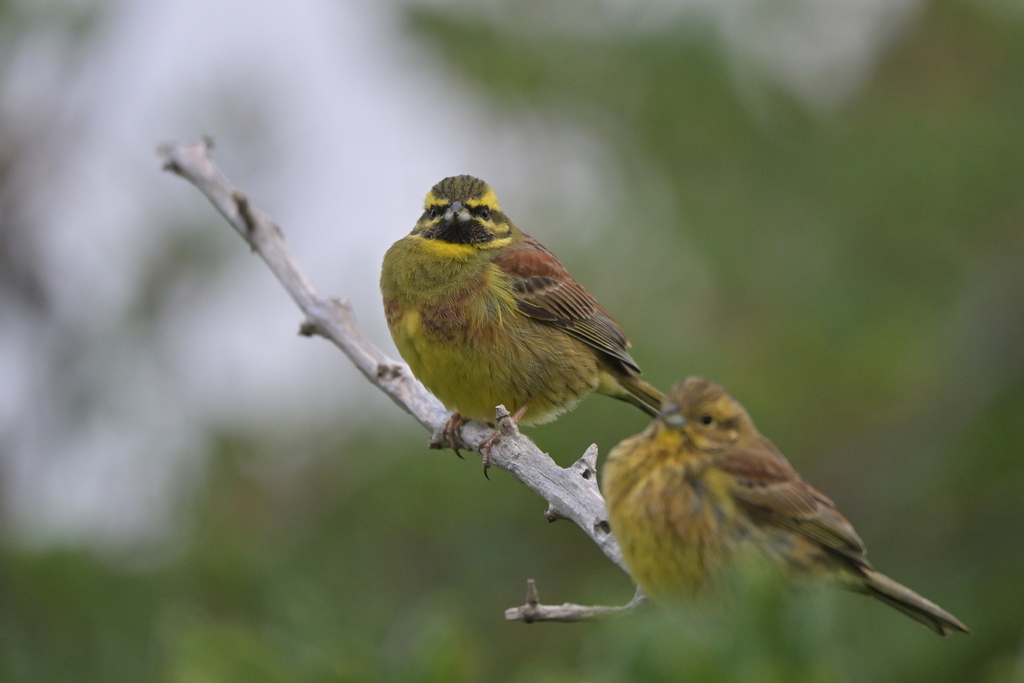
The cirl bunting is a small passerine, measuring around 15.5 cm (6.1 in) in length with a wingspan of 22–25.5 cm (8.7–10.0 in). Males are strikingly patterned with a bright yellow head marked by a black crown, eyestripe and throat, and a distinctive greenish breast band across otherwise yellow underparts. The back is heavily streaked brown. Females are much more subdued, resembling the yellowhammer, but can be distinguished by their streaked grey-brown rump and chestnut shoulders. The species has the thick, seed-eater's bill typical of buntings. Males produce a monotonous, rattling trill song, somewhat resembling the Arctic warbler or the terminal rattle of the lesser whitethroat.
Range & Habitat
The cirl bunting breeds across southern Europe, Mediterranean islands, and north Africa, remaining resident year-round in these warmer regions and not migrating in winter. The species favours open areas with scattered scrub or trees, with a particular preference for sunny slopes. Ideal habitat comprises a mosaic of grassland and arable fields divided by thick hedgerows with dense scrub pockets—particularly blackthorn, hawthorn, bramble and gorse. They tolerate some urbanisation and can be found in parks and green spaces even in major cities like Rome. A small established population persists in the South Island of New Zealand, descended from 19th-century introductions. In England, the species once occurred widely across the south but is now largely restricted to south Devon.
Behaviour & Diet
Cirl buntings are sedentary, typically travelling only 250 metres from their nests to forage in summer, though extending to 2 kilometres in winter to find stubble. They breed from April until mid-September, usually raising two broods, occasionally three. Nests are built at low level within dense cover. Females lay two to five eggs, which are incubated for 12–13 days and hatch with the hair-like markings characteristic of buntings. Nestlings fledge after 11–13 days and are fed by both parents for a further two to three weeks.
In summer, the birds feed primarily on invertebrates such as grasshoppers and crickets to provision their chicks. In winter, they switch to small seeds from over-wintered stubbles, fallow land, and set-aside fields, often feeding in flocks during this season.
Best Time & Places to See It
South Devon, particularly near Kingsbridge, offers the most reliable opportunity to see cirl buntings in Britain, where conservation efforts have increased the population substantially since 1989. For European sightings, the species can be found throughout southern Europe and the Mediterranean region year-round. The birds are resident and do not migrate, making them potentially visible in any season, though winter flocking behaviour may make them somewhat easier to locate during the colder months when they concentrate around food sources.
Photography Tips
Male cirl buntings, with their striking yellow and black head markings and greenish breast band, offer excellent photographic subjects and are far more visually distinctive than the subtly-plumaged females. Look for birds perching in low scrub, hedgerows, or open grassland, where they often sing from exposed perches. In winter, visiting stubble fields and set-aside land where flocks congregate will increase your chances of close encounters. Early morning light will best showcase the male's bright yellow plumage.