Identification
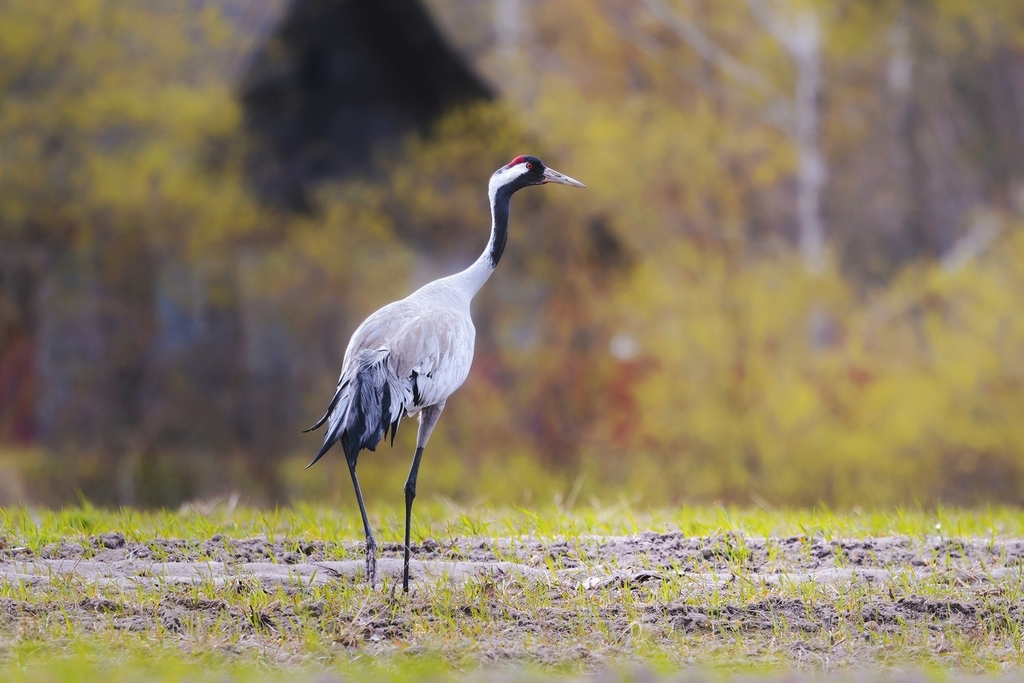
The common crane is a large, stately bird measuring 100–130 cm in length with an impressive wingspan of 180–240 cm, making it a medium-sized crane. Adults are predominantly slate-grey with distinctive markings: a blackish forehead and lores contrasting with a bare red crown, and a striking white streak running from behind the eyes to the upper back. The back and rump are darkest, while the breast and wings are paler. Black feathering on the primaries, secondary tips, tail tip, and upper tail coverts, combined with drooping greater coverts that form dramatic plumes, are key identification features. Juveniles appear quite different, with yellowish-brown tips to body feathers, a fully feathered crown, and lacking both the drooping wing plumes and the bright neck pattern of adults.
Males are slightly larger and heavier than females. The species is most easily distinguished from similar Asian crane species such as the hooded and black-necked cranes by this combination of colouration and plumage pattern. The common crane has a loud, piercing trumpeting call audible from considerable distances, delivered in flight and during display, which is often one of the first signs of the bird's presence.
Range & Habitat
The common crane breeds across Europe and the Palearctic to Siberia, with the largest breeding populations concentrated in Russia, Finland, and Sweden. It is a rare breeder in southern and western Europe, though numbers are increasing in central and eastern regions. The species has reappeared in several western European countries where it had been extirpated centuries ago, including the United Kingdom and, since 2021, the Republic of Ireland. Eastward, the breeding range extends to the Chukchi Peninsula, while southward it reaches northern China, Turkey, and the Caucasus region.
In Europe, common cranes breed in boreal and taiga forests, mixed forests, treeless moors, bogs, and dwarf heather habitats, typically at elevations from sea-level to 2,200 metres. Breeding sites usually include small lakes or pools. In Sweden, birds favour small swampy openings within pine forests, while in Germany they use marshy wetlands. As a highly migratory species, European breeders predominantly winter in Portugal, Spain, and northern Africa, with some remaining in southern Europe during mild winters. Eastern European populations winter in Sudan, Ethiopia, Tunisia, and Eritrea, while those breeding in central Russia favour the Indian subcontinent and Pakistan. The easternmost breeders winter in eastern China.
Behaviour & Diet
The common crane is renowned for its spectacular dancing display, which involves leaping with wings uplifted—a behaviour that is equally impressive in photographs and in person. During migration, flocks characteristically fly in a distinctive "V" formation. The species undergoes a complete moult every two years before migration, during which it remains flightless for approximately six weeks until new feathers grow.
Migration timing varies by location: autumn migration occurs from August to October in breeding areas but extends from late October to early December at wintering sites, while spring migration begins in February at wintering sites and continues through May in breeding areas. Notably, migration phenology is changing due to climate change. Important staging areas occur across a vast range from Sweden, the Netherlands, and Germany to China, with particularly large concentrations around the Caspian Sea where thousands can be observed in a single day during autumn migration.
Best Time & Places to See It
Spring and autumn migration periods offer the best opportunities to see common cranes in large numbers. Major staging areas during migration include the Caspian Sea region, where thousands gather, as well as sites across Sweden, the Netherlands, and Germany. For winter viewing, Portugal, Spain, and northern Africa support substantial populations. During breeding season, the species can be found in boreal forests and wetland habitats across Russia, Finland, and Sweden, though sightings require visiting remote regions.
Autumn migration from August through December is particularly rewarding for observers in central Europe, while spring migration from February through May offers another excellent window. The UK and Ireland have recently become viable locations as reintroduction efforts establish breeding populations. For those interested in seeing the species in its Asian wintering grounds, eastern China hosts significant numbers during winter months.
Photography Tips
The common crane's striking plumage and large size make it an excellent photographic subject. The distinctive white facial streaks, red crown, and slate-grey body provide strong contrast, particularly in soft morning or evening light. The dramatic drooping wing plumes are a signature feature worth capturing, especially when birds are perched or resting between flights.
Migration viewing offers outstanding opportunities to photograph birds in flight, particularly in the characteristic "V" formation. Positioning yourself at major stopover sites during migration season—such as the Caspian Sea region or northern European wetlands—maximizes the chances of capturing large numbers of birds in a single frame. The loud, piercing call and dynamic dancing display behaviour provide opportunities for more intimate behavioural photography, though patience and a good vantage point are essential. Early morning light at wetland habitats is ideal for capturing the subtle tonal variations in the grey plumage and the brilliant red of the crown.