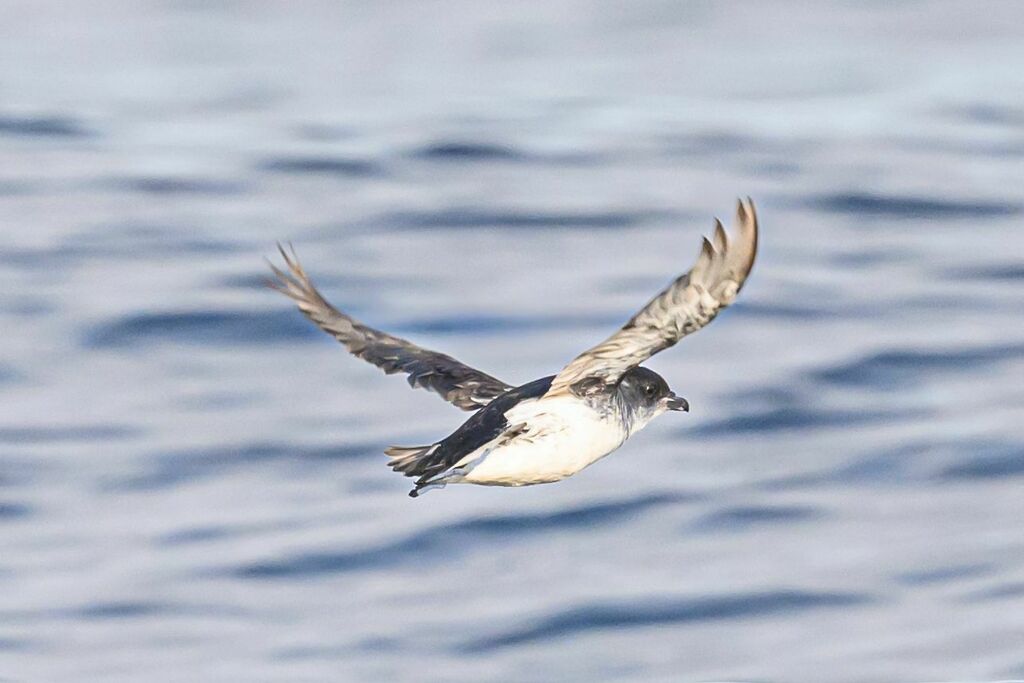
Common Diving Petrel
Photo © Alan Bell
Photo © Alan Bell — CC BY 4.0 — Source: iNaturalist photo #468964822Identification
The common diving petrel is a small, plump seabird measuring 200 to 250 mm in length and weighing around 86 to 186 grams. It features black plumage above and dull white below, with a relatively short black bill and distinctive thin white strips on the wings. The legs and feet are blue with blackish-brown webbing, while the face and neck may appear more brown than black. Unless observed at close range, it is nearly indistinguishable from the South Georgian diving petrel, though the common diving petrel has brown inner web primary feathers (compared to light feathering in its relative), smaller and narrower bills, and lacks the posterior black line down the tarsi found on the South Georgia species.
Range & Habitat
The common diving petrel is found between latitudes 35 and 55 degrees south, distributed across the South Atlantic islands, subantarctic islands of the Indian Ocean, New Zealand waters, and south-eastern Australian islands. Six subspecies occupy different regions, from the Tristan da Cunha archipelago to the Falkland Islands, Chatham Islands, and Australian coastlines. The species is native to islands and islets rather than mainland coasts, where it inhabits vegetated slopes where it digs burrows approximately 1.5 metres long, though burrows are occasionally constructed on flatland.
Behaviour & Diet
The common diving petrel is a specialist wing-propelled diver, capable of diving to depths of 60 metres while hunting for prey. Its diet is dominated by crustaceans, and it forages predominantly at night, targeting vertically migrating plankton. During the breeding season, it feeds on the continental shelf near shore, though its movements and feeding range during the non-breeding season—which lasts only two months annually—remain poorly understood. It occasionally ventures into deeper pelagic waters outside the breeding period.
Breeding occurs in large colonies with dense nest spacing of approximately one nest per square metre. Pairs form monogamous relationships, though mating habits are not extensively documented. Females lay a single white egg measuring 38 by 29 millimetres, incubated for 53 to 55 days. Chicks are brooded for 10 to 15 days and fledge at 45 to 59 days, with both parents sharing offspring care. Young are grey-downed when hatched, and the species has a life expectancy of 6.5 years.
Best Time & Places to See It
The common diving petrel's non-breeding movements remain poorly known, making timing recommendations uncertain. However, breeding colonies on subantarctic and southern ocean islands offer the best opportunities for observation. Key locations include islands off New Zealand such as the Chatham Islands, Snares, Stewart Island, and the Antipodes Islands; South Atlantic sites including South Georgia, the Falkland Islands, and Tristan da Cunha; and southern Indian Ocean islands such as Kerguelen, Heard, and McDonald Islands. Visiting during breeding season would increase encounter likelihood, though access to remote colonies is often restricted.
Photography Tips
Photographing the common diving petrel presents challenges due to its small size, remote island habitat, and nocturnal feeding behaviour. The bird's plumage contrast—black upperparts against white underparts—provides natural photographic appeal when well-lit. Given the species' similarity to the South Georgian diving petrel, careful attention to bill size and feather details will be necessary for identification in photographs. Night photography may capture feeding behaviour on migrating plankton, though this requires specialized equipment and patience. The blue legs and feet provide distinctive colour accents worth highlighting when possible.
Chile: Fuegian Snipe & Juan Fernandez
Sydney Harbour National Park
Sydney, Australia
+203 birds+26 mammals
Where Sydney Harbour's sheltered waters meet the sandstone headlands of New South Wales, a mosaic of coastal heathland, eucalyptus woodland and rocky shores creates one of…
VIEW NATIONAL PARKWilsons Promontory National Park
Australia
+210 birds+21 mammals
Where granite headlands plunge toward Bass Strait, Wilson's Promontory National Park sprawls across nearly 1,300 square kilometers of southeastern Victoria's most rugged coastal wilderness. The park's…
VIEW NATIONAL PARKSea Lion Island
Sealion Island Settlement, Falkland Islands
+74 birds+3 mammals
Windswept tussock grasslands roll across volcanic terrain where Southern Ocean swells crash against rocky shores, creating one of the Falkland Islands' most dramatic wildlife theatres. This…
VIEW ISLAND & ARCHIPELAGOKidney Island
Stanley, Falkland Islands
+47 birds
Wind-scoured tussock grassland sweeps across this remote South Atlantic outcrop, where peaty soils and exposed rock formations create a landscape as austere as it is vital.…
VIEW ISLAND & ARCHIPELAGOCape Dolphin
falskland islands, Falkland Islands
+54 birds+1 mammals
Where windswept grasslands meet dramatic coastal cliffs, the Falkland Islands' northern reaches reveal one of the Southern Hemisphere's most compelling seabird sanctuaries. The terrain here is…
VIEW NATURE RESERVEWest Point Island
West Point, Falkland Islands
+67 birds+3 mammals
Windswept cliffs plunge dramatically into the South Atlantic, their rust-coloured rock faces sculpted by millennia of gales and spray. This northwestern outpost of the Falkland Islands…
VIEW ISLAND & ARCHIPELAGOCabo de Hornos National Park
Cape Horn, Chile
+88 birds+9 mammals
Where the Andes plunge into the Southern Ocean and the Drake Passage churns between two continents, Cabo de Hornos National Park sprawls across one of Earth's…
VIEW NATIONAL PARKSalisbury Plain
South Georgia, South Georgia and the South Sandwich Islands
+33 birds+4 mammals
Where tussock grasses bow to relentless Antarctic winds and glacial meltwater carves braided channels through obsidian volcanic soil, one of Earth's most remote wildlife sanctuaries reveals…
VIEW PROTECTED LANDSCAPESt. Andrews Bay
South Georgia, South Georgia and the South Sandwich Islands
+34 birds+6 mammals
Where windswept tundra dissolves into obsidian beaches, one of the planet's most extraordinary wildlife theaters unfolds across St. Andrews Bay. This remote corner of South Georgia…
VIEW PROTECTED LANDSCAPEFortuna Bay
Stromness, South Georgia and the South Sandwich Islands
+37 birds+5 mammals
Where tussock grasslands sweep down to black-sand beaches and elephant seals haul out in thunderous colonies, the raw sub-Antarctic landscape reveals itself in its most dramatic…
VIEW PROTECTED LANDSCAPEPrion Island
Prince Olav Harbour, South Georgia and the South Sandwich Islands
+36 birds+2 mammals
Windswept tussock grasslands rise sharply from boulder-strewn beaches where the Southern Ocean hurls its grey swells against black volcanic rock. This remote speck in South Georgia's…
VIEW ISLAND & ARCHIPELAGOElsehul Bay
Bird Island Station, South Georgia and the South Sandwich Islands
+33 birds+4 mammals
Granite peaks rise sheer from the Southern Ocean, their weathered faces streaked with cascading meltwater and cloaked in tussock grass that bends beneath relentless winds. This…
VIEW PROTECTED LANDSCAPENo community photos yet. Log in to add the first one.
No community observations of this species yet.