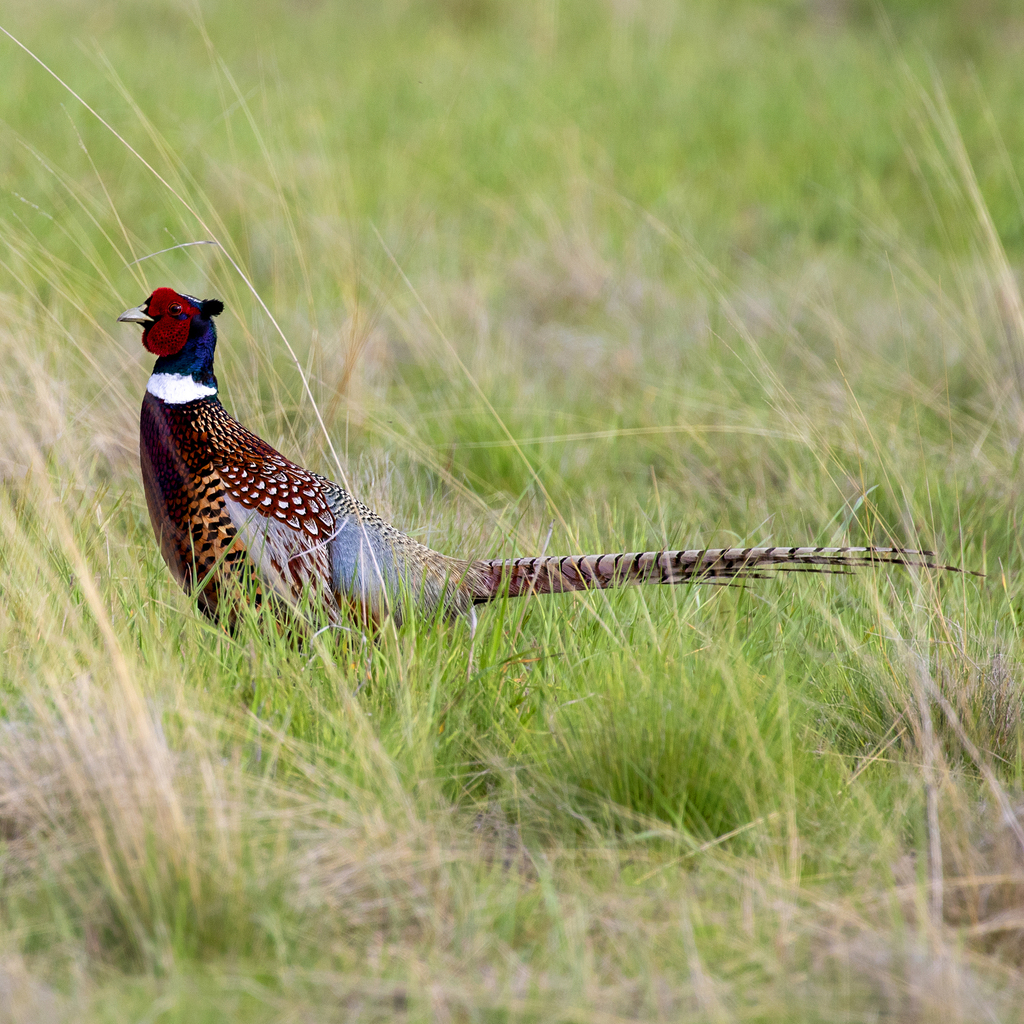
Common Pheasant
Photo © Dan Vickers
Photo © Dan Vickers — CC BY 4.0 — Source: iNaturalist #256420801Identification
The common pheasant is a striking and highly variable gamebird. Males of the nominate subspecies display iridescent plumage in fiery copper-red and chestnut-brown, with a distinctive bottle-green head, small crest, and red facial wattle. The body is barred with bright gold, while the wings show white or cream with black markings. The long tail, accounting for almost half the bird's total length of 60–89 cm, is brown and streaked with black. Males typically weigh around 1.2 kg. Females and juveniles are far more cryptic, with mottled brown plumage measuring 50–63 cm in length. Considerable colour variation exists across the species due to captive breeding and hybridisation between subspecies; melanistic (black) and flavistic (pale fawn) specimens are commonly encountered in some areas.
The species exhibits a wingspan of 56–86 cm. Females lack the male's vivid coloration and distinctive head markings, making them considerably more difficult to spot in the field. Juvenile males resemble females until about ten weeks of age, when characteristic bright feathers begin developing on the breast, head, and back.
Range & Habitat
Native to Asia, the common pheasant is widespread throughout its natural range and also occurs in the extreme southeast of Europe in the northern foothills of the Caucasus Mountains. As one of the world's most hunted birds, it has been widely introduced as a gamebird to many regions beyond its native range and is now naturalised in parts of Europe. In North America and other introduced regions, ring-necked pheasant populations are particularly well-established.
Behaviour & Diet
The common pheasant is a well-known gamebird of ancient and widespread importance. It is one of the world's most hunted bird species, testament to both its popularity and its suitability for hunting. The species is commonly reared on game farms, where commercial breeding is established, with stock from varying sources continually released to the wild.
Best Time & Places to See It
The common pheasant's extensive introduction as a gamebird makes it accessible in many parts of the world. Look for it in areas where game management and farming practices are active, and in regions where it has become naturalised following introduction.
Photography Tips
Male common pheasants are highly photogenic subjects with their vibrant plumage and distinctive features. The bottle-green head, red wattle, and long tail are particularly striking in good light. Females present a greater challenge due to their cryptic mottled brown coloration, requiring patience and careful positioning. Early morning or late afternoon light will best capture the iridescent sheen of males' plumage.
Abel Tasman National Park
Abruzzo, Lazio and Molise National Park
Acadia National Park
Aggtelek National Park
Algonquin Provincial Park
Alpilles Regional Nature Park
Alta Murgia National Park
Aoraki / Mount Cook National Park
Appennino Tosco-Emiliano National Park
Nothing matches these filters.
No community photos yet. Log in to add the first one.
No community observations of this species yet.