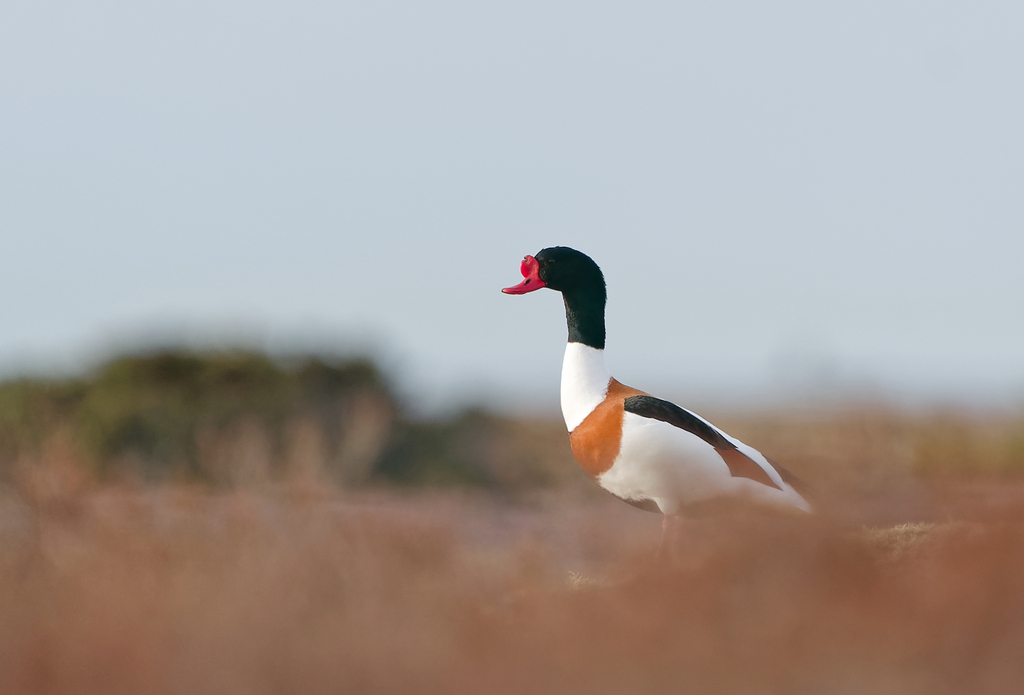
Common Shelduck
Photo © Mikael Nyman
Photo © Mikael Nyman — CC BY 4.0 — Source: iNaturalist photo #657419271Identification
The common shelduck is a striking waterfowl that resembles a small, short-necked goose in overall shape and size. Measuring 55–65 cm in length with a wingspan of 100–120 cm, it is instantly recognizable by its bold plumage: a white body adorned with distinctive chestnut patches, contrasting with a black belly, dark green head and neck, and reddish-pink bill. The wing coverts are white while the primary flight feathers are black; in flight, the secondary feathers display a striking black coloration with a strong green iridescent sheen. The underwings are predominantly white except for the black flight feathers. Males are particularly crisp and colorful during breeding season, featuring a bright red bill with a prominent knob at its base, while females are slightly smaller and often show white flecks on their green face. Ducklings are white with blackish-brown caps, hindnecks, and wing patches, while juveniles display greyish upper parts and mostly white underparts but already possess the adult's distinctive wing pattern.
Range & Habitat
The common shelduck is widespread and common throughout the Palearctic region. Historically restricted to coastal areas, salt marshes, and estuaries during the mid-20th century, this species has increased and spread dramatically since then. It now occurs inland in open freshwater wetlands and has expanded its range northward along the Norwegian coast and into northwestern Russia. Breeding has also extended southward, with extensive colonization of the Iberian Peninsula where it formerly only wintered. In northwest Africa, breeding is restricted to Tunisia, though it winters more widely west to Morocco.
The common shelduck is particularly common around the coastlines of Great Britain and Ireland, where it frequents salt marshes, estuaries, and tidal mudflats. It typically nests in rabbit burrows. Asian populations migrate to subtropical wintering grounds as far south as northern India and southern China, while European populations are largely resident, except for Scandinavian and some eastern European birds that migrate southwest, and movements to celebrated late-summer molting grounds such as the Wadden Sea on the north German coast.
Behaviour & Diet
The common shelduck exhibits behavior more similar to geese and swans than to dabbling ducks. Both parents actively protect ducklings and lead them to feeding areas, which may be up to 3 kilometers from the nest site, though only the female broods the young. The young possess a remarkable anti-predator behavior, diving underwater to escape threats while adults may fly away to act as decoys. Breeding typically begins at two years of age, and the maximum recorded lifespan is just under 20 years.
Molting flocks can reach extraordinary sizes, with congregations of up to 100,000 birds gathering at sites like the Wadden Sea. This occurs because most pairs leave their partially grown young in communal crèches tended by just one or two adults. The species produces a loud honk as its call. The expansion of the common shelduck's range since the mid-20th century is thought to relate to improved hunting protection and increased eutrophication of estuaries and wetlands, which has expanded food availability.
Best Time & Places to See It
The common shelduck is best observed around the coasts and estuaries of Great Britain and Ireland throughout the year. Salt marshes and tidal mudflats provide excellent viewing opportunities, particularly during winter months when birds are confined to these coastal habitats. The species is now increasingly found inland in open freshwater wetlands during breeding season. For those seeking massive congregations, the Wadden Sea on the north German coast hosts molting flocks of extraordinary size during late summer, when birds gather from across their range.
Photography Tips
The common shelduck's bold, distinctive plumage makes it an attractive photographic subject. The striking contrast between the white body, chestnut patches, and black belly provides excellent compositional opportunities. To capture the bird's iridescent green wing reflections, photograph birds in flight in good light, as this sheen is only visible when the secondary feathers are displayed in motion. Males in breeding plumage show particularly crisp coloration and the prominent red bill knob, making spring a rewarding season for portraits. Early morning light will enhance the metallic quality of the plumage. Shooting at molting grounds like the Wadden Sea offers opportunities to capture behavioral images of adults and young together, as well as the massive congregations characteristic of late summer.
Private Full-Day Birdwatching Tour from Algarve to Southwest Spain
Private Full-Day Birdwatching Tour from Lisbon to the Tagus Estuary
Nothing matches these filters.
Alpilles Regional Nature Park
Alta Murgia National Park
Altai Tavan Bogd National Park
Altun Mountain National Nature Reserve
Asinara National Park
Avesnois Regional Nature Park
Bannau Brycheiniog National Park
Bardenas Reales
Biebrza National Park
Nothing matches these filters.
No community photos yet. Log in to add the first one.
No community observations of this species yet.