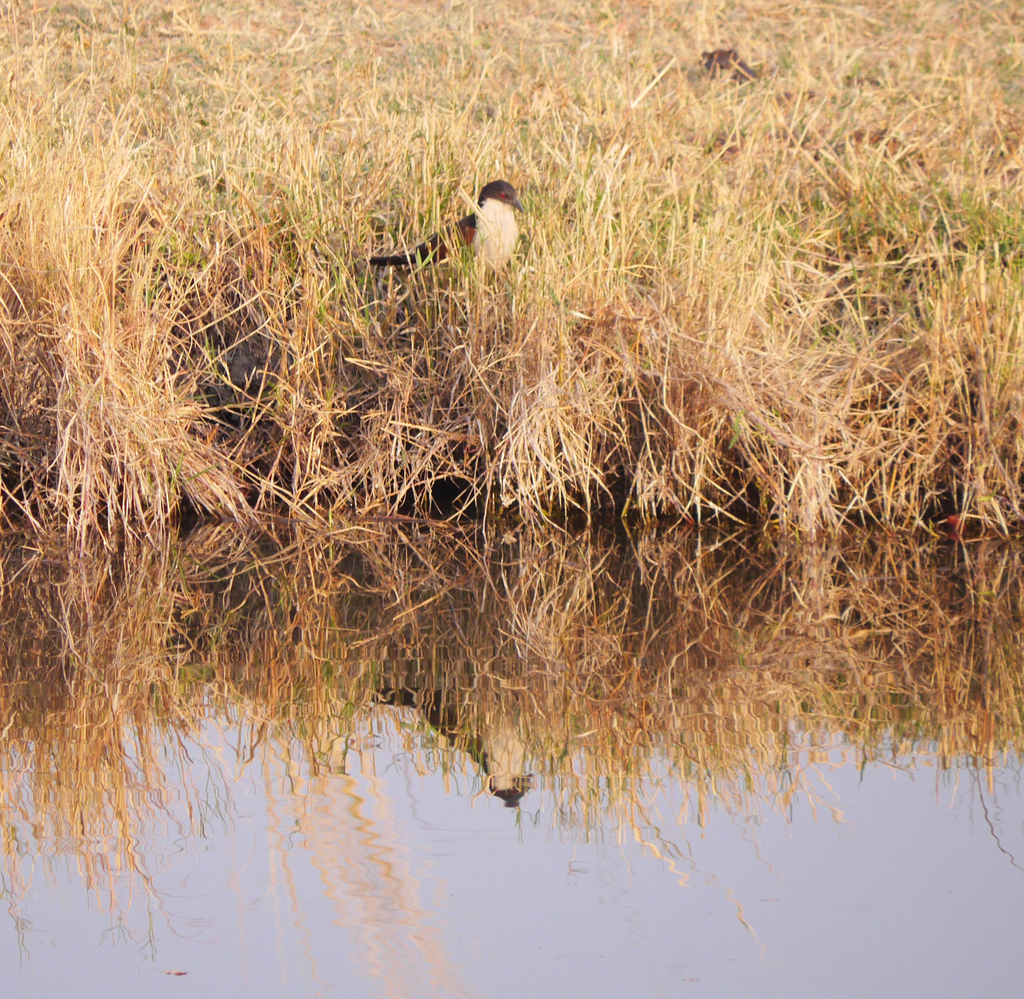
Coppery-tailed Coucal
Photo © Nico
Photo © Nico — CC0 1.0 — Source: iNaturalist #236385083Identification
The coppery-tailed coucal is a medium-sized member of the cuckoo family, measuring about 48 cm (19 inches) in length. It is a striking bird with a distinctive appearance: a black head and upperparts contrast sharply with white or cream-coloured underparts, while the rump displays a warm brown tone with a characteristic coppery sheen. The bird's long, broad tail is blackish-brown, and it possesses a noticeably curved beak. Males are slightly smaller than females. Immature birds can be identified by pale streaks on the head and barred flight feathers, distinguishing them from adults.
The species bears a close resemblance to the Senegal coucal, so careful observation of plumage details is necessary for accurate identification. The deep, bubbling call is a useful auditory clue for field identification, particularly during early morning and evening hours when the bird is most vocal.
Range & Habitat
This coucal is native to south-central Africa, with a distribution spanning from Angola in the west to southwestern Tanzania, northern Botswana, and the Caprivi Strip in Namibia. It also occurs in the Democratic Republic of the Congo, Malawi, Zambia, and Zimbabwe. The species occupies a very wide range covering approximately 1,750,000 square kilometres.
The coppery-tailed coucal favours wetland environments, with typical habitat including swampland and dense vegetation near rivers. It is also regularly found on inundated floodplains and near seasonal lakes, where dense waterside cover provides shelter and nesting opportunities.
Behaviour & Diet
The coppery-tailed coucal is a territorial bird throughout the year and is primarily active during two periods: shortly after dawn and in the evening. It is a terrestrial forager with a diverse and opportunistic diet. It hunts amphibians, fish, small birds, reptiles, and rodents, supplementing these with invertebrates such as grasshoppers, crabs, and snails. The bird also scavenges dead fish and other edible matter, and occasionally consumes green plant material. Notably, it tears open the nests of weaver birds and has been recorded swallowing blue quail whole.
During the breeding season from January to March, the species is believed to be monogamous. Both parents construct a distinctive domed nest from grasses, reed fragments, and twigs, lined with leaves and positioned low among reeds or tangled waterside vegetation. A clutch of two to four eggs is laid, with incubation beginning immediately after the first egg is laid. Young birds fledge at around seventeen days old and are fed on frogs and locusts by both parents.
Best Time & Places to See It
The coppery-tailed coucal is common in parts of its range, making it a rewarding species to encounter for travellers visiting suitable habitats across south-central Africa. The species is most easily observed during the early morning hours and in the evening when it is most active. The breeding season from January to March offers opportunities to observe nesting behaviour and family groups.
Wetland reserves and national parks encompassing swamps, river systems, and floodplain habitats throughout its range—particularly in Botswana, Zambia, and Zimbabwe—offer the best chances of sightings. Look for the bird foraging on the ground near dense vegetation or listen for its distinctive deep, bubbling calls in waterside environments.
Photography Tips
Photographing the coppery-tailed coucal requires patience and an early start, as the bird is most active shortly after dawn. Position yourself near suitable wetland habitat with dense vegetation where the bird forages on the ground. The bird's black and white plumage provides good contrast, but the coppery-sheen on the rump—a key field mark—requires appropriate lighting to capture effectively.
Since the bird is often found among reeds and tangled vegetation, a telephoto lens is essential to obtain clear images while maintaining distance from nesting sites. The evening period also offers photographic opportunities, though light levels will be lower. Patience in concealed positions near known feeding or nesting areas will reward photographers with images of this striking African species.
Chobe National Park
Botswana
+446 birds+45 mammals
Where the Chobe River cuts a sinuous path through northern Botswana, the landscape transforms into one of Africa's most dynamic wetland-savanna mosaics. This national park encompasses…
VIEW NATIONAL PARKNkasa Rupara National Park
Namibia
+283 birds+17 mammals
Where the Zambezi's floodplains spill across the border between Namibia and Botswana, Nkasa Rupara National Park unfolds across 518 square kilometers of wetland and woodland mosaic.…
VIEW NATIONAL PARKBwabwata National Park
Namibia
+377 birds+35 mammals
Where the Kavango River winds through northeastern Namibia, vast floodplains and dense riparian woodland create one of southern Africa's most ecologically dynamic protected landscapes. Spanning 14,249…
VIEW NATIONAL PARKMakgadikgadi Pans National Park
Gucta, Botswana
+272 birds+27 mammals
Where salt-crusted flatlands stretch endlessly toward a shimmering horizon, one of Africa's most extraordinary ecosystems awakens with the rains. The Makgadikgadi Pans comprise vast mineral-rich basins…
VIEW NATIONAL PARKNo community photos yet. Log in to add the first one.
No community observations of this species yet.