Corn Bunting
Emberiza calandra
Photo © SIA
Photo © SIA — CC BY 4.0 — Source: iNaturalist photo #496409241ABOUT
Subspecies of Corn Bunting
Occidental Corn BuntingOriental Corn Bunting
Identification
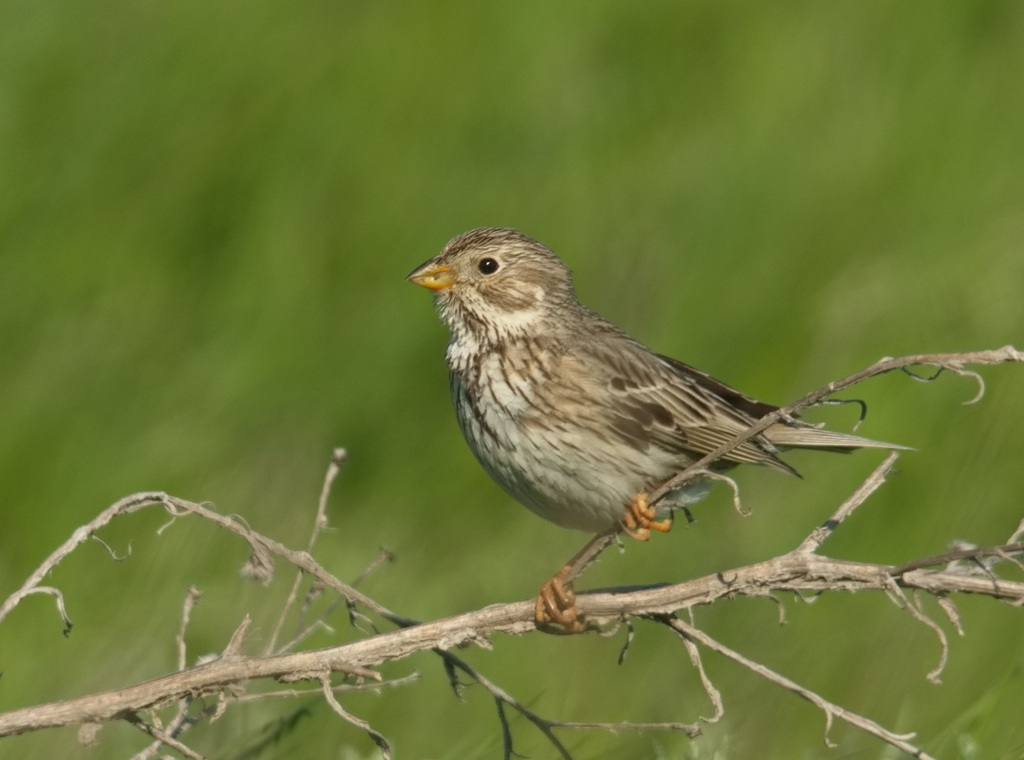
The corn bunting is a large, heavily streaked bunting with distinctive buff-brown plumage that may initially remind observers of a lark. Measuring 16–19 cm in length, it is a bulky bird with a conspicuously dark eye and yellowish mandibles. The sexes are similar in appearance, though males are approximately 20% larger than females—an unusual trait for the genus Emberiza, where males typically display showy head markings. Both sexes are streaked grey-brown above with whitish underparts, and the streaking extends over the flanks and breast, forming a characteristic gorget around the throat. The lesser wing coverts are distinctively dark with white tips, while the tail remains plain brown.
Range & Habitat
The corn bunting's range extends from Western Europe and North Africa across to northwestern China, with breeding populations spread throughout southern and central Europe, North Africa, and Asia to Kazakhstan. Two subspecies are recognized: the nominate calandra, found from northwest Africa, the Canary Islands, and Europe eastward to Turkey, the Caucasus, and northern Iran; and buturlini, occurring from the Middle East to northwestern China. While mainly resident, birds from colder regions of central Europe and Asia migrate southward during winter.
This species favors open country with scattered trees, including farmland and weedy wasteland. Sadly, corn bunting populations have declined dramatically in northwest Europe due to intensive agricultural practices that have eliminated vital food sources of weed seeds and insects. The species holds red conservation status in the UK and has recently become extinct in Wales and Ireland, where it was once common.
Behaviour & Diet
The corn bunting's diet consists mainly of seeds, supplemented with insects such as crickets, which become especially important when birds are feeding young. Males are highly vocal during the breeding season, producing a distinctive repetitive metallic song often likened to jangling keys, typically delivered from low bushes, fence posts, or telephone wires.
During breeding season, males defend territories and may be polygynous, with individual males sometimes maintaining up to three mates. Despite this polygyny, the population sex ratio typically remains 1:1, leaving some males unmated each season. Males provide minimal parental care, taking no part in nest building or incubation and only feeding chicks once they are more than half-grown. Females construct nests from grass lined with hair or fine grass, usually building on the ground. Average clutch size is four eggs, though clutches commonly range from three to five, occasionally reaching six.
Best Time & Places to See It
The corn bunting's breeding season is the best time to locate this species, when males are actively defending territories and singing from exposed perches. Spring and early summer offer the most reliable viewing opportunities. The species remains largely resident across much of its range, though winter visitors from northern populations may increase numbers in southern regions. Open farmland, weedy fields, and areas with scattered bushes and fence lines are the most productive habitats for observation.
Photography Tips
Patient photographers should focus on capturing males from their typical singing perches on low bushes, fence posts, or wires, where they are most exposed and vocal. Early morning light in open habitats will best reveal the bird's subtle streaked plumage patterns and distinctive white-tipped wing coverts. The plain brown tail and overall cryptic coloration mean that careful attention to lighting is essential; side-lighting often works better than backlighting for revealing field marks. Close attention to the head pattern—particularly the dark eye and yellowish mandibles—will help distinguish this species from similar larks and other buntings.
HIDES
HOTSPOTS
Country
Type
Sort by
National Park
Abruzzo, Lazio and Molise National Park
Pescasseroli·Italy
+139 birds+18 mammals
National Park
Aggtelek National Park
Szin·Hungary
+119 birds+13 mammals
Natural Park
Alpilles Regional Nature Park
Saint-Rémy-de-Provence·France
+219 birds+37 mammals
National Park
Alta Murgia National Park
Bari·Italy
+168 birds+6 mammals
National Park
Appennino Lucano Val d’Agri Lagonegrese National Park
Spinoso·Italy
+121 birds+3 mammals
National Park
Asinara National Park
Porto Torres·Italy
+103 birds+5 mammals
Desert & Arid Lands
Bardenas Reales
Arguedas·Spain
+234 birds+10 mammals
Natural Park
Baronnies Provençales Regional Nature Park
Sahune·France
+135 birds+30 mammals
National Park
Białowieża National Park
Bialowieza·Poland
+177 birds+23 mammals
Nothing matches these filters.
COMMUNITY
Share your photo of this species
Sort by
No community photos yet. Log in to add the first one.
0
Observed by
0
Hotspots reported
0
Countries
No community observations of this species yet.