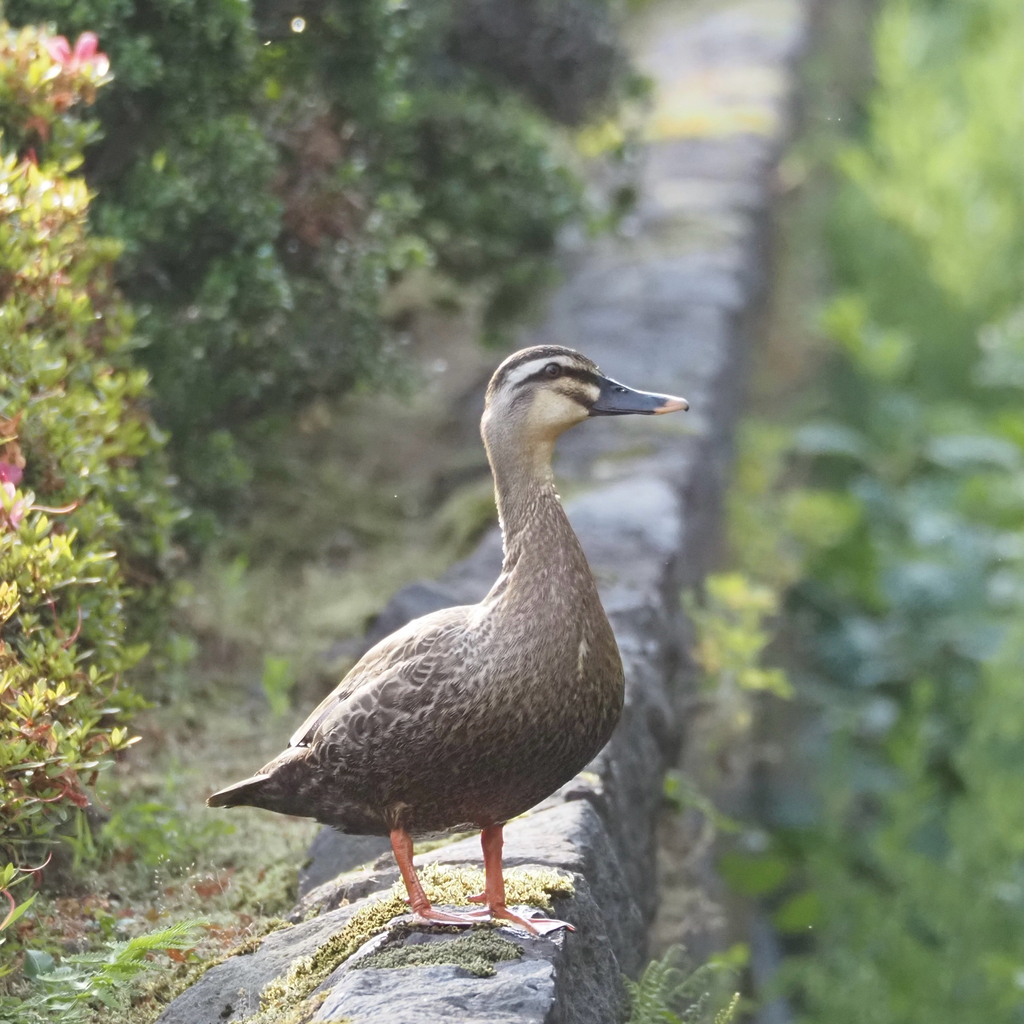
Eastern Spot-billed Duck
Photo © ITÔ, Hiroki
Photo © ITÔ, Hiroki — CC BY 4.0 — Source: iNaturalist #291616956Identification
The Eastern Spot-billed Duck is a medium-sized dabbling duck, approximately the same size as a mallard, measuring 55–63 cm in length with a wingspan of 83–95 cm. Both males and females are predominantly grey with a distinctive paler head and neck, contrasting with a black bill tipped bright yellow—the namesake feature that identifies this species. The wings display a striking white-bordered green speculum when in flight, with whitish wing coverts and black flight feathers visible from below. The legs and feet are bright orange, providing another helpful field mark. Juveniles are considerably browner and duller than adults, while the body plumage features an overall scaly pattern. Unlike some duck species, males lack an eclipse plumage, maintaining consistent coloration year-round.
This species is darker and browner than its close relative, the Indian Spot-billed Duck, and notably lacks the red bill spot characteristic of that species. Both males and females produce calls similar to mallards, with females delivering a loud quack and males a deeper, quieter vocalization. Both sexes undergo a complete postnuptial moult, simultaneously dropping all wing feathers during this vulnerable period.
Range & Habitat
The Eastern Spot-billed Duck is a migratory species that breeds in East and Southeast Asia, wintering in southern China and possibly Southeast Asia. Notably, populations in Japan and the Russian Far East have expanded their range northwards by more than 500 km since the early 20th century, a shift possibly driven by global warming. The species is occasionally recorded as a rare vagrant to the Aleutian Islands of Alaska.
This duck favours freshwater lakes and marshes in fairly open country. It is quite gregarious outside the breeding season, forming small flocks with other individuals and species. The breeding season varies depending on local rainfall and water conditions but typically occurs between April and July, with birds nesting on the ground in vegetation near water.
Behaviour & Diet
The Eastern Spot-billed Duck is a dabbling duck that feeds primarily on plant material, foraging mainly in the evening or at night when it is less conspicuous. Its feeding behaviour involves the typical dabbling technique of tipping forward in shallow water to access submerged vegetation.
During breeding season, pairs establish territories and construct ground nests in waterside vegetation. Clutches typically contain 7–9 eggs, and incubation begins only after the last egg is laid, ensuring that chicks hatch simultaneously after approximately 24 days. The chicks are black with a yellow back and resemble mallard ducklings closely, though they possess a wider eyestripe. Young birds fledge and become independent as they grow through summer and autumn.
Best Time & Places to See It
The best opportunities to observe Eastern Spot-billed Ducks occur during the winter months in southern China, where this migratory species congregates in significant numbers. Freshwater lakes and marshes in open landscapes are the prime habitats to search, particularly where shallow water and aquatic vegetation provide ideal feeding grounds. Winter visits to wetland reserves and protected areas in China offer the most reliable sightings, especially where birds gather in small flocks.
During breeding season, observers in Japan and the Russian Far East may encounter this species in suitable breeding habitat from April through July. However, winter populations in China provide the most accessible and productive viewing opportunities for most travellers.
Photography Tips
Photograph this species in early morning or late afternoon light to best capture the subtle grey plumage and vibrant yellow bill tip. The bright orange legs and feet are distinctive features worth highlighting in your images. When birds are in flight, aim to capture the striking white-bordered green speculum and the contrast between white wing coverts and black flight feathers, which are particularly striking from below.
Since these ducks feed primarily in evening and night hours, schedule photography sessions accordingly for natural feeding behaviour. In winter, when birds gather in flocks, focus on capturing both individual portraits showing the pale head and black bill, and wider habitat shots that convey their gregarious nature and wetland environment.
Orang National Park
Rangagarapathar, India
+298 birds+1 mammals
Where the Brahmaputra's floodplains meet the foothills of Assam, Orang National Park unfolds across a mosaic of riverine grasslands, forests and wetlands that pulse with the…
VIEW NATIONAL PARKGiant Panda National Park
Mianyang, China
+447 birds+47 mammals
Where the eastern slopes of China's Sichuan plateau descend into cloud-wrapped valleys, one of Asia's most biodiverse landscapes unfolds across more than 350,000 square kilometres. This…
VIEW NATIONAL PARKJiuzhai Valley
Jiuzhaigou County, China
+226 birds+7 mammals
Where crystalline alpine streams cascade through limestone gorges and karst terrain rises in dramatic vertical walls, Jiuzhai Valley unfolds across nearly 1,300 square kilometers of southwestern…
VIEW NATURAL MONUMENTHustai National Park
Altanbulag, Mongolia
+198 birds+16 mammals
Where the steppe rolls endlessly beneath vast Mongolian skies, Hustai National Park preserves one of Central Asia's most dynamic grassland ecosystems. Rolling hills and open prairie…
VIEW NATIONAL PARKKhoridol Saridag National Park
Khatgal, Mongolia
+164 birds+6 mammals
Where granite peaks thrust skyward across Mongolia's remote southeastern reaches, a landscape of raw geological drama unfolds. Deep river gorges carved through ancient stone create a…
VIEW NATIONAL PARKSanjiangyuan National Park
Nagqu, China
+187 birds+25 mammals
Where the headwaters of three great Asian rivers emerge from a high alpine plateau, the landscape unfolds in tundra and dwarf shrubland—a world of austere beauty…
VIEW NATIONAL PARKNortheast China Tiger and Leopard National Park
Mu Dan Jiang Shi, China
+202 birds+19 mammals
Across the temperate forests of northeastern China, where winters grip the landscape in subzero silence and summers remain cool and brief, the Mudanjiang region supports a…
VIEW NATIONAL PARKYancheng National Nature Reserve
Yancheng, China
+208 birds+4 mammals
Where the East China Sea's tidal rhythms sculpt the Jiangsu coast, Yancheng National Nature Reserve sprawls across one of Asia's most dynamic wetland complexes. This vast…
VIEW NATURE RESERVEZhalong National Nature Reserve
Qiqihar, China
+78 birds
Across the wetlands of northeastern China, where the Heilongjiang climate swings between brutal winters and warm summers, lies one of East Asia's most vital refuges for…
VIEW NATURE RESERVEPoyang Lake National Nature Reserve
Shangrao, China
+270 birds+7 mammals
Where the Yangtze River's massive floodplain spreads across central China, Poyang Lake National Nature Reserve encompasses one of the continent's most dynamic and water-rich wetland systems.…
VIEW NATURE RESERVECaohai National Nature Reserve
Bijie, China
+93 birds
At roughly 1,900 metres elevation on Guizhou's high plateau, Caohai sprawls across a temperate landscape shaped by pronounced seasonal extremes. Winters here are dry and cool,…
VIEW NATURE RESERVEQinghai Lake National Nature Reserve
Hainan Tibetan Autonomous Prefecture, China
+243 birds+11 mammals
At 3,200 metres above sea level on the Tibetan plateau, where winter temperatures plunge far below freezing and snow blankets the landscape for half the year,…
VIEW NATURE RESERVENo community photos yet. Log in to add the first one.
No community observations of this species yet.