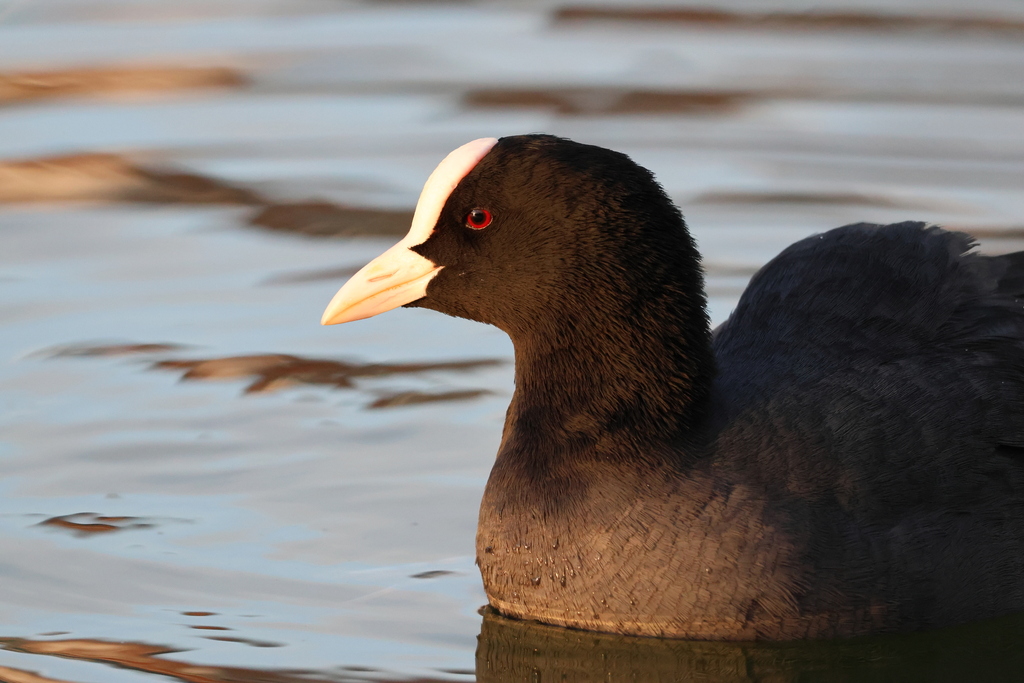
Eurasian Coot
Photo © Diego González Dopico
Photo © Diego González Dopico — CC BY 4.0 — Source: iNaturalist photo #350219904Identification
The Eurasian Coot is a striking and unmistakable waterbird, measuring 36–38 cm in length with a wingspan of 70–80 cm. Its plumage is predominantly slaty-black, with a glossy black head that contrasts sharply with a pure white bill and prominent white frontal shield—a distinctive facial marking that inspired the English phrase "as bald as a coot," documented as early as 1430. Males are slightly larger than females, typically weighing around 890 g compared to 750 g, though the sexes are otherwise similar in appearance. Juveniles are notably paler, with a whitish breast and lacking the characteristic facial shield; they develop full adult plumage by three to four months of age, though the white shield takes approximately one year to fully develop.
As an aquatic specialist, the coot possesses partial webbing on its long, strong toes, perfectly adapted for swimming. The species is notably vocal, with a wide repertoire of crackling, explosive, or trumpeting calls often heard echoing across water bodies, especially at night.
Range & Habitat
The Eurasian Coot boasts an extensive distribution across the Old World, occurring in Europe, Asia, Australia, Africa, and New Zealand, where it has recently expanded its range. Four recognized subspecies occupy different regions, from northern Europe and Asia extending south to Japan, India, Southeast Asia, the Philippines, Borneo, and New Guinea. The species is known occasionally as a vagrant in North America.
Coots breed on freshwater lakes and ponds throughout their range and have adapted remarkably well to urban environments, thriving in parks and gardens with water access. They are resident in milder parts of their range but migrate southward and westward from much of Asia during winter as waters freeze over.
Behaviour & Diet
Unlike most members of the rail family, the Eurasian Coot is notably conspicuous and sociable, often seen swimming openly on water or walking across waterside grasslands. The species is highly aggressive and strongly territorial during breeding season, with both parents defending their territory vigorously. Outside the breeding season, coots may form large flocks, possibly as a predator-avoidance strategy. When alarmed, coots are reluctant fliers, taking off by running frantically across the water surface with much splashing, though they can cover surprisingly large distances during nocturnal migrations.
The coot is an omnivore with a varied diet that includes small live prey and the eggs of other waterbirds. When defending territory or engaged in conflict with other waterbirds, coots attack aggressively by charging and striking opponents with their powerful long legs.
Best Time & Places to See It
Eurasian Coots are generally easy to locate on any accessible freshwater lake, pond, or urban waterway within their range. Urban parks and gardens with water features offer excellent opportunities for observation, as coots have become thoroughly habituated to human presence in many areas. They are visible year-round in milder regions, though winter months may see population fluctuations due to migration from frozen northern waters.
Photography Tips
The coot's contrasting black and white plumage makes it highly photogenic against water backgrounds. Photograph during calm conditions to capture reflections and to clearly document the distinctive white facial shield and bill. The species' tendency to remain in open water and its relatively unafraid demeanor in urban settings provide good opportunities for close approach. Capture their characteristic head-bobbing swimming motion or their entertaining scrambling take-offs across water surfaces, which create dynamic action shots. Early morning and late afternoon light will accentuate the glossy sheen of their black plumage. Watch for chicks in summer months—their fluffy black down with striking orange-red facial markings and red shields offer colorful photographic subjects.
Delta de l’Ebre Natural Park
Kanha Tiger Reserve
Abel Tasman National Park
Abruzzo, Lazio and Molise National Park
Aggtelek National Park
Alpilles Regional Nature Park
Alta Murgia National Park
Altun Mountain National Nature Reserve
Aoraki / Mount Cook National Park
Nothing matches these filters.
No community photos yet. Log in to add the first one.