Identification
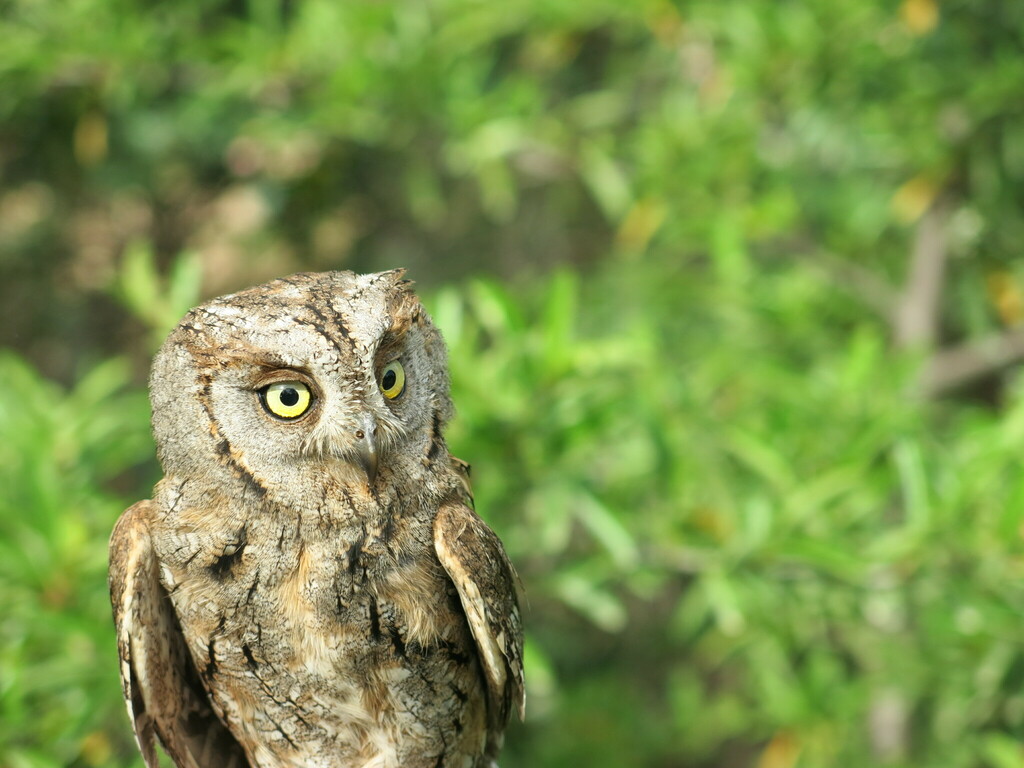
The Eurasian Scops Owl is a tiny owl, measuring just 19–21 cm in length with a wingspan of 47–54 cm, making it noticeably smaller than the little owl. Its most distinctive feature is the pair of small ear-tufts that give the species its name. The plumage is predominantly grey-brown, with a paler face, underparts, and shoulder line that create subtle but effective camouflage. This upright-perching owl has long, narrow wings that reflect its migratory lifestyle and enable a strong, direct flight.
The species produces a deep whistling call given by both sexes, remarkably similar to the calls of midwife toads. This distinctive sound is often the most reliable way to locate the bird in the field, particularly during breeding season.
Range & Habitat
The Eurasian Scops Owl breeds across southern Europe and extends eastwards through western and central Asia into southern Siberia and the western Himalayas. Five subspecies are recognised, ranging from the Iberian Peninsula to Pakistan. Most populations are migratory, wintering in sub-Saharan Africa, though birds remain year-round in parts of Mediterranean Europe. The species is rarely recorded far north of its breeding range outside the breeding season.
This owl favours open woodland, parks, and gardens for breeding. It nests in tree cavities, wall holes, or occasionally takes over old nests abandoned by other species such as crows. Breeding habitat includes areas from the Mediterranean region eastwards across temperate and subtropical zones.
Behaviour & Diet
The Eurasian Scops Owl is largely nocturnal, making it a challenging species to observe visually. It specialises in hunting small prey, particularly insects and other invertebrates. Breeding pairs nest in cavities where the female alone incubates a clutch of typically 4 or 5 white eggs. After an incubation period of 24–25 days, the chicks hatch and are fed by both parents until fledging at 21–29 days old. Young owls become independent of their parents within 30–40 days.
Best Time & Places to See It
The best time to locate this species is during the breeding season when males call frequently, particularly at dusk and throughout the night. Mediterranean regions, including southern France, Italy, Greece, Spain, and Turkey, offer the most reliable opportunities. The owl is unlikely to be found outside its breeding range during the non-breeding season, when birds are silent and far more difficult to detect. Spring overshoots occasionally occur north of the normal range.
Photography Tips
Photographing the Eurasian Scops Owl presents significant challenges due to its small size, nocturnal habits, and cryptic coloration. Focus your efforts during the breeding season when birds are more active and vocal. Listen for the distinctive deep whistle to locate individuals, then approach carefully and quietly. Use high ISO settings and fast lenses to capture images in low-light conditions. The owl's upright posture and ear-tufts are key identifying features to emphasise in your images. Early evening or pre-dawn sessions offer the best window for photography when the owl may be more active.