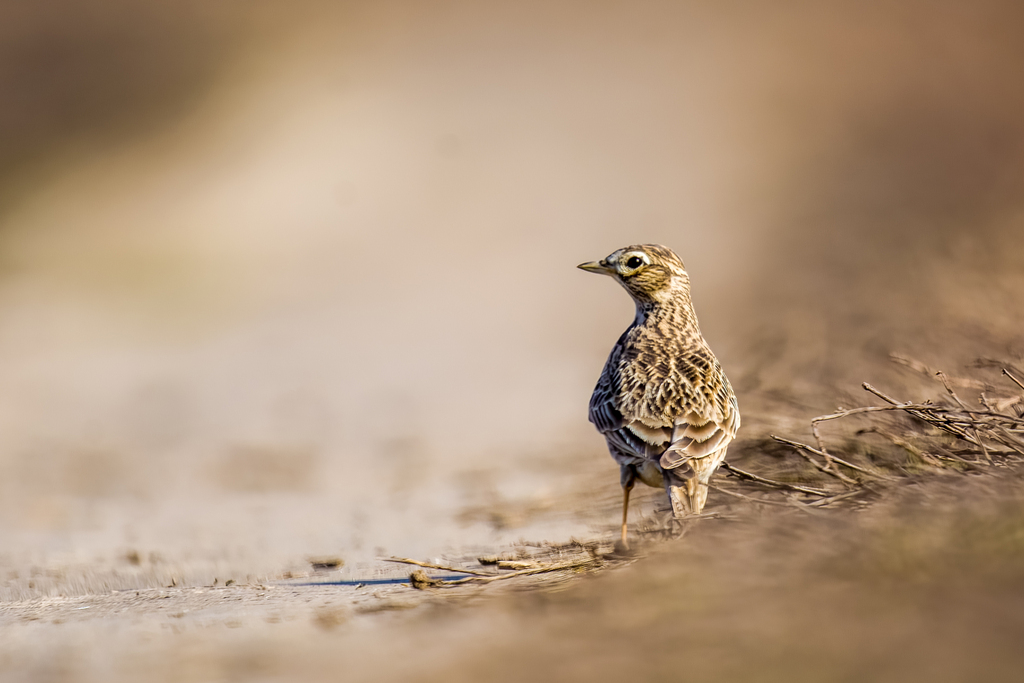
Eurasian Skylark
Photo © Шальнов Кирилл
Photo © Шальнов Кирилл — CC BY 4.0 — Source: iNaturalist photo #266746478Identification
The Eurasian Skylark is a rather dull-looking passerine, measuring 18–19 cm in length. It is streaked greyish-brown above and on the breast, with a buff-white belly. Both sexes are alike in plumage. The bird has a distinctive short blunt crest on the head, which can be raised and lowered at will. In flight, it shows a short tail and short broad wings; the tail and rear edge of the wings are edged with white, visible when the bird flies away. The male has notably broader wings than the female—an adaptation for more efficient hovering flight, likely evolved through females' preference for males that sing and hover for extended periods.
Range & Habitat
The Eurasian Skylark is a widespread species found across Europe and Asia, breeding in the mountains of north Africa as well. Eleven subspecies are recognized across this vast range. Western populations are mainly resident year-round, while eastern populations are more migratory, moving south in winter. Even in milder western regions, many birds descend to lowlands and coastal areas during winter months. The species favours open farmland and heath, breeding on open ground well away from trees, bushes and hedges.
The species has been introduced to several regions outside its native range, including New Zealand (from 1864 onwards), Australia (from 1850), Canada, and the Hawaiian Islands (from 1865). In Australia, it is now widespread in the southeast, while in New Zealand it had spread throughout both islands by the 1920s.
Behaviour & Diet
The Eurasian Skylark is renowned for the male's extraordinary song, delivered in hovering flight at heights of 50 to 100 metres, often appearing as just a dot in the sky to ground observers. The song is a clear, bubbling warble, generally lasting two to three minutes, though it may extend to 20 minutes or more during the mating season. Males display local microdialects, with neighbouring birds sharing distinctive song patterns that function as group signatures. At wind farm sites, males have been observed singing at higher frequencies to compensate for wind turbine noise.
The female builds an open nest in a shallow depression on open ground, laying three to five eggs which she incubates for around 11 days. Both parents feed the chicks, which leave the nest after 8–10 days before they can fly, scattering and hiding in vegetation while continuing to receive parental care until they achieve flight at 18–20 days of age. Parents can raise several broods in a single season, though nests face high predation rates from larger birds and small mammals.
Best Time & Places to See It
The Eurasian Skylark is best observed during breeding season in open farmland and heath habitats across Europe and Asia. Spring and early summer are ideal times to locate birds, particularly at dawn when males are most vocal and active in their hovering song flights. In western Europe, the species is resident year-round, making it potentially observable in any season, though winter movements to lowlands and coasts may shift local populations. Eastern populations are more migratory, so timing visits to breeding grounds during spring and summer maximizes sighting opportunities.
Photography Tips
Photographing the Eurasian Skylark presents both challenges and rewards. The male's hovering song flight at 50–100 metres height makes it an exhilarating subject, though capturing it as more than a speck requires good telephoto reach and fast shutter speeds to freeze the hovering motion. Early morning visits to open farmland offer the best chances of locating singing males. Look for the characteristic short crest and watch for the white-edged tail and wing rear edges visible in flight. Ground-nesting birds are wary of disturbance, so approach nesting areas with caution and maintain distance to avoid disturbing brooding females or vulnerable chicks hidden in vegetation.
Private Full-Day Birdwatching Tour from Lisbon to the Tagus Estuary
Nothing matches these filters.
Abel Tasman National Park
Abruzzo, Lazio and Molise National Park
Aggtelek National Park
Alta Murgia National Park
Aoraki / Mount Cook National Park
Appennino Lucano Val d’Agri Lagonegrese National Park
Appennino Tosco-Emiliano National Park
Arthur’s Pass National Park
Asinara National Park
Nothing matches these filters.
No community photos yet. Log in to add the first one.
No community observations of this species yet.