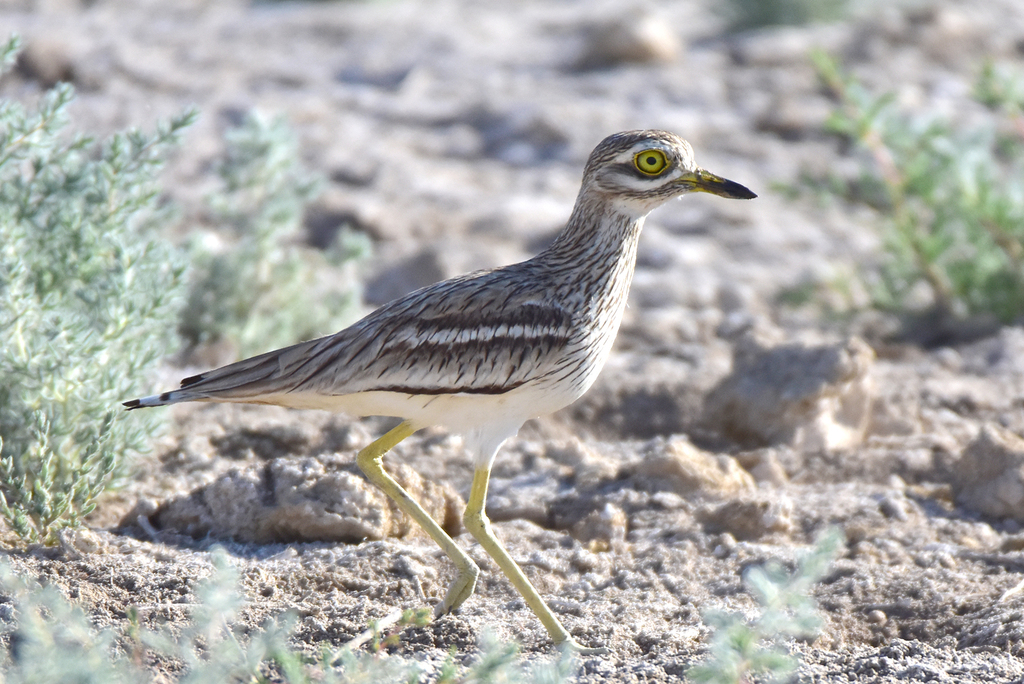
Eurasian Stone-curlew
Photo © Kudaibergen Amirekul
Photo © Kudaibergen Amirekul — CC BY-SA 4.0 — Source: iNaturalist photo #208434255Identification
The Eurasian stone-curlew is a fairly large wader, measuring 38 to 46 cm in length with a wingspan of 76 to 88 cm. Its most distinctive features are its large, piercing yellow eyes that give it a striking "reptilian" or "goggle-eyed" appearance, combined with a strong yellow and black beak. The bird's overall plumage is cryptic and earth-toned, providing excellent camouflage in its preferred stony habitats. In flight, however, it reveals bold black and white wing markings that make it surprisingly conspicuous. The species is named for its prominent tibiotarsal joints—the "thick knees" that distinguish it from other waders.
Range & Habitat
This species occurs throughout Europe, north Africa, and southwestern Asia, with five recognized subspecies distributed across this vast range. In temperate European and Asian regions, it is a summer migrant, wintering in Africa, while populations in warmer areas may be resident or move less predictably. Despite being classified as a wader, the Eurasian stone-curlew is unusual in preferring dry open habitats with bare ground rather than wetlands, making it at home on stony heaths, grasslands, and other arid or semi-arid terrain.
Behaviour & Diet
The Eurasian stone-curlew is largely nocturnal, particularly when vocal. Its loud, wailing songs are reminiscent of curlews—a resemblance that contributed to its common name. The bird feeds primarily on insects and other small invertebrates, though it will also take small reptiles, frogs, and rodents when available. Breeding birds typically first breed at three years of age, laying two eggs in a simple scrape on open ground. Both parents incubate the eggs for 24–26 days and care for the precocial chicks for 36–42 days after hatching. Normally only one brood is raised annually, though replacement clutches are laid if eggs or young are lost. Ring-recovery data from the British Isles documents individuals living more than 22 years in the wild.
Best Time & Places to See It
In Europe, the best time to observe stone-curlews is during the breeding season from spring through summer, when birds are most vocal despite their nocturnal habits. Listen for their distinctive wailing calls at dawn, dusk, and through the night in open, stony habitats. Winter visitors are more likely in African wintering grounds. The species' preference for bare, open terrain means that suitable habitat is often visible from roadsides and viewpoints, though patience and timing—visiting during active hours—will greatly improve your chances of sightings.
Photography Tips
The stone-curlew's cryptic plumage makes it challenging to photograph in its preferred habitat, but the bird's distinctive yellow eyes and striking wing patterns reward careful effort. Early morning and late evening light is ideal for capturing both the subtle earth tones of the plumage and the piercing gaze for which the species is famous. If you locate a breeding bird or territory, return repeatedly to the same spot to learn the bird's patterns and movements. In flight, the black and white wing markings are most apparent, so be ready to capture these revealing moments. The bird's preference for open ground means you may have reasonable shooting distances without heavy cover obstruction.
Monfragüe National Park
Torrejón el Rubio, Spain
+219 birds+10 mammals
Where the Tagus River cuts through limestone plateaus in central Extremadura, Monfragüe National Park rises as a fortress of Mediterranean and Atlantic woodland, its dramatic rocky…
VIEW NATIONAL PARKS’Albufera Natural Park
Platja de Muro, Spain
+253 birds+6 mammals
Where Mediterranean lagoons meet the Balearic coast, S'Albufera stretches across nearly 1,600 hectares of wetland and dune systems that rank among Europe's most ecologically vital shallow-water…
VIEW NATURAL PARKL’Albufera Natural Park
València, Spain
+321 birds+18 mammals
Where shallow lagoons meet Mediterranean coastal marshland, L'Albufera Nature Park unfolds as one of Spain's most vital wetland complexes. This protected landscape, designated under IUCN Category…
VIEW NATURAL PARKSchleswig-Holsteinisches Wattenmeer National Park
Germany
+378 birds+49 mammals
Where the North Sea ebbs and flows across a vast expanse of exposed mud and sand, the Schleswig-Holsteinisches Wattenmeer National Park reveals one of Europe's most…
VIEW NATIONAL PARKTimanfaya National Park
Tinajo, Spain
+37 birds
Across Lanzarote's northwestern plains, where the Atlantic wind sculpts black lava fields into a landscape of geological drama, lies one of Europe's most visually arresting volcanic…
VIEW NATIONAL PARKDoñana National Park
Hinojos, Spain
+300 birds+13 mammals
Where the Guadalquivir River delta spreads into the Atlantic, vast marshes, cork woodlands, and coastal dunes converge to create one of southwestern Europe's most biodiverse wetland…
VIEW NATIONAL PARKTablas de Daimiel National Park
Daimiel, Spain
+246 birds+6 mammals
Where the Guadiana River spreads into a labyrinth of shallow lagoons and reed beds across the sun-baked plains of central Spain, Tablas de Daimiel National Park…
VIEW NATIONAL PARKMurchison Falls National Park
Uganda
+608 birds+33 mammals
Where the Victoria Nile compresses through a narrow gorge and explodes across a 45-meter precipice, the landscape speaks in thunder. Murchison Falls National Park sprawls across…
VIEW NATIONAL PARKCabo de Gata-Níjar Natural Park
San José, Spain
+274 birds+11 mammals
Where volcanic ridges plunge toward the Mediterranean, Cabo de Gata-Níjar Nature Park unfolds across one of Europe's most arid coastlines, a landscape sculpted by tectonic violence…
VIEW NATURAL PARKDelta de l’Ebre Natural Park
Eucaliptus, Spain
+341 birds+18 mammals
Where the Ebro River spreads into a vast labyrinth of shallow lagoons, reed beds, and brackish marshes before surrendering to the Mediterranean, one of southern Europe's…
VIEW NATURAL PARKCap de Creus Natural Park
Roses, Spain
+245 birds+23 mammals
Where the Pyrenees tumble into the Mediterranean, Cap de Creus Nature Park unfolds across 300 square kilometres of one of northeastern Spain's most dramatic coastal wilderness…
VIEW NATURAL PARKDanube Delta Biosphere Reserve
Tulcea, Romania
+277 birds+27 mammals
Where the Danube surrenders to the Black Sea, a vast labyrinth of channels, reed beds, and freshwater lakes sprawls across nearly 13,400 square kilometers of eastern…
VIEW NATIONAL PARKCabañeros National Park
Retuerta del Bullaque, Spain
+183 birds+8 mammals
Cabañeros National Park is one of Spain’s finest wildlife destinations and one of the best-preserved examples of Mediterranean forest and scrubland in Europe. Located in the…
VIEW NATIONAL PARKCévennes National Park
Vebron, France
+187 birds+63 mammals
Where granite gorges slice through the limestone plateaux of southern France, the Cévennes Cœur National Park unfolds across nearly 3,500 square kilometres of one of Europe's…
VIEW NATIONAL PARKSierra de Cazorla, Segura y las Villas Nature Park
Las Canalejas, Spain
+176 birds+21 mammals
Where granite gorges slice through mountainous terrain in eastern Andalusia, the Sierra de Cazorla, Segura y las Villas Nature Park sprawls across more than 5,200 square…
VIEW NATURAL PARKParc del Garraf
Rat-Penat, Spain
+190 birds+15 mammals
Where limestone ridges rise abruptly from the Mediterranean coastal plain, Parc Natural del Garraf unfolds across 319 square kilometers of one of Catalonia's most dramatic protected…
VIEW NATURAL PARKCollserola Natural Park
Barcelona, Spain
+194 birds+20 mammals
Where Mediterranean scrubland rises steeply from Barcelona's urban edge, Collserola unfolds across 173 square kilometres of low mountains that form a crucial ecological buffer between city…
VIEW NATURAL PARKHortobágy National Park
Hortobágy, Hungary
+260 birds+17 mammals
Across the North Great Plain of Hungary stretches one of Europe's most expansive semi-natural grassland systems, where horizon-wide vistas of steppe and wetland create a landscape…
VIEW NATIONAL PARKSierra de Andújar Natural Park
Our Lady of Cabeza, Spain
+198 birds+19 mammals
Where granite gorges slice through Mediterranean scrubland and cork forests cascade down Andalusian hillsides, one of Spain's most pristine wilderness areas unfolds across 74,000 hectares of…
VIEW NATURAL PARKEspacio Natural Remolar-Filipinas
El Prat del Llobregat, Spain
+297 birds+7 mammals
Where the Llobregat River delta meets the Mediterranean, a patchwork of salt marshes, reed beds, and shallow lagoons creates one of Catalonia's most dynamic wetland ecosystems.…
VIEW NATURE RESERVEUrdaibai Biosphere Reserve
Txatxarramendi, Spain
+268 birds+8 mammals
Where the Pyrenean foothills surrender to the Bay of Biscay, tidal estuaries carve through Basque limestone, creating one of Europe's most ecologically vital wetland complexes. Salt…
VIEW BIOSPHERE RESERVECamargue Regional Nature Park
Saintes-Maries-de-la-Mer, France
+378 birds+48 mammals
Where the Rhône Delta sprawls into the Mediterranean, a landscape of stark and haunting beauty emerges—vast salt marshes punctuated by shallow lagoons, reed beds, and scrubland…
VIEW NATURAL PARKRegional Park of the Catalan Pyrenees
Olette, France
+244 birds+63 mammals
Where granite peaks thrust skyward above cloud-laden valleys, a wild tapestry of Mediterranean and alpine ecosystems interweaves across the Franco-Spanish frontier. These Pyrenean slopes harbour extraordinary…
VIEW NATURE RESERVEDirigida Laguna de Gallocanta Nature Reserve
Las Cuerlas, Spain
+250 birds+7 mammals
Where continental steppe meets the vast mirror of inland water, Spain's largest natural lagoon reveals a landscape of haunting beauty. The shallow alkaline lake, cradled in…
VIEW NATURE RESERVEMontes de Málaga Natural Park
Málaga, Spain
+159 birds+7 mammals
Where cork oak and pine forest sweep across the rugged hills inland from the Costa del Sol, the Montes de Málaga Nature Park unfolds as a…
VIEW NATURAL PARKSerra de Mariola Natural Park
Bocairent, Spain
+164 birds+19 mammals
Where limestone ridges rise above the Valencian interior, Serra de Mariola unfolds across 225 square kilometers of Mediterranean mountain terrain that shifts between dense evergreen woodland,…
VIEW NATURE RESERVEEstrecho Natural Park
Pedro Valiente, Spain
+281 birds+20 mammals
Where Mediterranean pine forests meet wind-sculpted coastal cliffs, one of Europe's most dynamic ecological crossroads unfolds across the Strait of Gibraltar. Spanning 686 square kilometers of…
VIEW NATURAL PARKSierras Subbéticas Natural Park
Algar, Spain
+156 birds+10 mammals
Where limestone ridges rise abruptly from the Córdoba countryside, the Sierras Subbéticas Nature Park sprawls across nearly 583 square kilometres of one of Andalusia's most rugged…
VIEW NATURAL PARKPollino National Park
Viggianello, Italy
+125 birds+9 mammals
Where limestone ridges rise abruptly from the Basilicatan foothills, Pollino National Park enfolds a landscape of profound ecological character—one defined by steep valleys, alpine meadows clinging…
VIEW NATIONAL PARKCirceo National Park
Italy
+232 birds+6 mammals
Where limestone headlands plunge toward the Tyrrhenian Sea, Circeo National Park preserves a rare mosaic of Mediterranean coastal habitats that few Italian reserves can match. The…
VIEW NATIONAL PARKTuscan Archipelago National Park
Rio, Italy
+174 birds+8 mammals
Where the Tyrrhenian Sea fragments into granite and schist islands, the Arcipelago Toscano National Park protects one of the Mediterranean's most biodiverse maritime realms. Scattered across…
VIEW NATIONAL PARKGargano National Park
Cagnano Varano, Italy
+219 birds+7 mammals
Where the Gargano Peninsula's limestone plateaus descend toward the Adriatic, Cagnano Varano sits at the threshold of one of southern Italy's most ecologically vital landscapes. The…
VIEW NATIONAL PARKAsinara National Park
Porto Torres, Italy
+103 birds+5 mammals
Rocky limestone cliffs plunge toward the Tyrrhenian Sea where Dell'Asinara National Park guards a slender island sanctuary off Sardinia's northwestern coast. The park's terrain is a…
VIEW NATIONAL PARKBiebrza National Park
Goniądz, Poland
+242 birds+33 mammals
Where the Narew River sprawls across northeastern Poland's flatlands, Biebrza National Park unfolds as one of Europe's largest and most ecologically vital wetland complexes. Encompassing roughly…
VIEW NATIONAL PARKKerkini Lake National Park
Serres, Greece
+291 birds+18 mammals
Where the Strymon River widens into a sprawling freshwater lake hemmed by the Rhodope Mountains, Kerkini National Park unfolds across northern Greece as one of southeastern…
VIEW NATIONAL PARKCabo Peñas
Susacasa, Spain
+303 birds+21 mammals
Where sea cliffs rise sheer from the Bay of Biscay, Susacasa's observation point commands one of Asturias's most dramatic coastal vistas. The landscape here is defined…
VIEW OBSERVATION POINTPort-Cros National Park
Hyères, France
+271 birds+29 mammals
Where Mediterranean granite islands rise from crystalline waters off the Provençal coast, Port-Cros National Park protects one of Europe's most intact marine and terrestrial ecosystems. The…
VIEW NATIONAL PARKPyrénées National Park
Hautes Pyrenees, France
+150 birds+35 mammals
Where alpine meadows give way to limestone cliffs and rushing torrents carve through ancient stone, the Pyrénées National Park spans a landscape of austere beauty along…
VIEW NATIONAL PARKCalanques National Park
Bouches-du-Rhône, France
+233 birds+42 mammals
Where limestone cliffs plunge dramatically into crystalline Mediterranean waters, Calanques National Park preserves one of Europe's most striking coastal landscapes. These steep-sided inlets, carved by erosion…
VIEW NATIONAL PARKAlta Murgia National Park
Bari, Italy
+168 birds+6 mammals
Across the limestone plateaux of Apulia's interior, where the Adriatic's influence fades into continental warmth, lies a landscape sculpted by millennia of human pastoralism and Mediterranean…
VIEW NATIONAL PARKNo community photos yet. Log in to add the first one.
No community observations of this species yet.