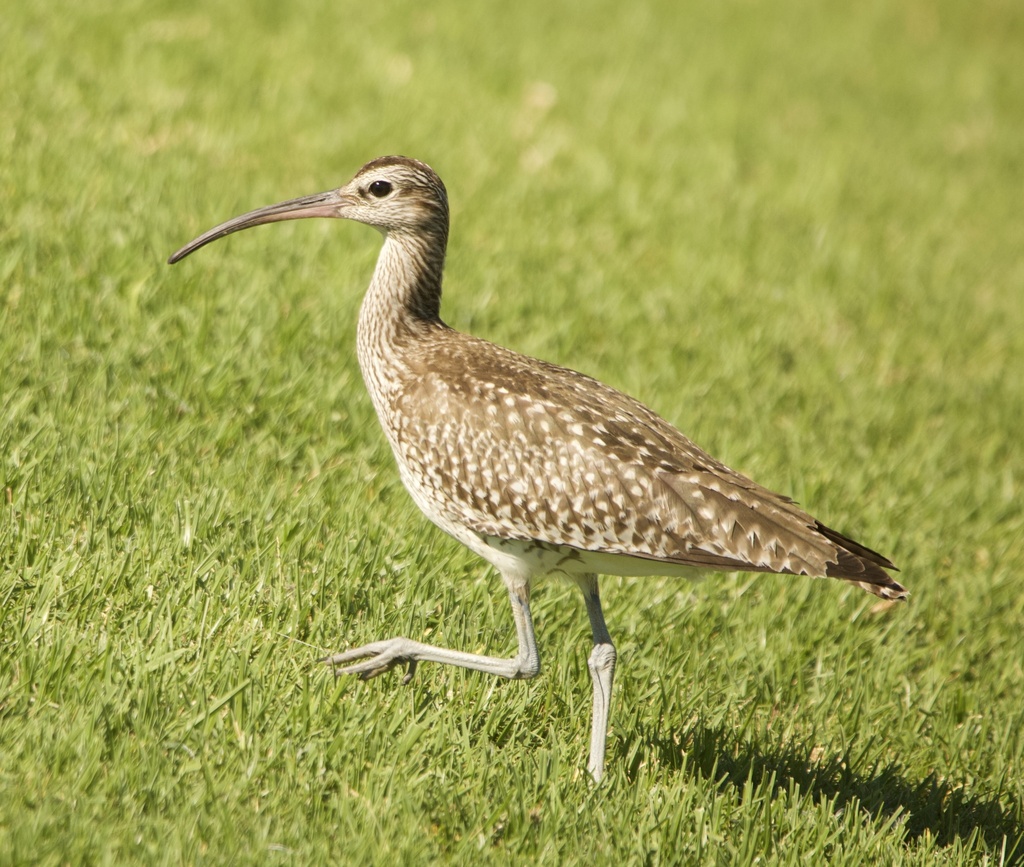
Eurasian Whimbrel
Photo © Morgan Caygill
Photo © Morgan Caygill — CC BY 4.0 — Source: iNaturalist photo #438316294Identification
The Eurasian whimbrel is a fairly large wader, mid-sized within the curlew genus, measuring 37–47 cm in length with a wingspan of 75–90 cm. Its most distinctive feature is a long, curved bill with a characteristic kink rather than a smooth curve—a trait that gives the genus its name, derived from the Greek words for "new" and "moon," referencing the crescent shape. The plumage is mainly greyish brown with a white back and rump (in most subspecies), making it readily distinguishable from the similar Hudsonian whimbrel of the Americas, which has a drab brown rump matching the rest of its body. The bird's rippling whistle call is imitative and diagnostic, prolonged into a trill during song.
Range & Habitat
One of the most widespread of the curlews, the Eurasian whimbrel breeds across much of the subarctic Palearctic region and Europe as far south as Scotland, with five recognized subspecies occupying different geographic ranges from Norway and Iceland to northeastern Siberia. The species is highly migratory, wintering on coasts across Africa, South Asia, and Australasia. During breeding season, it favours lowland plains, grasslands, and wetlands in flat, wet areas with low vegetation; it breeds in Scotland particularly around Shetland, Orkney, the Outer Hebrides, and mainland areas such as Sutherland and Caithness. The species is notably coastal during migration periods and fairly gregarious outside the breeding season.
Behaviour & Diet
The whimbrel feeds primarily by probing soft mud for small invertebrates and by picking small crabs and similar prey from the surface. Before migration, berries become an important dietary component, and the bird has been observed taking insects, including blue tiger butterflies. During breeding, pairs nest in bare scrapes on tundra or Arctic moorland, often in low vegetation or moss. Clutches typically consist of three to five eggs. When threatened near the nest, the mother employs a distraction display, remaining motionless until danger approaches, then flying a short distance away while making noise to lure predators from her vulnerable chicks. The fluffy, yellow and black chicks possess short beaks unlike their parents, and within weeks of hatching become highly mobile, leading to swift nest abandonment.
Best Time & Places to See It
The Eurasian whimbrel occurs in Ireland and the United Kingdom, with breeding populations in Scotland being the most accessible to European birdwatchers. Iceland hosts approximately one-third of the world's breeding population, making it an excellent destination during the breeding season. As a migratory species, whimbrels can be encountered on coasts during spring and autumn migration periods when they are fairly gregarious. Winter sightings are possible along coasts in Africa, South Asia, and Australasia where the species winters.
Photography Tips
The whimbrel's diagnostic white rump is best captured in flight, providing a striking identification feature against its greyish-brown plumage. The long, kinked bill is a key photographic detail worth emphasizing. During breeding season in Scotland and Iceland, patient photographers may document the species in its moorland habitat. Coastal settings during migration periods offer opportunities to photograph the bird's gregarious behaviour, while its rippling whistle call can help locate individuals for photography. The bird's distraction display during breeding season, though challenging to photograph ethically, represents fascinating behavioural documentation.
Private Full-Day Birdwatching Tour from Lisbon to the Tagus Estuary
Week-long Birdwatching Programme in Northern & Central Portugal
Nothing matches these filters.
Parque del Centenario
Queen Elizabeth National Park
Tombstone Territorial Park
Abel Tasman National Park
Acadia National Park
Addo Elephant National Park
Agulhas National Park
Alaska Maritime National Wildlife Refuge
Algonquin Provincial Park
Nothing matches these filters.
No community photos yet. Log in to add the first one.