Hide 9 Pins
Iberian Green Woodpecker · Great Spotted Woodpecker+17
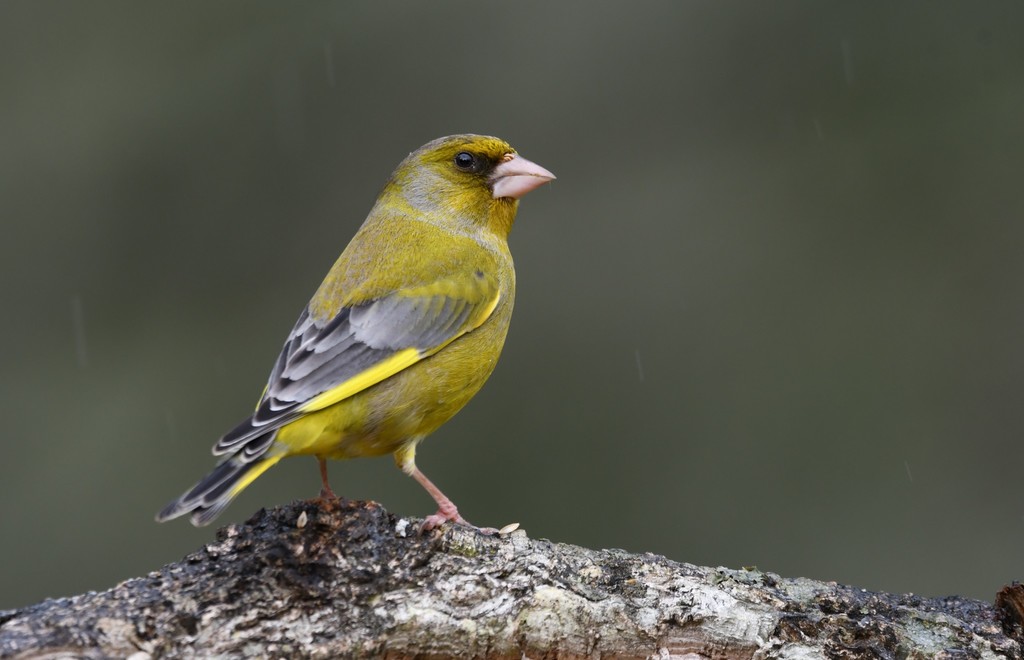
The European greenfinch is a small finch measuring 15 cm long with a wingspan of 24.5 to 27.5 cm, making it roughly similar in size and shape to a house sparrow. Males are predominantly green with striking yellow markings in the wings and tail, while females and young birds are duller with brownish tones on the back. All birds have a thick, conical bill adapted for seed-eating. The male's song is distinctive, featuring frequent trilling and twittering interspersed with wheezing notes, and males perform an eye-catching "butterfly" display flight during breeding season.
The European greenfinch is widespread throughout Europe, North Africa, and Southwest Asia. It is primarily resident across much of its range, though populations from the far north migrate southward seasonally. The species has also been introduced to Australia, New Zealand, Uruguay, and Argentina. Within its native range, it favours woodland edges, farmland hedges, and gardens with relatively thick vegetation, particularly for breeding purposes.
This finch feeds on a wide variety of seeds, berries, fruit, buds, flowers, and some arthropods, foraging in trees, bushes, and on the ground. The breeding season runs from the second half of March through June, with fledging occurring in early July. Females build nests in trees or bushes and lay clutches of 4–6 greyish-white, bluish-white, or beige eggs with reddish or brownish markings. The female incubates eggs for 13–14 days while the male provides food. Chicks fledge 16–18 days after hatching, and the species typically produces two or three broods per year. In Australasia, breeding occurs from October to March.
The greenfinch is widespread and relatively easy to observe throughout its European range during the breeding season from March through July. Its preference for gardens, hedgerows, and woodland edges makes it accessible to birdwatchers in both rural and suburban settings. Year-round residents can be found across much of the range, while migrants from northern populations are most visible during spring and autumn movements.
The male's vibrant green and yellow plumage makes for striking photographs, particularly when captured in good light to show the contrast between the green body and yellow wing and tail markings. The distinctive "butterfly" display flight performed by males offers dynamic shooting opportunities. Patience around gardens, hedges, and seed sources will reward photographers with close approach opportunities, and the species' relatively small size means a telephoto lens is beneficial for detailed shots.
Nothing matches these filters.
Nothing matches these filters.
No community photos yet. Log in to add the first one.
No community observations of this species yet.
We'd love to hear from you. We'll reply as soon as possible.
Found an error? Have a suggestion? We read every message.
A compact view of how this species lives, moves and responds to its environment.
Select a card to explore the details.
Please confirm the photo rights and credit terms first.
I'm the author of this photo or hold the rights to it, and I keep full ownership. I grant Wild Atlas Guide a free, non-exclusive licence to display it on the site and in Wild Atlas Guide's own channels, including social media, always credited to me by my display name or the Instagram handle I choose to provide. I confirm it does not reveal a sensitive wildlife location or a recognisable person without their permission. I can withdraw future social use for this photo or ask for it to be removed at any time.
Please accept the photo rights and credit terms to continue.
Uploading…
We use cookies to measure traffic and improve Wild Atlas Guide. You decide. Privacy policy