European Pied Flycatcher
Ficedula hypoleuca
Photo © Вячеслав Шуплецов
Photo © Вячеслав Шуплецов — CC BY 4.0 — Source: iNaturalist photo #655436339ABOUT
Subspecies of European Pied Flycatcher
European Pied FlycatcherIberian Pied FlycatcherSiberian Pied Flycatcher
Identification
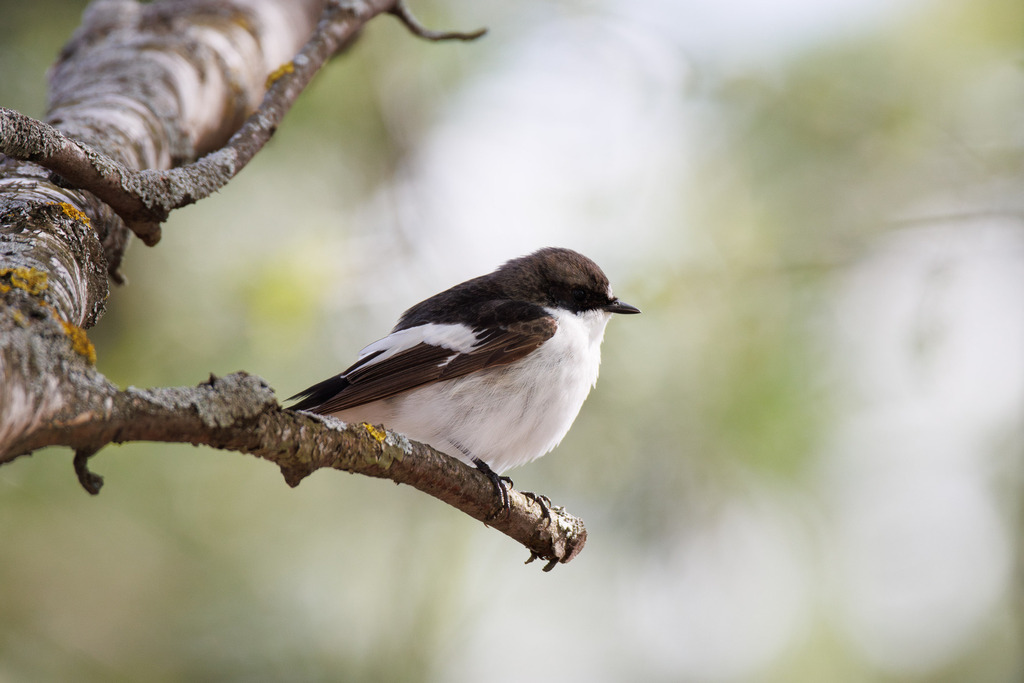
The European pied flycatcher is a small songbird measuring 12–13.5 centimetres in length. Breeding males are unmistakable, displaying mainly black plumage above contrasted with white underparts, a large white wing patch, white tail sides, and a small white forehead patch. The Iberian subspecies has a more prominent forehead patch and a pale rump. Non-breeding males, females, and juveniles are considerably more challenging to identify, as their black markings are replaced by pale brown—a feature that can make them very difficult to distinguish from the closely related collared flycatcher, with which they hybridise to a limited extent. The bird has a characteristic black bill with the broad, pointed shape typical of aerial insectivores.
Range & Habitat
The European pied flycatcher has a very large range across much of Europe and the Western Palearctic. The nominate subspecies inhabits the UK, central Europe, and Scandinavia, while the Iberian subspecies is found in the Iberian Peninsula, and the eastern subspecies in eastern Europe and Russia. These birds are highly migratory, spending winters mainly in tropical Africa. They favour deciduous woodlands, parks, and gardens, with a particular preference for oak trees. The species typically inhabits open forests and woodlands, and has adapted well to urban settings. In 2005, the European population was estimated at 3–7 million pairs, reflecting its healthy conservation status.
Behaviour & Diet
The European pied flycatcher is mainly insectivorous, feeding on a diet that includes caterpillars, flies, spiders, ants, bees, and other arthropods. It hunts both by darting after insects in flight and by foraging amongst oak foliage for caterpillars, and will occasionally take berries. The species is known for its loud, rhythmic, and melodious song, which is characteristic of oak woods in spring, and produces a distinctive short whistled contact and alarm call: 'whit, whit, whit'. The bird's breeding behaviour is particularly notable—it practices a mixed mating system combining monogamy and polygyny. Males typically acquire a secondary mate by establishing a second territory, then return to their primary female to assist with chick-rearing and feeding duties.
Best Time & Places to See It
Spring is the ideal season for observing the European pied flycatcher, particularly in oak woodlands where its loud song is most characteristic and conspicuous. The species is an earlier spring migrant than the spotted flycatcher, making it a reliable sight during the breeding season across its European range. Oak-dominated woodlands, deciduous forests, parks, and gardens throughout the UK, Scandinavia, central Europe, and the Iberian Peninsula all offer good opportunities for sightings during the breeding months.
Photography Tips
Breeding males in their striking black-and-white plumage offer the most rewarding photographic subjects. Focus on oak woodlands in spring when the bird's behaviour is most active and vocal. The bird's habit of hunting amongst foliage and making aerial sallies for insects provides varied shooting opportunities. Be aware that non-breeding birds and females are far more subtle in appearance and may require patience to identify and photograph successfully. Nest boxes installed in suitable habitat can provide excellent close-up opportunities, as the species readily adapts to open-fronted boxes for breeding.
HIDES
HOTSPOTS
Country
Type
Sort by
National Park
Aggtelek National Park
Szin·Hungary
+119 birds+13 mammals
Natural Park
Alpilles Regional Nature Park
Saint-Rémy-de-Provence·France
+219 birds+37 mammals
National Park
Alta Murgia National Park
Bari·Italy
+168 birds+6 mammals
National Park
Asinara National Park
Porto Torres·Italy
+103 birds+5 mammals
National Park
Åsnens National Park
Kronoberg County·Sweden
+141 birds+8 mammals
Natural Park
Avesnois Regional Nature Park
Saint-Hilaire-sur-Helpe·France
+206 birds+40 mammals
National Park
Bannau Brycheiniog National Park
Powys·United Kingdom
+178 birds+36 mammals
Desert & Arid Lands
Bardenas Reales
Arguedas·Spain
+234 birds+10 mammals
Natural Park
Baronnies Provençales Regional Nature Park
Sahune·France
+135 birds+30 mammals
Nothing matches these filters.
COMMUNITY
Share your photo of this species
Sort by
No community photos yet. Log in to add the first one.
0
Observed by
0
Hotspots reported
0
Countries
No community observations of this species yet.