Identification
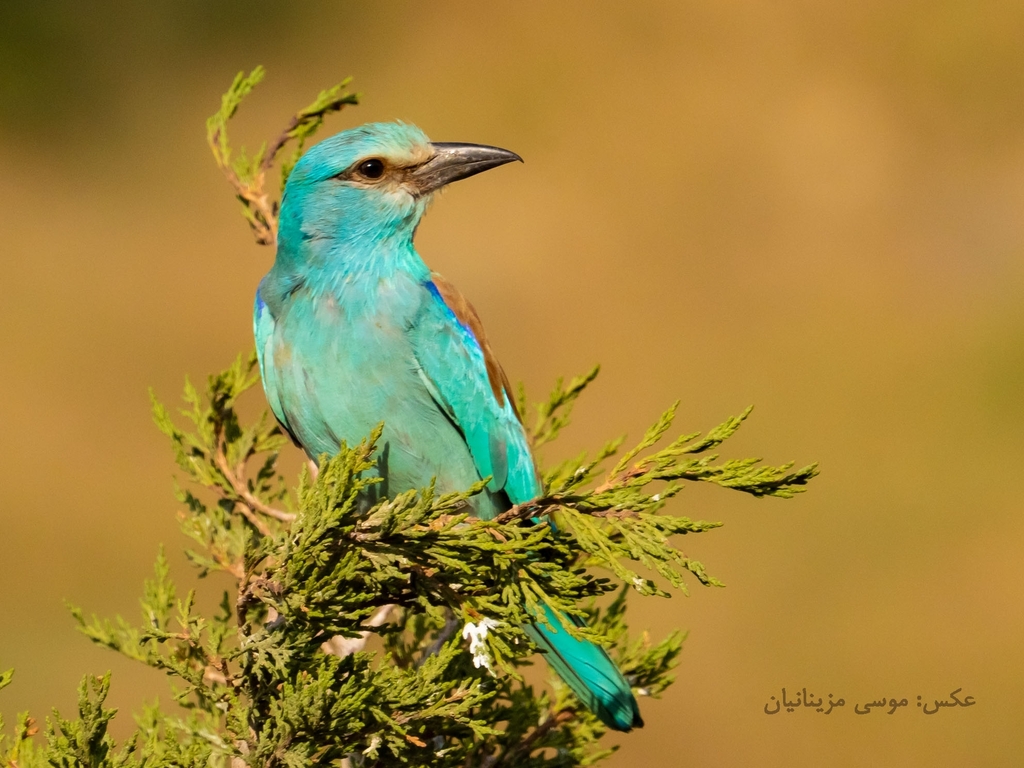
The European roller is a striking stocky bird, roughly the size of a Eurasian jay, measuring 29–32 cm in length with a wingspan of 52–58 cm. Its most distinctive feature is its predominantly blue plumage contrasting with an orange-brown back. In flight, the brilliant blue is dramatically set off by blue-black flight feather tips, creating a spectacular aerial display that inspired the bird's common name. Sexes are similar in appearance, though juveniles are noticeably duller versions of adults. The bird has a hooked bill typical of its family and gives a harsh, crow-like call that becomes a raucous series when the bird is alarmed.
Range & Habitat
The European roller is the only member of the roller family breeding in Europe. The nominate subspecies breeds across northern Africa from Morocco to Tunisia and throughout southern and east-central Europe, extending eastward through northwestern Iran to southwestern Siberia. A second subspecies occurs from Iraq and southern Iran east through Kashmir and southern Kazakhstan to Xinjiang. The species has experienced a long-term decline in its northern and western range, with extinction as a breeding bird in Sweden and Germany.
This is a bird of warm, dry, open country with scattered trees, preferring lowlands but occurring up to 1,000 m in Europe and 2,000 m in Morocco. Oak and pine woodlands with open areas provide prime breeding habitat, along with farms, orchards and mixed vegetation areas. The bird winters primarily in southern Africa in dry wooded savanna and bushy plains, south of the Sahara. It avoids treeless plains and typically nests in tree holes.
Behaviour & Diet
European rollers are sit-and-wait hunters that characteristically perch prominently on trees, posts, or overhead wires while scanning for prey, much like giant shrikes. They feed on large insects, small reptiles, rodents, and frogs, with adult diets dominated by beetles. Nestlings, however, consume mostly Orthoptera such as grasshoppers and bush crickets. A remarkable defensive behaviour of roller chicks involves vomiting a foul-smelling orange liquid onto themselves to deter predators; this odour also serves as a warning signal to parents returning to the nest.
Best Time & Places to See It
The European roller is a long-distance migrant, with different populations following distinct migration routes. Southwestern European populations winter in Angola, Namibia and Botswana, while eastern European birds winter further east in Zambia, Zimbabwe and Botswana. Some populations migrate through western India. The Sahel savannah region immediately south of the Sahara, particularly around Lake Chad, serves as an important autumn refuelling site for many populations. Spring migration routes northward via the Arabian Peninsula make this an excellent season for observing migrating birds in that region.
Photography Tips
The European roller's striking aerial displays offer exceptional photographic opportunities—the twists and turns in flight showcase the brilliant blue plumage against darker flight feathers. The bird's habit of perching prominently on exposed posts, wires, and tree branches makes it relatively accessible for photography in open woodland habitats. Early morning and late afternoon light will enhance the vibrant blue coloration. Photographers visiting African wintering grounds in dry wooded savanna will find plenty of open perches from which to photograph these conspicuous birds.