Identification
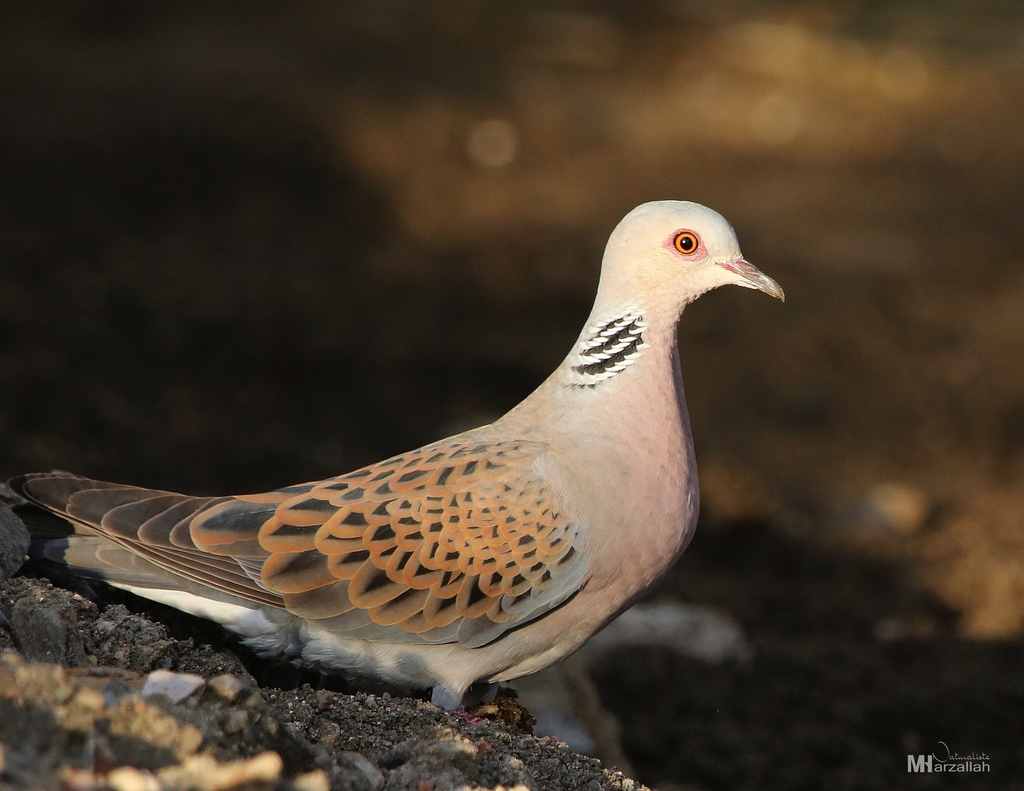
The European turtle dove is a small, slender dove measuring 26–28 cm in length with a wingspan of 47–53 cm and weighing 100–156 g. The mature bird is unmistakable, featuring a blue-grey head, neck, flanks, and rump contrasting with distinctive cinnamon-coloured wings mottled with black. The breast is vinaceous (wine-coloured) while the abdomen and undertail coverts are white. Most characteristically, it bears a striking black-and-white-striped patch on the side of its neck—a field mark that instantly separates it from other doves. The bill is black, and the legs and eye rings are red. In flight, the wedge-shaped tail with a dark centre and white borders and tips is particularly noticeable. Juvenile birds are browner and duller overall, lack the distinctive neck patch, and have brown legs rather than red.
Range & Habitat
The European turtle dove is a long-distance migratory species with a western Palearctic range covering most of Europe and the Middle East, including Turkey and North Africa, though it is rare in northern Scandinavia and Russia. It winters south of the Sahara, making it one of the latest migrants to arrive in Northern Europe, rarely appearing before the end of April and departing again in September. Four subspecies are recognised across its range, from western Europe to western China.
This species prefers open woodlands to dense forests and characteristically feeds on the ground. Although it occasionally nests in large gardens, it is usually extremely timid, likely due to heavy hunting pressure during migration. Its flight is often described as arrow-like, and in spring its arrival is heralded by its distinctive cooing or purring song—a rather deep, vibrating "turrr, turrr" that gives the species its name.
Behaviour & Diet
The European turtle dove feeds primarily on weed seeds and shoots, with fumitory being a particularly favoured food source. It is generally a timid species, though it performs a spectacular nuptial flight in spring—high and circling like the common wood pigeon, though with less pronounced undulations, accompanied by the distinctive whip-crack of its downward flicked wings. Despite its arrow-like flight description, it is not particularly fast.
Best Time & Places to See It
Spring migration, from late April onwards, offers the best opportunity to encounter this species, when males announce their presence with their characteristic purring song. The species can be found throughout its breeding range across Europe, the Middle East, and North Africa during the breeding season, though it is rare in northern Scandinavia and Russia. The bird's preference for open woodlands and ground feeding makes it most visible in such habitats during daylight hours.
Photography Tips
The European turtle dove's striking plumage and distinctive neck patch make it rewarding to photograph. The contrasting blue-grey head and cinnamon wings provide excellent colour composition. When the bird is in flight away from the observer, the characteristic wedge-shaped tail with white borders and tips is particularly photogenic. Ground-feeding behaviour offers opportunities for natural behaviour shots, while the bird's timid nature means patience and careful approach are essential. The red eye-rings and legs add detail worth capturing in close-up portraits.