Identification
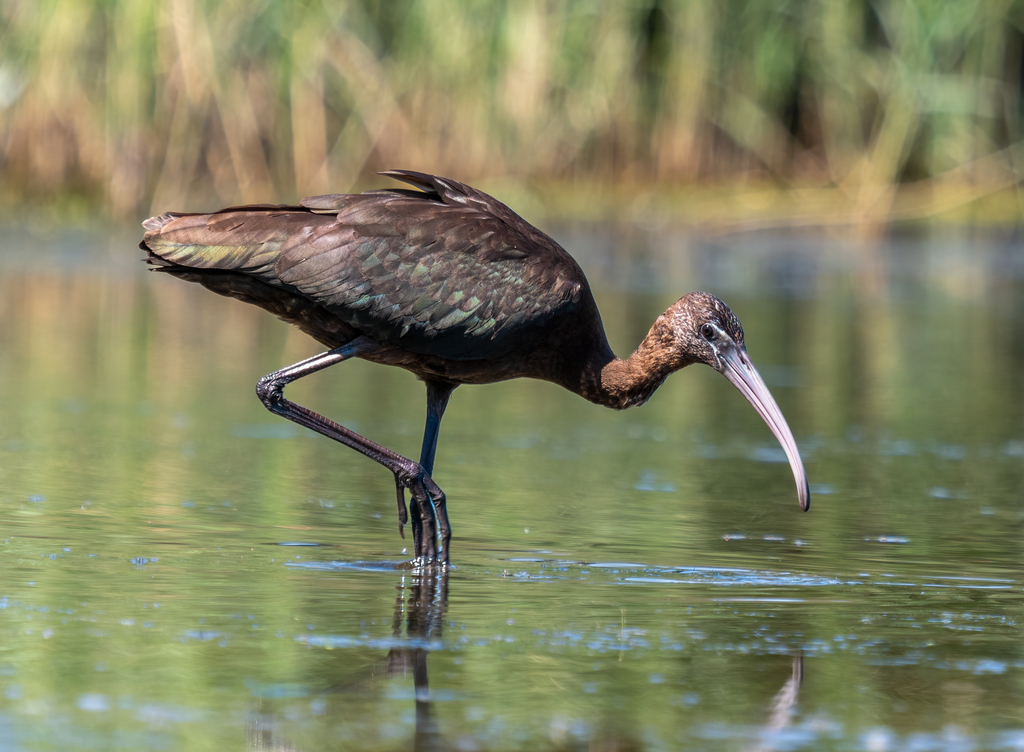
The glossy ibis is a mid-sized wading bird measuring 48–66 cm in length with a wingspan of 80–105 cm. Its most distinctive feature is its long, sickle-shaped bill, which gives the species its scientific name referring to this curved form. Breeding adults are unmistakable: they display rich reddish-brown bodies with strongly iridescent wing feathers that shift from bottle-green to bronze or purple depending on the angle of light. A narrow white facial band runs above and below the bill, though this is much less prominent than in the closely related white-faced ibis. Non-breeding birds and juveniles are considerably duller, with dark brown heads and necks finely streaked with white. The facial skin ranges from blue-grey in non-breeding birds to cobalt blue during breeding season, and the legs are red-brown. In flight, glossy ibises are graceful and unmistakable, unlike herons, as they fly with their necks outstretched, often in V formation.
Range & Habitat
The glossy ibis is the most widespread ibis species, breeding in scattered sites across warm regions of Europe, Asia, Africa, Australia, and the Americas. It likely originated in the Old World and naturally spread from Africa to northern South America during the 19th century, subsequently reaching North America by 1817. The species experienced significant range expansion northwards in the 1940s and westwards in the 1980s. After suffering major declines due to hunting and habitat loss in the 19th and early 20th centuries, populations have recovered dramatically with legal protection, particularly in Spain and France. Britain and Ireland now see increasing numbers of visitors, with the first successful breeding in Britain occurring in Cambridgeshire in 2022. In India, glossy ibises have become breeding species in agricultural wetlands and forested areas. Glossy ibises prefer very shallow water for feeding and nest in freshwater or brackish wetlands with tall, dense emergent vegetation such as reeds, papyrus, or rushes, often in mixed-species colonies.
Behaviour & Diet
Glossy ibises are highly nomadic and undertake substantial dispersal movements after breeding. Northern populations are fully migratory, travelling on a broad front; those ringed in the Black Sea region prefer the Sahel and West Africa for wintering, while birds from the Caspian Sea move to East Africa, the Arabian peninsula, and as far east as Pakistan and India. Tropical populations time their breeding to coincide with the rainy season, whereas temperate populations breed during local spring. These ibises are often found in mixed-species colonies during nesting and may form flocks exceeding 100 individuals during migration. When not breeding, they forage in small flocks and roost communally at night in large groups, sometimes in trees distant from feeding areas. The glossy ibis is a rather quiet bird, producing a variety of croaks and grunts, including a distinctive hoarse call during breeding season.
Best Time & Places to See It
The best time and location for seeing glossy ibises depends on your region. In Europe, increasing numbers of non-breeding visitors are appearing in northwestern areas historically rare for the species, with growing winter populations in Britain and Ireland. Spain and France now host thousands of breeding pairs in several colonies, particularly during spring and summer breeding seasons. In India, winter and summer months show the highest concentrations, with birds declining during monsoon season. In Australia, glossy ibises have been present as a breeding species since the 1930s. Recent arrivals in New Zealand, usually occurring in July, offer another viewing opportunity. Agricultural wetlands and flooded farmlands are particularly productive habitats for observation.
Photography Tips
Photographing glossy ibises is rewarding for those patient enough to track their movements. The iridescent plumage of breeding birds is best captured in good light conditions where the bronze, green, and purple sheens on the wings are visible—shoot from angles that allow light to play across the feathers. In flight, the outstretched neck and V-formation flocking behaviour present excellent opportunities for dynamic shots. Early morning and late afternoon light enhance the subtle coloration of non-breeding birds and juveniles. Communal roosting sites at dusk can yield striking silhouette images. Shallow wetland feeding areas are ideal for close-up work, as birds often remain concentrated in small flocks. A telephoto lens is essential for capturing detail without disturbing these rather quiet birds.