Identification
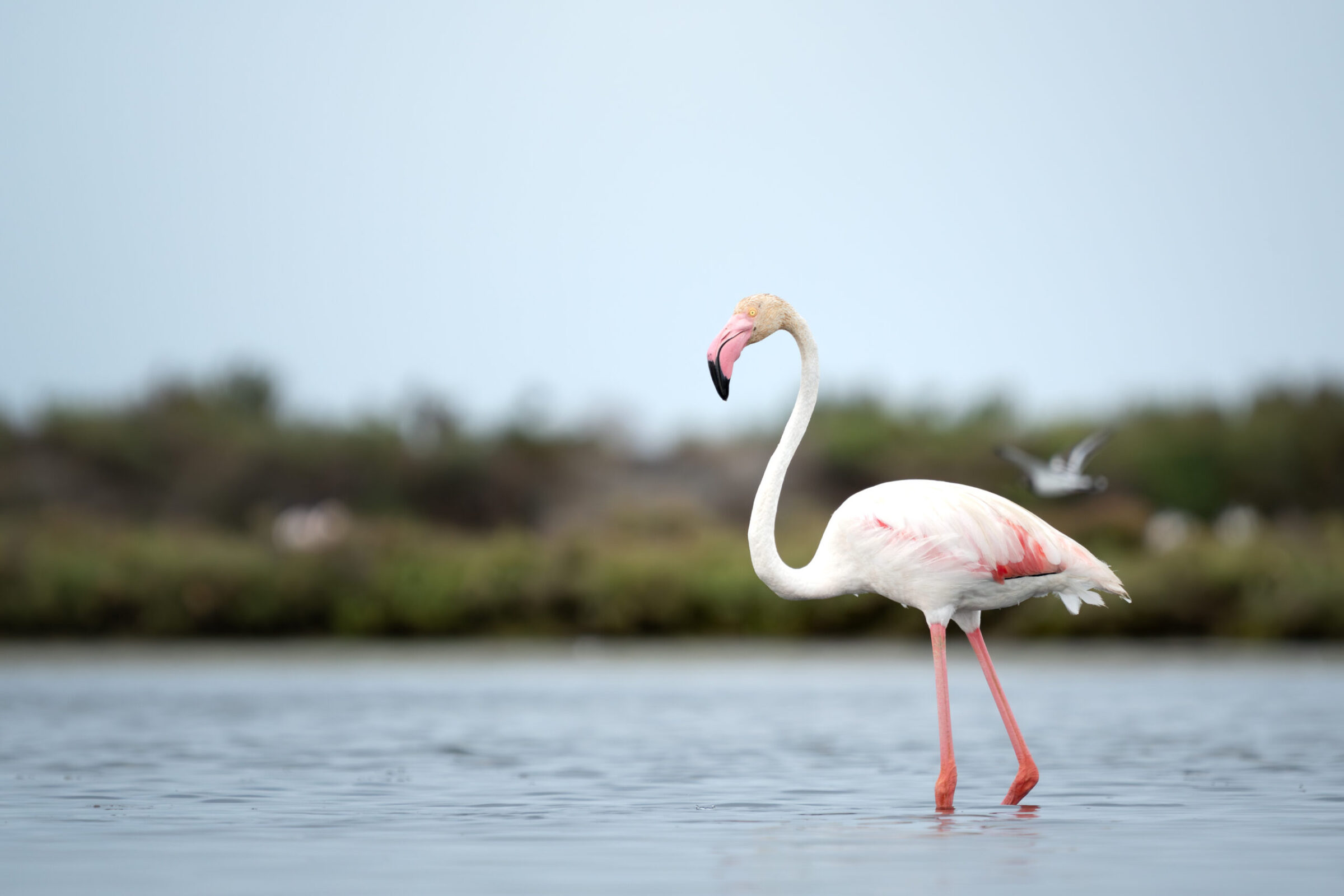
The greater flamingo is the largest living species of flamingo, standing 110–150 cm tall and weighing 2–4 kg. Its most distinctive feature is its striking plumage: predominantly pinkish-white with bright red wing coverts and black primary and secondary flight feathers. The bill is characteristically pink with a restricted black tip, while the legs are entirely pink. The bird's vivid coloration derives from carotenoid pigments in the organisms of its feeding grounds; during breeding season, flamingos intensify this colouration by frequently spreading uropygial secretions over their feathers—a behaviour sometimes described as applying "make-up." Chicks are covered in grey fluffy down, while subadults appear paler with darker legs. The greater flamingo's call is a distinctive goose-like honking.
Range & Habitat
The greater flamingo is the most widespread flamingo species, found throughout the Old World from Northern and Sub-Saharan Africa, across Southern Asia and Western Asia, to Southern Europe. Its range spans from coastal North Africa (Algeria, Egypt, Libya, Morocco, Tunisia) through East African countries (Kenya, Tanzania, Uganda) and the Indian subcontinent (India, Pakistan, Sri Lanka, Bangladesh) to the Middle East (Iran, Iraq, UAE, Qatar, Oman) and Mediterranean Europe (Spain, France, Italy, Greece, Turkey, and others). The northernmost breeding populations occur at Lake Tengiz in central Kazakhstan at around 50°N latitude, where several thousand pairs breed annually.
Greater flamingos inhabit mudflats and shallow coastal lagoons with salt water, where they can access the specialized feeding grounds they require. They have also established a small feral population at Zwillbrocker Venn in western Germany, presumed to originate from escaped zoo birds.
Behaviour & Diet
Greater flamingos are highly social birds known for spectacular courtship displays performed in large mixed-sex groups. They do not form long-term pair bonds; instead, they show a preference for older, more experienced partners, resulting in pairs of similar age. The complexity of an individual's courtship display reflects its age and fitness, increasing in intricacy until around 20 years of age. Both sexes participate in parental care, though males appear more involved in incubation and nest protection, while females may spend more time feeding and recovering from egg-laying.
These filter-feeders have a unique feeding mechanism: they stir up mud with their feet, then suck water through their bill, filtering out small shrimp, brine shrimp, crustaceans, blue-green algae, diatoms, insect larvae, seeds, and molluscs. Their upper jaw is movable rather than rigidly fixed, enabling this specialized feeding technique performed with the head held downward.
Best Time & Places to See It
Greater flamingos can be observed year-round at numerous locations across their range. In India, notable sites include the Nal Sarovar Bird Sanctuary, Khijadiya Bird Sanctuary, Flamingo City, and Thol Bird Sanctuary in Gujarat, where flamingos remain throughout the entire winter season. Mediterranean breeding sites in the Camargue (France), Spanish wetlands, and Turkish lagoons offer excellent viewing opportunities, particularly during breeding season. The UAE's Abu Dhabi Emirate supports breeding populations at three different locations. Lake Tengiz in Kazakhstan hosts breeding populations of several thousand pairs.
Photography Tips
The greater flamingo's vivid pink and red plumage creates striking photographic opportunities, particularly during breeding season when birds enhance their colouration through uropygial gland secretions. Photograph birds in shallow water during feeding, when their distinctive head-down feeding posture and filter-feeding behaviour are visible. Courtship displays in large groups provide dynamic compositional possibilities. Early morning and late afternoon light will illuminate their pink plumage most effectively. Breeding colonies with mud mounds and nesting birds offer additional subjects. Patient positioning near shallow lagoons and mudflats allows for intimate portraits capturing the birds' elegant stance and characteristic pink legs.