Identification
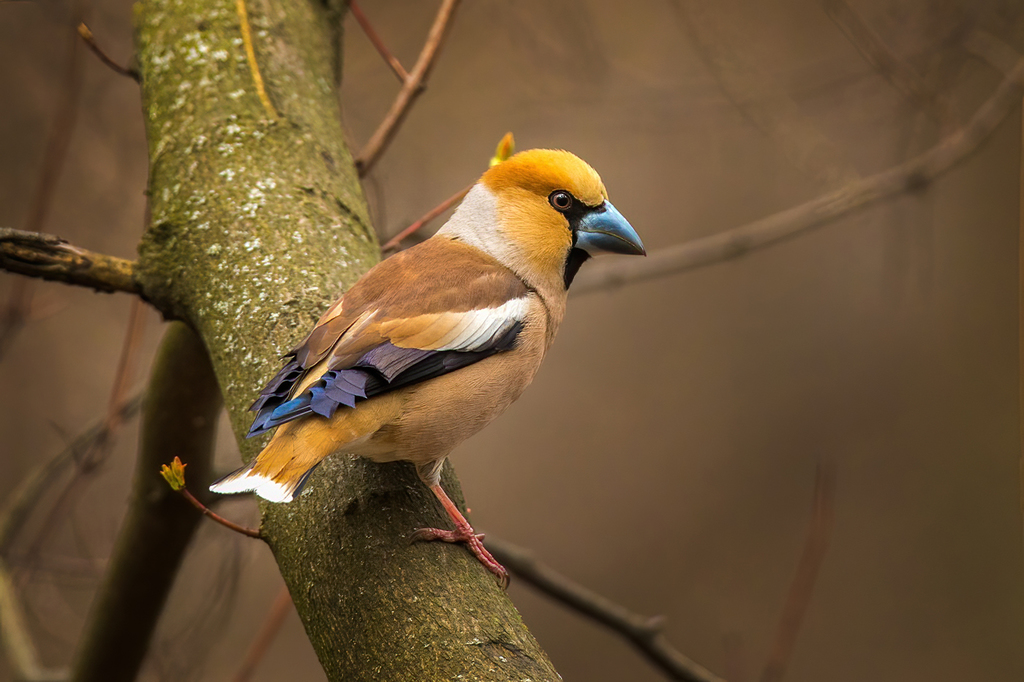
The hawfinch is a distinctive 16.5–18 cm long finch with a stocky, bull-headed appearance and notably short tail. Its most striking feature is a massive, powerful conical bill that appears black in summer but pales in winter—perfectly adapted for cracking hard seeds and kernels. The head is orange-brown with a bold black eyestripe and bib, while the upperparts are dark brown and underparts orange. In flight, brilliant white wing bars and a white tail tip flash prominently against the darker plumage, making identification straightforward. The sexes are similar in appearance, though females are slightly paler overall.
Range & habitat
The hawfinch breeds across Europe and temperate Asia within the Palearctic region, extending from the British Isles and Scandinavia to Japan, with the range having expanded northward since the 1950s. It is mainly resident in Europe, though many Asian populations migrate southward in winter. The species is a rare vagrant to western Alaska. Deciduous or mixed woodlands with large mature trees—particularly hornbeam—are preferred for breeding. During autumn and winter, hawfinches favour fruit-bearing forests, especially those with cherry and plum trees, and they readily visit parks and gardens where suitable food is available.
Behaviour & diet
Hawfinches are typically seen in pairs or small groups rather than large flocks. Their diet consists primarily of seeds and fruit kernels, with cherries being a particular favourite; their massive bill is perfectly designed to crack even the hardest pits. They build their nests in bushes or trees, laying 2–7 eggs per season. Despite their size and striking appearance, hawfinches are relatively unobtrusive birds, with quiet, mumbled songs punctuated by hard chick calls.
Best time & places to see it
Winter months offer the best opportunities to encounter hawfinches, particularly in areas with abundant fruit-bearing trees. In the British Isles, southeastern England is the stronghold for the species. Continental Europe, particularly deciduous and mixed woodlands, provides reliable sightings. Gardens and parks with cherry or hornbeam trees can attract them, especially during autumn and winter when natural food sources are depleted.
Photography tips
The hawfinch's bold black-and-orange head markings and prominent white wing bars and tail tip photograph well in good light. Their short tail and compact silhouette become particularly apparent in flight shots. Winter visits to gardens with fruiting trees offer excellent opportunities for close photography. Early morning light will highlight the metallic sheen of the bill and the orange tones of the plumage, while catching the bird in flight reveals the striking white wing pattern.